
VSM: Decoding the Dual Dynamics of Video Virality in Social Networks
Modeling video viewing and sharing behaviors in online social networks
This paper introduces the Video Viewing and Sharing Model (VSM), a novel aggregated diffusion framework designed to characterize the dual dynamics of video views and shares in Online Social Networks (OSNs). By analyzing a unique dataset from Renren, the authors develop a non-linear epidemic-inspired model that successfully accounts for external media influence and human behavioral periodicity.
TL;DR
Predicting how a video spreads requires more than just tracking "shares"; it requires understanding the symbiotic relationship between private "views" and public "shares." This paper proposes VSM (Video Sharing Model), a framework that integrates social epidemic logic with real-world complexities like daily human routines (periodicity) and sudden media spikes (external influence).
The Missing Link: Why Views and Shares Differ
In traditional Video Sharing Sites (VSS) like YouTube, growth is driven by search and recommendations. In Online Social Networks (OSNs) like Facebook or Renren, it's driven by social cascades. However, most researchers face a data wall: sharing data is public, but viewing data is often private.
The authors discovered three critical insights from the Renren dataset:
- Diffusion Speed: Videos reach 90% of their total shares within 10 days—much faster than photos.
- Saturation Lag: Views keep growing even after shares stop, often driven by "related video" sidebars.
- External Shocks: Viral peaks are frequently triggered by external front-page recommendations rather than purely organic word-of-mouth.
Methodology: The VSM Framework
The VSM model moves beyond linear regression by adopting an Epidemic Compartment Model perspective ().
1. The Core Mechanics
The model assumes that only sharers are infectious. When an unaware user () contacts a sharer (), they may become a viewer () based on the video's attractiveness (). Subsequently, a viewer may become a sharer ().
2. Handling Periodicity and Shocks
Unlike static models, VSM incorporates:
- Decaying Infectivity: Social influence isn't permanent; it follows an exponential decay .
- Daily Cycles: A periodic function adjusts infectivity to match the "rise and fall" of active users during the 24-hour cycle.
- External Impulse: and allow the model to account for sudden spikes at specific timestamps ().
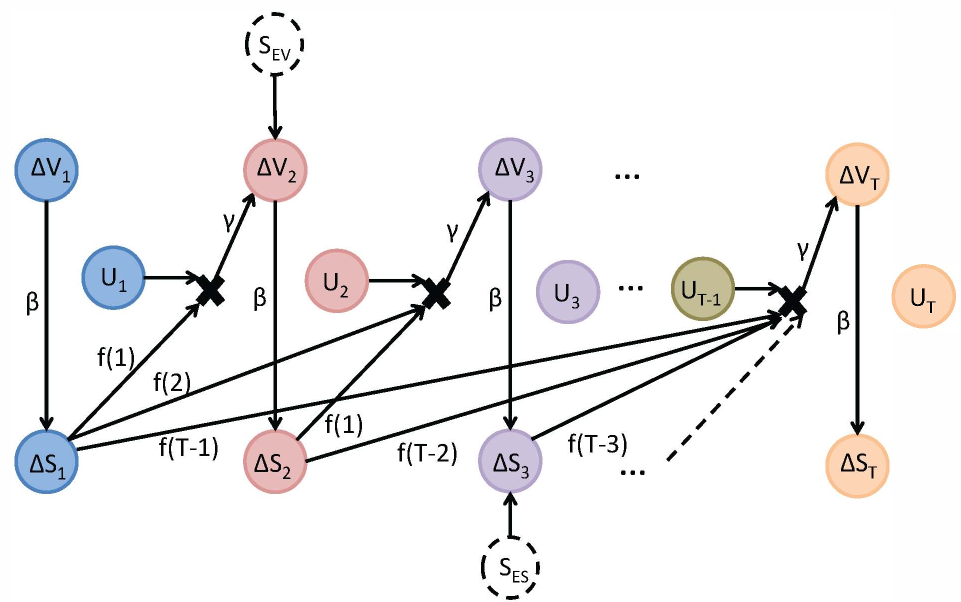 Fig 1: The VSM framework illustrating the flow between Unaware, Viewers, and Sharers with external influences.
Experiments and Superiority
The authors compared VSM against the S2I3R (a multi-stat epidemic model) and VAR (Vector Autoregressive) models.
Explanatory Power
VSM proved far more capable of capturing the "spiky" nature of real-world data. While S2I3R smoothed out peak behaviors, VSM tracked the initial external shock and subsequent daily fluctuations with high precision.
- Average RMSE Reduction: ~58% compared to S2I3R.
Prediction Accuracy
When predicting the "tail" of a video's lifespan (the 5 days following the initial peak), VSM’s ability to model non-linear decay and periodicity gave it a massive edge over VAR.
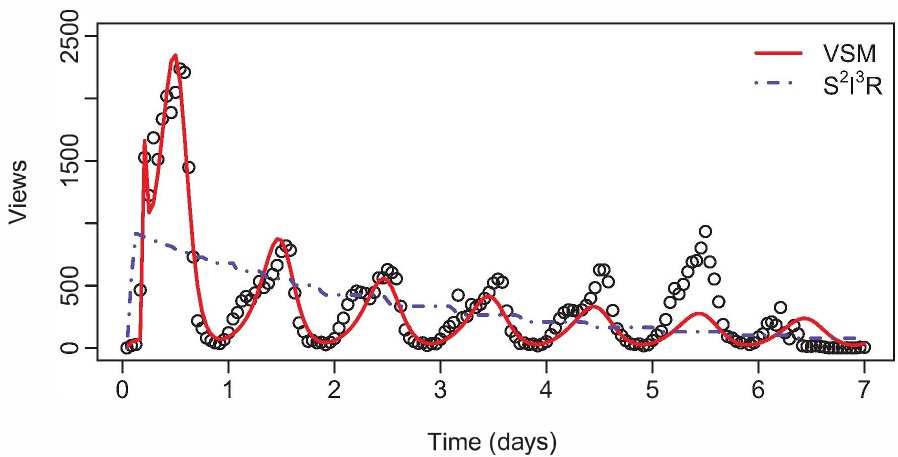 Fig 2: VSM (solid line) accurately fitting the complex, periodic fluctuation of video views compared to baseline models.
Critical Insight & Future Work
The real value of VSM lies in its interpretability. By looking at the parameters (), platform operators can distinguish between a video that is inherently "viral" (high ) and one that is simply "pushed" by the system (high ).
Limitations: Currently, the model is optimized for videos with a single external shock. As social media becomes more fragmented, extending VSM to handle multiple, overlapping waves of external influence will be the next frontier in information diffusion research.
Conclusion
VSM provides a robust mathematical bridge between the act of watching and the act of sharing. For developers building recommendation engines or CDN caching strategies, understanding this interaction—modulated by the time of day and external promotions—is essential for optimizing network traffic and maximizing user engagement.