
Modeling Wikipedia Admin Elections: Beyond the "Closed Clique" Myth
Modeling Wikipedia admin elections using multidimensional behavioral social networks
This study presents a framework for modeling Wikipedia Request for Adminship (RfA) elections using Multidimensional Behavioral Social Networks (MBSN) mined from edit histories. By analyzing the Polish-language Wikipedia, the authors developed a data-mining model that classifies RfA votes with approximately 84% accuracy and provides a quantitative mechanism for recommending potential admin candidates.
TL;DR
As Wikipedia's administrative workload explodes, the influx of new "sysops" (admins) is paradoxically slowing down. This paper investigates the Polish Wikipedia's election process (RfA) using a Multidimensional Behavioral Social Network (MBSN). Key finding: The community isn't a closed clique; instead, voters are demanding higher "topic diversity" and "experience similarity" than ever before.
Context & Motivation
Administrators are the backbone of Wikipedia, handling everything from vandalism to complex edit wars. However, the Polish Wikipedia community noticed a disturbing trend: Request for Adminship (RfA) success rates plummeted from 70% in 2008 to 42% in 2010.
Two competing hypotheses emerged to explain this:
- Hypothesis A (The Clique): New admins are elected based on who they know (acquaintance).
- Hypothesis B (The Experience): Voters look for candidates who share their specific editing interests and demonstrate vast experience.
Methodology: The MBSN Framework
The researchers moved beyond simple edit counts, mining 220GB of Polish Wikipedia history to build a multidimensional map of human interaction.
The Four Dimensions of Behavior:
- Co-edits: Content added near another editor's text (a proxy for trust).
- Reverts: One editor undoing another's work (a proxy for conflict).
- Discussion: Interactions on talk pages (quantified via proximity of text).
- Topics: A bipartite graph linking editors to Wikipedia categories.
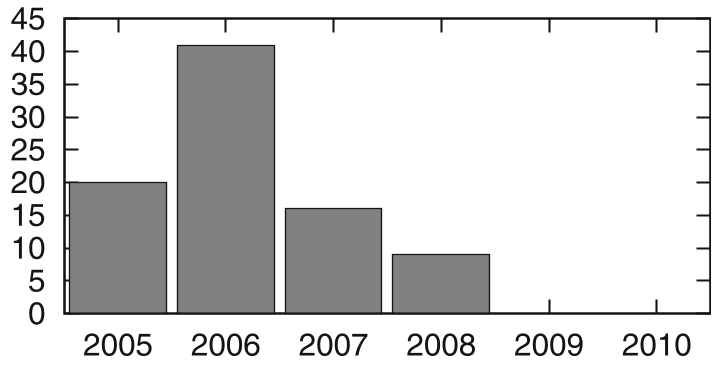 The study mapped behavioral links (edit history) directly onto voting links (RfA records).
The "Rising Bar" for Adminship
The data revealed a staggering increase in the "cost of entry." In early 2006, an admin could be elected with roughly 2,000 edits. By 2010, the community consensus shifted, requiring an average of 14,000 edits.
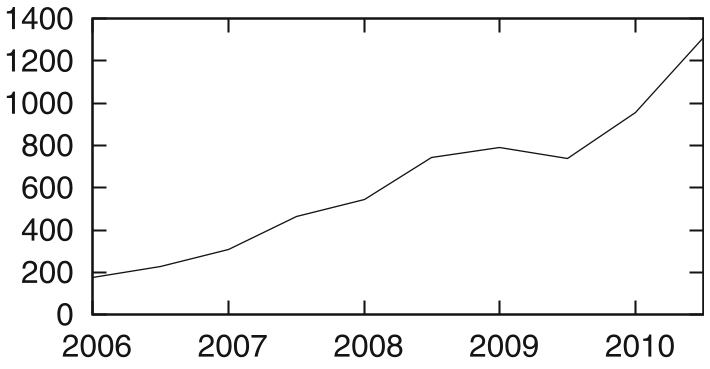 Figure 4: The exponential growth in the experience required to win an election.
Key Insights: Why do People Vote "For"?
Using SAS Enterprise Miner to build decision trees, the authors achieved an 84.1% accuracy in predicting how a user would vote.
- The Power of Common Ground: The variable
topics_common(shared editing categories) was a major predictor. If a voter and candidate edit in the same niches, a "Yes" vote is highly likely (Hypothesis B confirmed). - Acquaintance is Secondary: While the "Discussion" dimension was validated as a proxy for "real-world acquaintance" through surveys, its importance in the decision tree was relatively low. This suggests the Wikipedia community is meritocratic: they care more about what you know than who you know (Hypothesis A rejected).
| Variable | Importance |
|---|---|
| Total Edits | 99% |
| Topic Diversity (topics_c) | 100% |
| Common Topics | 73% |
| Strong Discussion | 18% |
Critical Analysis & Conclusion
Takeaway for Platform Governance
This research proves that "digital footprints" (behavioral data) can accurately model complex social processes like elections. For Wikipedia, this allows for the creation of Candidate Recommendation Systems that scan the contributor pool for "hidden gems"—users with high topic diversity and low conflict scores who haven't yet been nominated.
Limitations
A notable finding was that several behavioral proxies didn't align perfectly with human declarations. For instance, Reverts were a poor proxy for subjective conflict (many editors see reverting as a "technical duty" rather than a personal "argument"). This highlights a critical lesson for AI researchers: Behavioral data does not always equal social intent.
Future Outlook
As decentralized platforms (Web3, DAOs) struggle with governance, the MBSN approach offers a blueprint for data-driven, impartial leadership selection that prioritizes domain expertise over social popularity.