
Modeling XSS Worm Propagation: Why Your Follower Count Matters to Network Security
Modeling the propagation of XSS worm on social networks
This paper introduces a specialized logic matrix-based propagation model for XSS worms on social networks. By leveraging a directed graph topology that reflects real-world power-law distributions, the authors simulate how malicious scripts spread through friend and follower (fan) relationships, achieving a precise depiction of infection paths.
TL;DR
Social network security is often a race against time. This paper presents a novel model for Cross-Site Scripting (XSS) worms that moves beyond general statistics to map individual infection paths. By using a logic matrix and a directed topology, the study reveals that the "fan-host" relationship is a far more potent vector for worm spread than local friend circles.
Background: Beyond Simple Epidemics
Most classic models (like SIR) treat network infections like a biological flu—estimating how many people get sick without showing who gave it to whom. In the context of XSS worms—malicious scripts hidden in links that hijack profiles (e.g., the infamous Samy worm)—understanding the topology is everything. This paper addresses the gap by modeling the specific directed relationships (following vs. friending) that define platforms like X or MySpace.
The Core Insight: Directed Dynamics
The authors argue that undirected graphs are insufficient. They build a network where:
- Bidirectional Edges: Two users are "friends" (mutual interaction).
- Unidirectional Edges: One user is a "fan" of a "host" (one-way information flow).
By applying a power-law distribution, they mimic the "celebrity effect" where a few nodes have massive in-degrees (fans).
Methodology: The Logic Matrix
The technical heart of the paper is the use of Logic Matrix Operations. Instead of solving continuous differential equations, the model uses discrete time ticks and binary vectors to track:
- : Online/Offline Infectious nodes.
- : Online/Offline Susceptible nodes.
- : Immune nodes.
The infection process is calculated via a specialized matrix multiplication: This formula identifies exactly which susceptible nodes are adjacent to currently online infectious nodes at each step.
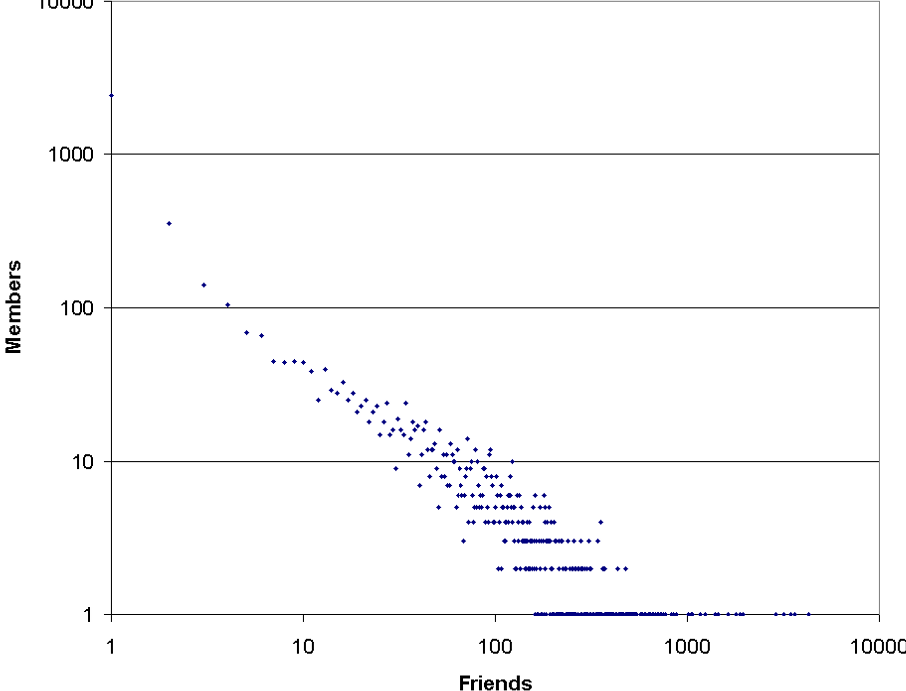 Figure 1: The state transition diagram illustrating how nodes move between online/offline status and eventually to an immune state via patching.
Experimental Analysis: What Drives the Outbreak?
1. The Impact of Online Activity
Unsurprisingly, the speed of the worm is tied to how many people are "awake" (online) at once. High concurrency leads to a steeper infection curve, as malicious links are clicked more frequently in a shorter window.
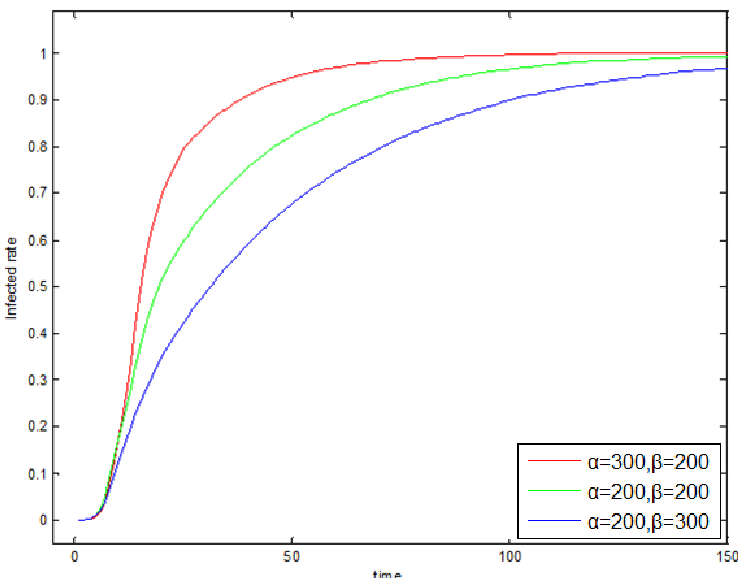 Figure 2: Comparison of different online user ratios (α and β) showing that higher activity leads to faster saturation.
2. Fans vs. Friends
One of the paper's most critical findings is that unidirectional "fan" relationships produce a greater influence on propagation. Even if the probability of clicking a link from a close friend is higher, the sheer volume of fan-to-host connections in a scale-free network creates a more efficient "highway" for the worm.
3. The Power of the Patch
The model incorporates a Patch Strategy where the cumulative number of immune nodes grows over time. The results prove that the timing of the patch (η) is more important than the speed of the patch (γ). If security teams delay the initial release, the worm captures the majority of the network regardless of how fast people install the patch later.
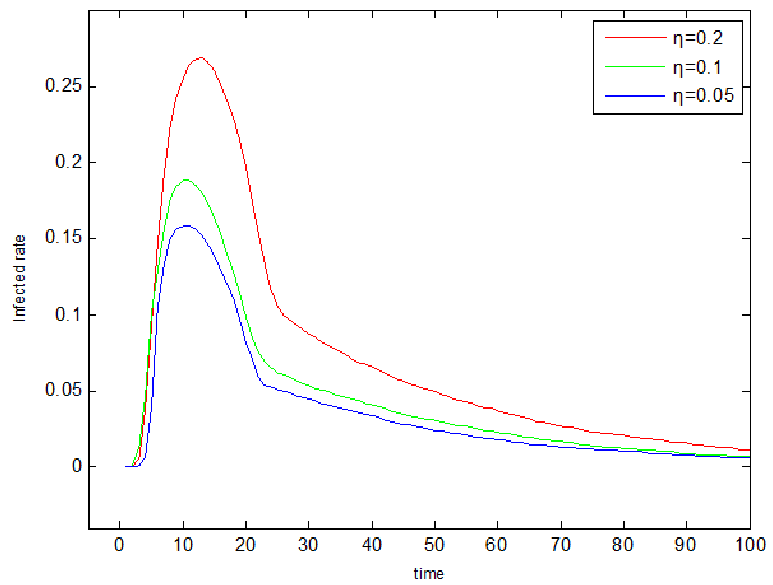 Figure 3: Simulation results showing that early intervention (smaller η) is the only way to effectively cap the total number of infections.
Critical Insight & Conclusion
This work highlights a fundamental vulnerability in social media architecture: centralization. Because social networks rely on "hubs" (users with many followers), an XSS worm that hits a hub can compromise thousands of fans instantly.
Key Takeaways:
- Micro-Modeling Matters: Logic matrices allow us to trace the path, not just the count.
- High-In-Degree Protection: Security efforts should be focused on "hosts" or influencers.
- Patch Latency: Reducing the "Time to Release" for a security patch is more effective than trying to increase the "Rate of Adoption."
While the model is currently tested on smaller artificial networks, its logic scale-free approach provides a robust framework for future studies on massive datasets like modern X (Twitter) or Facebook.