
Social Thermodynamics: Can We Model Human Networks Like a Gaseous System?
Modelling communication dynamics in social network
The paper proposes "Social Thermodynamics," a framework that maps thermodynamic variables—entropy, temperature, energy, and pressure—onto social networks to model communication dynamics. By treating users as molecules and connections as volume, the authors simulate Isochoric and Adiabatic processes on a large-scale enterprise network of 250,000 users.
TL;DR
Is a viral tweet like a burst of high-pressure gas? Researchers from Tata Consultancy Services suggest the answer is "Yes." By mapping the laws of thermodynamics—specifically the Otto Cycle—onto a social network of 250,000 users, they've developed a way to measure the "Temperature" and "Pressure" of human communication, offering a new macro-perspective on how information spreads.
Problem & Motivation: The Gap Between Micro and Macro
Most social network analysis is obsessed with the individual. We track "influencers" (microstates) and try to predict the whole system from the parts. However, in physics, we don't track every molecule to understand a steam engine; we look at Pressure, Volume, and Temperature.
The authors argue that social science lacks this macroscopic rigor. They point out that while "Social Thermodynamics" was discussed as early as the 70s, we lacked the data to prove it. Existing models fail to explain why some groups feel "tense" or "highly active" (high pressure) while others remain stagnant, regardless of the individual influencers present.
Methodology: Mapping Social "Steam"
The paper introduces a synthetic mapping of physical variables to social constructs:
- Molecules (N): Individual users.
- Volume (V): The connection "pipes" between users.
- Internal Energy (U): A weighted sum of interactions (likes, comments, shares).
- Entropy (S): The degree of randomness or the number of ways a network can be configured.
The Social "Otto Cycle"
The authors adapt the Otto Cycle (the cycle used in car engines) to social dynamics:
- Isochoric Heating: In a mature group where connections (Volume) are stable, an increase in interactions (Energy) leads to a rise in Temperature and Pressure.
- Adiabatic Expansion: When an influencer joins a network, connections explode so fast that "heat" doesn't have time to transfer, leading to a sudden drop in systemic pressure as the network stabilizes.

The core mathematical insight is the derivation of Social Temperature (): This means temperature represents how much the system's energy changes as its randomness (entropy) increases.
Experiments & Results: Real-World Testing on 250K Users
The study utilized an internal enterprise platform with 860 million connections—a massive testbed.
Key Findings:
- Linear Correlation: For "Isochoric" groups (stable connections), the researchers found a near-linear relationship between Energy, Temperature, and Pressure.
- Weekend Dips: The model accurately detected a "Scenario 2" where pressure dropped significantly—matching real-world weekend behavior when participation crashed.
- Influencer Impact: The arrival of a "High Mass" user caused an "imploding force," rapidly expanding connections and then stabilizing the system's pressure, a phenomenon perfectly described by adiabatic expansion.
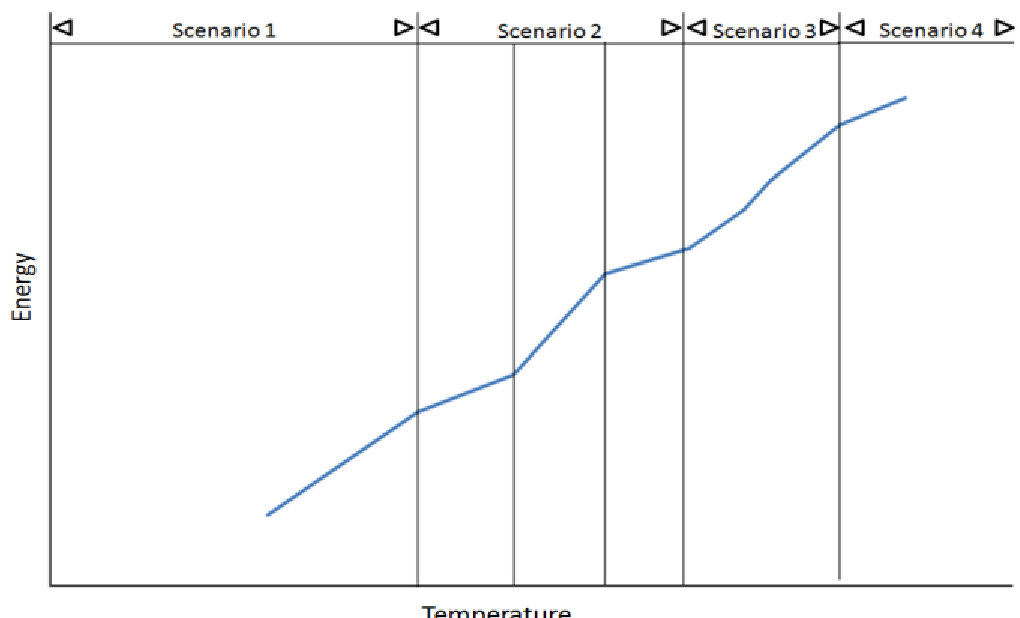 Figure: The sudden drop in Pressure as Volume (connections) expands, mimicking a cooling gas.
Critical Analysis & Conclusion
This paper is a fascinating bridge between the "hard" sciences and "soft" social dynamics. By moving away from individual tracking and toward Statistical Mechanics, it provides a tool for Business Intelligence to identify the "ideal time" to inject information into a network (when "Pressure" is optimal).
Limitations: The authors admit to several "Ideal Gas" assumptions—treating all connections as having equal volume and ignoring "mass" (the varying weight of different users' interactions). In the real world, "friction" (resistance to information flow) exists, and not all connections are created equal.
Future Outlook: The next step for Social Thermodynamics lies in refining the "Social Coefficient" (). If we can accurately quantify the "mass" of a user and the "friction" of a platform, we might just be able to predict a "social explosion" (viral event) with the same precision as a chemist predicts a gas expansion.
Takeaway
Social networks aren't just lists of people; they are dynamic thermal systems. Understanding the "Temperature" of your community might be more important than counting your followers.