
The Empathic Robot: Bridging the Gap Between Machine and Companion in Schools
Modelling empathic behaviour in a robotic game companion for children: an ethnographic study in real-world seings
This paper introduces an autonomous empathic model for a robotic game companion (iCat) designed to play chess with children. The study evaluates a system capable of real-time affect recognition and adaptive action selection, achieving a significant positive impact on children's perception and emotional engagement in real-world school settings.
TL;DR
Researchers from the University of Lisbon and University of Birmingham deployed an autonomous robotic chess companion, the iCat, in a real-world elementary school. By integrating an SVM-based affect recognition system and a Reinforcement Learning selection mechanism, they demonstrated that a robot that "cares" about a child's frustration or joy significantly enhances the social bond and perceived intelligence compared to a neutral machine.
Background: Beyond the Laboratory
Most Human-Robot Interaction (HRI) studies are conducted in sterile labs with adult participants. However, children interact with technology through a unique lens of "suspension of disbelief." The goal of this research was to move the tech into the "wild"—a Portuguese elementary school—to see if empathy could transform a chess-playing bot from a mere computer-in-a-box into a genuine social companion.
The Core Problem: The Danger of "Inaccurate" Empathy
Social robots often fail because they are "static." If a robot smiles while you are losing, or offers unhelpful encouragement, it breaks the social contract. Previous research suggested that inaccurate empathy can actually decrease trust. The challenge is not just having emotional responses, but selecting the right response for the right child at the right time.
Methodology: The Affective Loop
The authors build a closed-loop system comprised of two main pillars:
- Affect Detection (The "Senses"): Using a webcam and SVM (Support Vector Machines), the robot tracks head rotation, eye gaze, and "probability of smile" over 6-second windows. It also looks at "game state" (who is winning) to contextually understand the child's likely frustration or pride.
- Adaptive Action Selection (The "Brain"): When the robot detects a non-positive state, it chooses an empathic strategy (Encouraging, Scaffolding, Offering Help, or Intentionally Losing). Crucially, it uses a Reinforcement Learning algorithm to learn which strategy works best for a specific child over time.
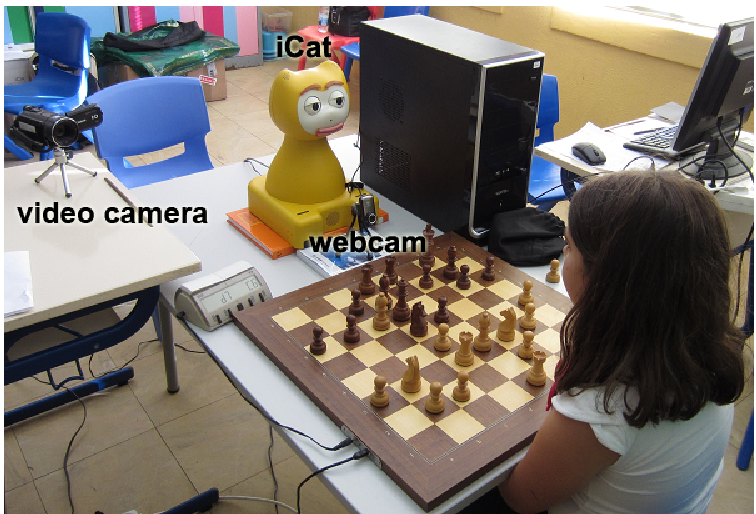 Above: The experimental setup in the school, integrating the iCat, electronic board, and the affective sensing loop.
Experimental Results: Happiness vs. Anxiety
The study compared three groups: Neutral, Random Empathic, and Adaptive Empathic.
- Perceived Intelligence: In the Adaptive group, nearly all children believed the iCat knew how they felt. In the Neutral group, children viewed the robot as a "machine" that was simply "too focused on its own game."
- Emotional Paradox: Interestingly, the "Random" empathic group (where strategies were chosen without learning) reported higher levels of anxiety and nervousness. This proves that poorly implemented social behaviors are worse than none at all.
- Comparison to Humans: Children noted that while their human friends often get distracted or rush them, the iCat was "calm" and "focused," yet stayed more "excited" and "supportive" than a standard computer.
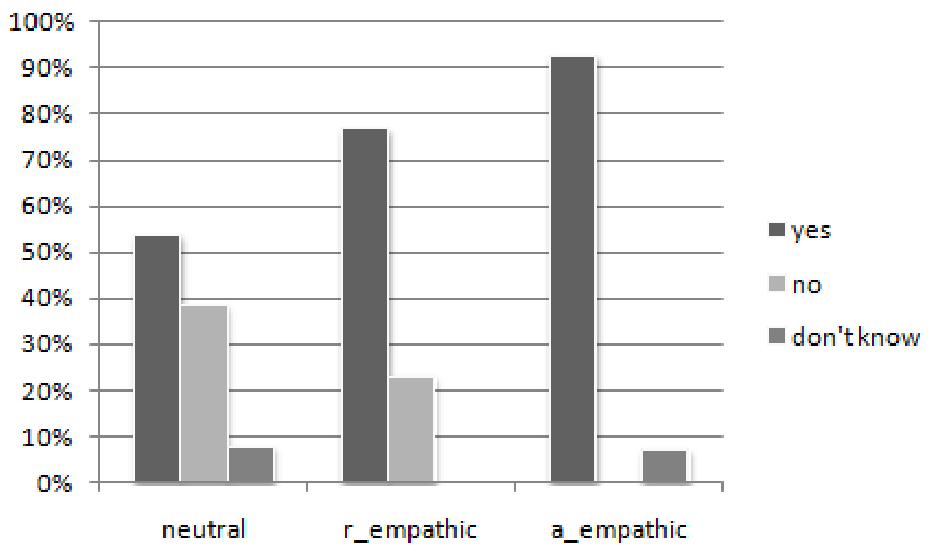 Above: Significant disparity in "Perceived Empathy" between Neutral and Adaptive Empathic conditions.
Critical Insight & Lessons Learned
The study highlights a few key "Academic Blackbelt" takeaways:
- Degree of Empathy: There is a "Goldilocks zone" for robot empathy. Some children found the robot "too nice" and wanted it to show its "real feelings" (frustration) when it lost, suggesting that complete subservience is less believable than a balanced social ego.
- The Novelty Effect: While children loved the iCat, much of the initial engagement is driven by novelty. The real test for these adaptive models is the "long-term" interaction (months, not days).
- Ethnographic Nuance: Children are prone to "pleasing the researcher." The authors suggest that in future studies, asking "how can we improve?" is far more productive than asking "what did you hate?" because children rarely want to criticize their new "robotic friend" to its face.
Conclusion
This work provides a foundational roadmap for creating robots that don't just "play a game," but "share an experience." By moving from static scripts to adaptive learning models, we can move closer to robots that understand the nuanced emotional landscape of a child's world.
Keywords: HRI, Social Robotics, Affective Computing, Reinforcement Learning, Ethnographic Study.