
Modelling Learning & Performance: A Social Networks Perspective
Modelling learning & performance: a social networks perspective
This paper presents an exploratory study that models the relationship between social networks, learning, and performance within an eLearning environment. Using Social Network Analysis (SNA), the authors introduce "Content Richness" (CR) as a novel metric for social learning and demonstrate that while network properties significantly influence learning engagement, the link to final exam performance remains indirect.
TL;DR
Is being "well-connected" enough to learn better? This study shifts the focus from simple networking to the quality of interaction. By introducing a "Content Richness" metric, the researchers prove that meaningful dialogue—supported by efficient network positions and strong social ties—is the true driver of learning in digital environments, even if it doesn't always translate directly to exam scores.
Background: Beyond the "Digital Native" Hype
While we often assume that social media and web-based platforms naturally foster learning, the actual dynamics remain poorly understood. This paper moves past the theoretical frameworks of Situated Learning and Connectivism to provide empirical evidence. It asks a critical question: In the age of Learning Analytics, how do we quantify the "learning" that happens between people?
The Problem: The Performance Gap
Most prior research attempts to draw a straight line from a student's social position to their grades. However, this ignores the black box of the learning process itself. Dense networks often lead to redundant information, and high participation (sending many messages) doesn't necessarily mean high-quality reflection. The authors argue that we need a surrogate measure for social learning that looks at what is actually being said.
Methodology: Quantifying the Dialogue
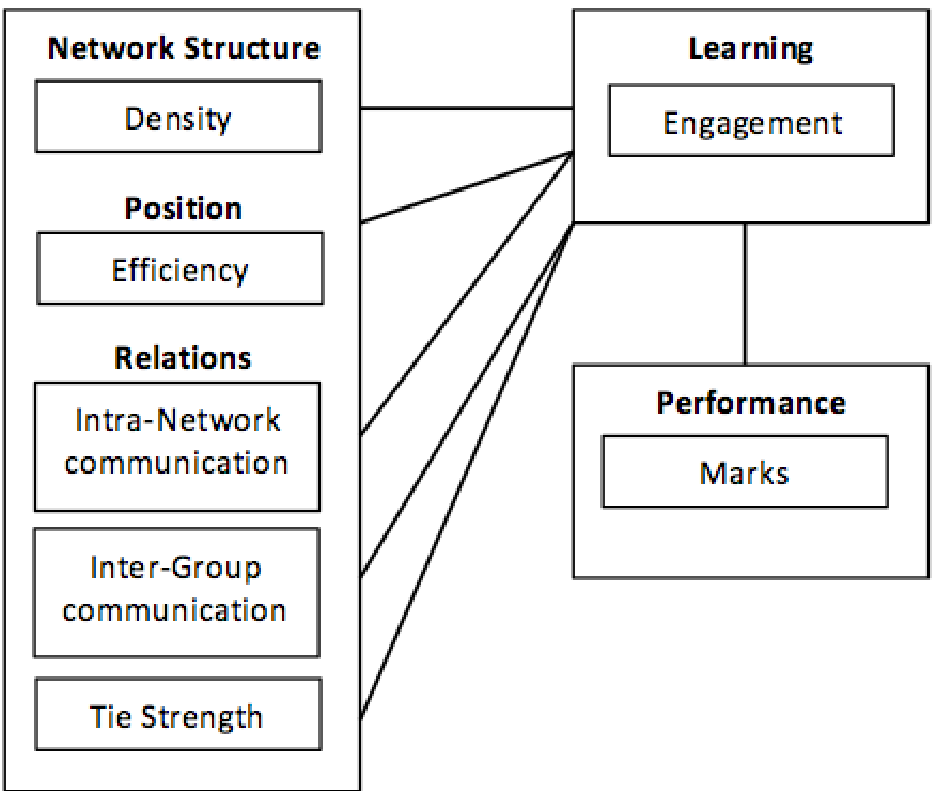
The authors propose a comprehensive model that evaluates learners across three dimensions: Structure (Density), Position (Efficiency), and Engagement (Content Richness).
The "Content Richness" (CR) Innovation
To solve the problem of measuring learning quality, the study categorized human dialogue into a weighted scale:
- Level 0 (Empty): "Thank you."
- Level 1 (Team Building): "Great work, team!"
- Level 4 (Collaboration): Problem-solving, providing new insights, and critical inquiry.
Model Architecture
The following model illustrates the hypothesized relationships between these network variables and final outcomes:
Key Insights & Results
The data from 36 professionals in a Project Management program revealed several counter-intuitive truths:
- Density is a Distraction: A significant negative correlation was found between network density and Content Richness (r = -.406). More connections often lead to shallower, "noisier" conversations.
- The Power of Strong Ties: Contrary to Granovetter’s "Strength of Weak Ties" (which favors weak ties for finding jobs), this study found that strong ties (r = .422) are essential for social learning. Trust and closeness are required to engage in deep, Level 4 collaboration.
- Efficiency over Volume: Learners who optimized their networks (high Efficiency) reached higher Content Richness scores without the "interaction fatigue" of maintaining redundant contacts.
Performance Metrics Comparison
The correlation matrix below highlights where social learning actually pays off:
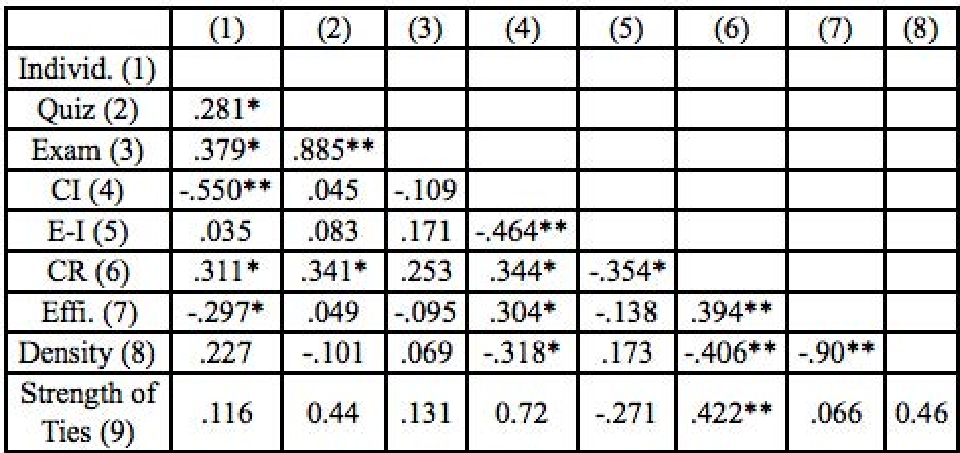 (Note: CR significantly impacts Quiz and Individual assignments, but the Final Exam remains an outlier.)
Critical Analysis & Conclusion
Takeaway
The core contribution is the Content Richness Score. It provides a roadmap for future Learning Management Systems (LMS) to move beyond "post counts" and toward "value-based" analytics. It suggests that educators should encourage internal group cohesion and efficient bridging rather than just broad social expansion.
Limitations & Future Work
The study is limited by its sample size (n=36) and its reliance on manual message classification—a process that is time-consuming and prone to bias.
The next frontier for this research lies in Automated Semantic Analysis. By using modern NLP models (like BERT or GPT-based embeddings), we could calculate Content Richness in real-time, allowing instructors to intervene when a group's dialogue becomes "shallow" or "redundant" before the final assessment is reached.