
The Physics of Persuasion: Modeling the Tug-of-War Between Experts and Majorities
Modelling majority and expert influences on opinion formation in online social networks
The paper proposes a novel continuous opinion formation model that integrates both "Majority Influence" and "Expert Influence" using an entropy-based consistency metric. By quantifying group homogeneity and expertise credibility, the model accurately predicts opinion evolution on Online Social Networks (OSNs), specifically outperforming existing benchmarks in tracking real-world debates like vaccination sentiment on Twitter.
TL;DR
How do we change our minds? Usually, it's a balance between "what everyone else thinks" (Majority Influence) and "what the smartest person says" (Expert Influence). This paper introduces a sophisticated mathematical model that uses Entropy to measure the consistency of these two forces. Tested against real Twitter data regarding vaccination debates, it proves remarkably accurate at predicting how individual opinions drift over time.
Contextual Positioning
In the landscape of social dynamics, most models are either too simple (treating opinions as binary 0s and 1s) or too narrow (ignoring the "group effect" of experts). This work sits comfortably in the Continuous Opinion Dynamics space, acting as an upgrade to the classical Hegselmann-Krause (HK) and Moussaid models by adding a layer of information theory to quantify group strength.
Problem & Motivation: The Consistency Gap
Traditional models often use "averaging." If your neighbors have opinions of 0.1 and 0.9, the average is 0.5. But in reality, there is no "consensus" there—there is a conflict.
The authors argue that Consistency Matters. A tight-knit group of 10 people all saying "0.8" is far more influential than 10 people scattered across the spectrum. Existing models failed to distinguish between these scenarios. Furthermore, they overlooked the "Expert Group" effect—where a cluster of experts carries more weight than the sum of their individual parts.
Methodology: The Entropy Insight
The core innovation is calculating the Credibility Score () of a neighborhood using Shannon’s Entropy.
- Opinion Consistency (): Uses entropy to see if opinions are clustered in specific "blocks" or scattered randomly.
- Expertise Credibility (): Not just how much an expert knows, but how much that knowledge aligns within their opinion group.
The Three Scenarios
The model dynamically switches between three modes based on the neighborhood configuration:
- Scenario 1 (Joint Influence): A large, consistent group of experts. You'll likely compromise with the whole group.
- Scenario 2 (Expert Group): A smaller but highly consistent expert cluster.
- Scenario 3 (Individual Experts): When no groups exist, you look for the single most credible person nearby.
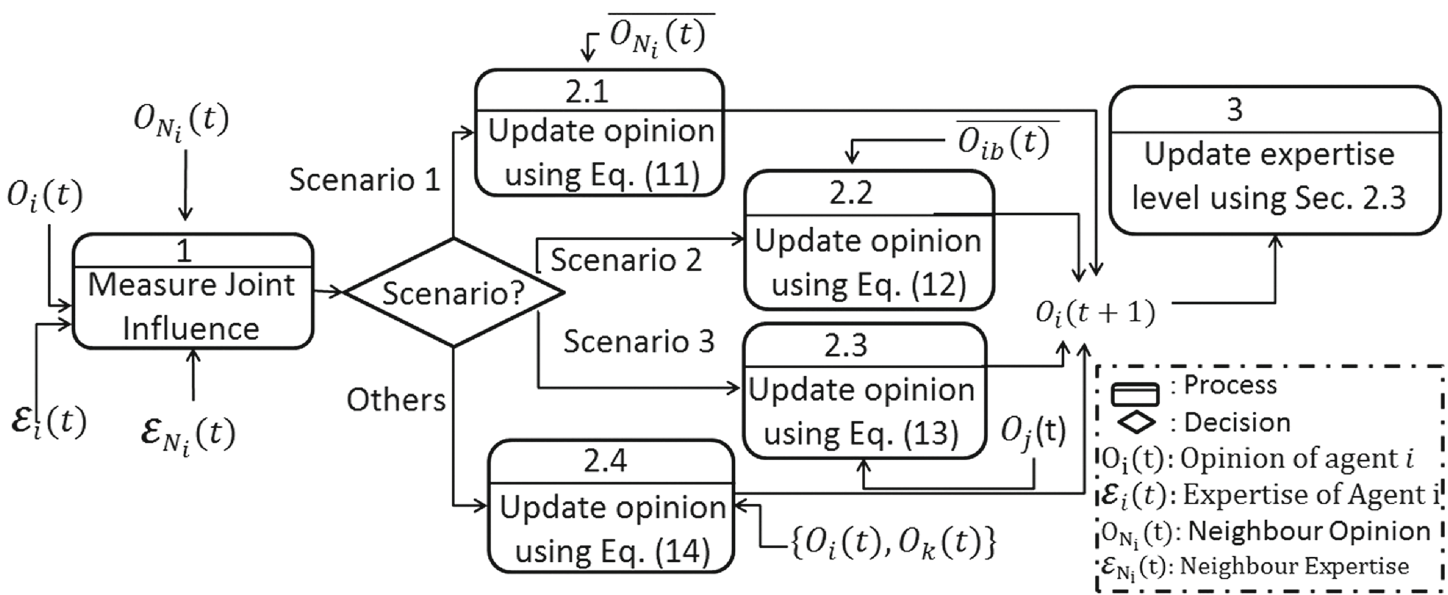 Figure: The schematic diagram showing how neighbors' opinions and expertise levels trigger scenario identification.
Real-World Validation: The Twitter Vaccination Debate
The authors didn't just stay in the realm of math; they scraped 14,226 tweets related to vaccination. They used:
- Sentiment Analysis to convert text to a [0, 1] opinion score.
- Bio-information mining to determine "Expertise Levels" (looking at professional affiliations in Twitter bios).
Key Results
The proposed model outperformed the Biased Voter Model (BVM) and the Moussaid Model across all key metrics:
- RMSE (Error): 0.185 (Ours) vs 0.212 (Moussaid).
- DS (Directional Symmetry): Our model was significantly better at predicting whether an opinion would increase or decrease in its next tweet.
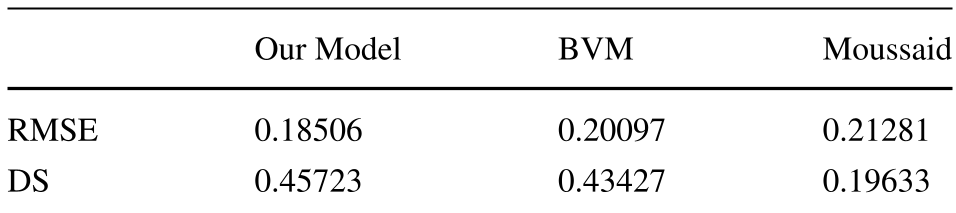 Table: Quantitative superiority of the entropy-based model over recent benchmarks.
Critical Insight: The "Expert vs. Majority" Threshold
A fascinating finding from their simulation is the Phase Transition. The authors discovered that:
- If experts have a consistency level above 0.8, they can pull the majority toward them, even if the majority is much larger.
- If experts are fractured or have lower expertise, the sheer volume of "average" opinions wins, leading to a majority-driven consensus.
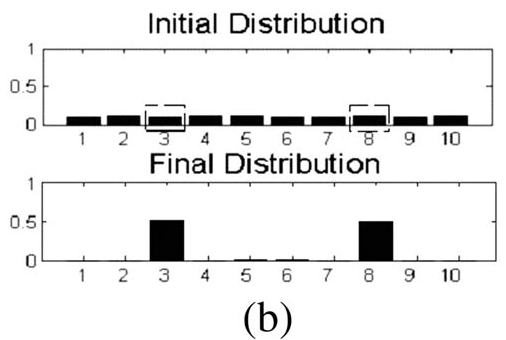 Figure: Visualization of how different expert cluster placements lead to (a) Consensus, (b) Polarization, or (c) Fragmentation.
Conclusion & Future Outlook
This paper provides a vital roadmap for understanding Online Social Networks (OSNs). By moving away from simple averages and toward "Consistency Metrics," we can better understand how fringe opinions become mainstream or how scientific consensus (experts) can combat popular misconceptions (majority).
Limitations: The model currently relies on sentiment analysis tools which are not 100% accurate. Future work could integrate more nuanced NLP to capture "sarcasm" or "uncertainty" in the expertise level extraction.