
The Physics of Echo Chambers: How Individual Attitude Shapes Social Communities
Modelling opinion formation driven communities in social networks
This paper presents a co-evolutionary model of social networks where opinion formation (transaction dynamics) and network restructuring (generation dynamics) occur on two distinct time scales. By introducing an "attitude parameter" (), the authors demonstrate how individual biases toward the overall societal mood lead to the emergence of distinguishable community structures with varying sizes.
TL;DR
Why does society fragment into small rebel groups and large mainstream masses? This paper models social networks as a "co-evolutionary" process where opinions and friendships change at different speeds. By introducing a personal "attitude parameter" (), researchers found that your bias toward the "global mood" is the primary driver behind the size and stability of the community you belong to.
Context: A Two-Speed Society
In social physics, we often struggle to balance how individuals change their minds versus how they change their friends. The authors argue that these two processes happen on different time scales:
- Fast Transactions: Daily discussions that nudge your opinion ().
- Slower Generations: The periodic "pruning" of your social circle and the forging of new ties ().
The genius of this model lies in the Attitude Parameter (). It isn't just about who you talk to; it's about how much you care to align with—or rebel against—the "overall mood" of the entire society.
Methodology: The Math of Social Friction
The opinion of an agent is represented by . The evolution of this opinion is governed by a two-part equation:
- Local Influence: Aligning with your immediate friends.
- Global Attitude (): Your reaction to the average opinion of the society.
If your is positive, you are a "conformist" seeking the majority. If it's negative, you are a "contrarian."
 Figure 1: Visualizing the interplay between opinion dynamics and topological rewiring.
The Rewiring Rule
The network isn't static. Every steps, the model applies two rules:
- Link Deletion: If you and a friend disagree too much (high ), the link is cut.
- Link Creation: You look at "friends of friends" (second neighbors). If joining them helps you reach a more extreme, stable opinion, you form a link.
Experimental Insights: Rebels vs. The Masses
Using a fitness algorithm to detect communities, the authors discovered a striking correlation between the attitude parameter and community size.
- Small Communities (Green/Blue): Comprised mostly of individuals with negative . These are people who resist the global trend, finding refuge in small, tight-knit groups where they can hold their "minority" views without constant global pressure.
- Large Communities (Red): Dominated by individuals with positive . Conformists naturally aggregate into "super-communities" because their desire to align with the global mood acts as a gravitational pull, merging smaller groups into a large consensus mass.
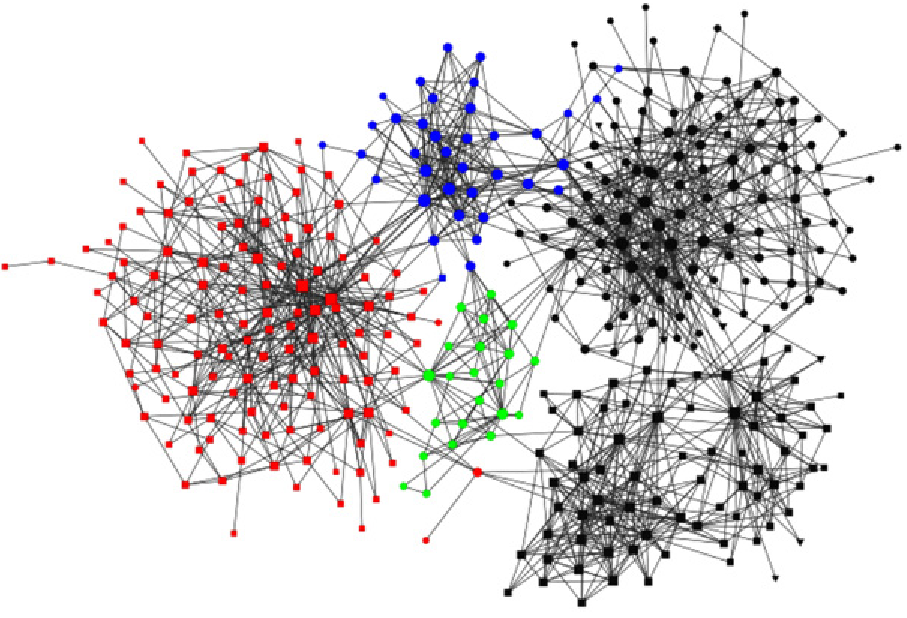 Figure 2: Community structure after evolution. Colors represent different groups where opinions and attitude parameters have converged.
Why the Attitude Distribution Matters
The researchers tested what happens when you shift the average attitude of the whole population ().
- Consensus: When everyone is a conformist (), the network collapses into a single giant community within minutes.
- Fragmentation: Peak diversity (the most communities) happens when the population has a healthy mix of conformists and contrarians.
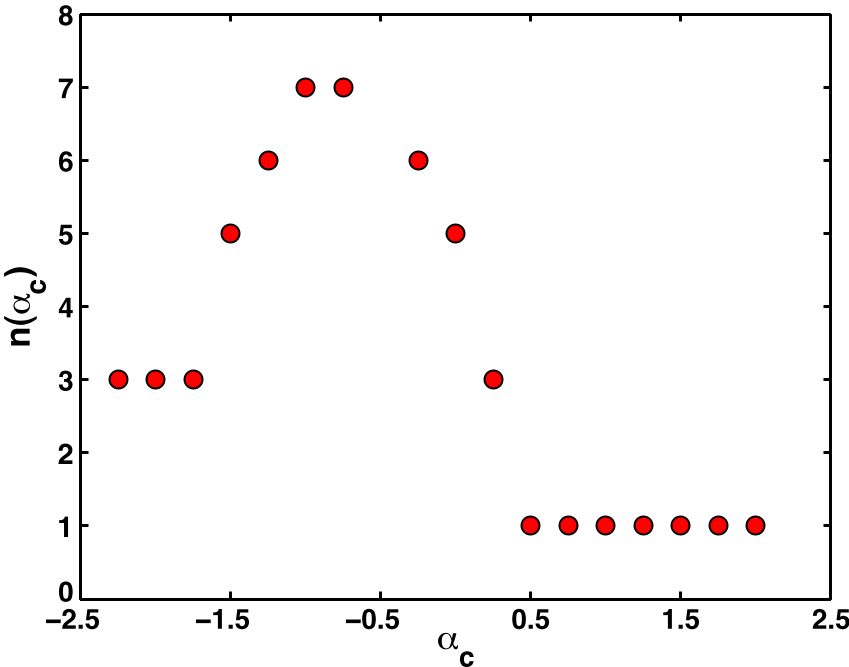 Figure 3: Number of communities as a function of the average attitude parameter.
Critical Insight & Conclusion
This paper provides a mathematical backbone for a common sociological observation: The "majority" is a large, often homogeneous block, while "resistance" is fragmented and localized.
The model demonstrates that "frustration" in a social system is minimized when contrarians stay in small groups. From a product perspective, this explains why social media platforms that emphasize "global trends" often trigger the formation of small, hyper-aggressive counter-cultures. To maintain a diverse yet stable society, a specific ratio of "conformity" and "rebellion" is mathematically required.
Limitations
While powerful, the model assumes "friends of friends" is the only way to meet new people. In the era of algorithmic recommendation engines (like TikTok or Twitter), the "focal closure" (meeting via shared interests regardless of distance) might be even more influential than the "cyclic closure" modeled here.