
Bridging Privacy and Logic: A New Reasoning Framework for Social Network Policies
Modelling and Reasoning Languages for Social Networks Policies
The paper introduces a framework for social network policies by integrating the Open Digital Rights Language (ODRL 2.0) with Formal Contract Logic (FCL). It provides a computationally oriented model to express, reason with, and execute complex privacy and sharing rules in dynamic social environments.
TL;DR
Social networks have revolutionized how we share data, yet our policy languages remain stuck in the "transaction" era of the early web. This paper proposes a powerful hybrid: ODRL 2.0 for expressing what we want, and Formal Contract Logic (FCL) for reasoning through the mess of conflicting permissions, social norms, and inevitable policy violations.
Positioning: This work bridges the gap between the flexibility of the Social Web and the formal rigor of the Semantic Web (Web 3.0), moving beyond simple Access Control Lists (ACLs) to a fully reasoning-capable policy stack.
The Social Policy Crisis: Why Current Models Fail
Traditional Digital Rights Management (DRM) is built for transactions—e.g., "Pay $1 to play this song 5 times." Social networks are fundamentally different. They revolve around dynamic groups (friends-of-friends) and social norms (if I comment on your blog, you might trust me with your photos).
Current platforms like Facebook or Flickr offer "all-or-nothing" or "vague group" settings. This leads to four critical failures:
- Expression: We can't describe complex conditions (e.g., "only for people who follow me on both X and Y").
- Conflict: What happens when a "Public" photo rule clashes with a "Blacklist" rule?
- Accountability: There is no way to track what happens when a policy is violated.
- Exceptions: Policies are often "usually true but sometimes not," a concept standard logic handles poorly.
Methodology: ODRL 2.0 + Defeasible Logic
The authors propose a two-layered solution. First, they adopt the ODRL 2.0 Core Model to define the "Vocabulary" of the social network.
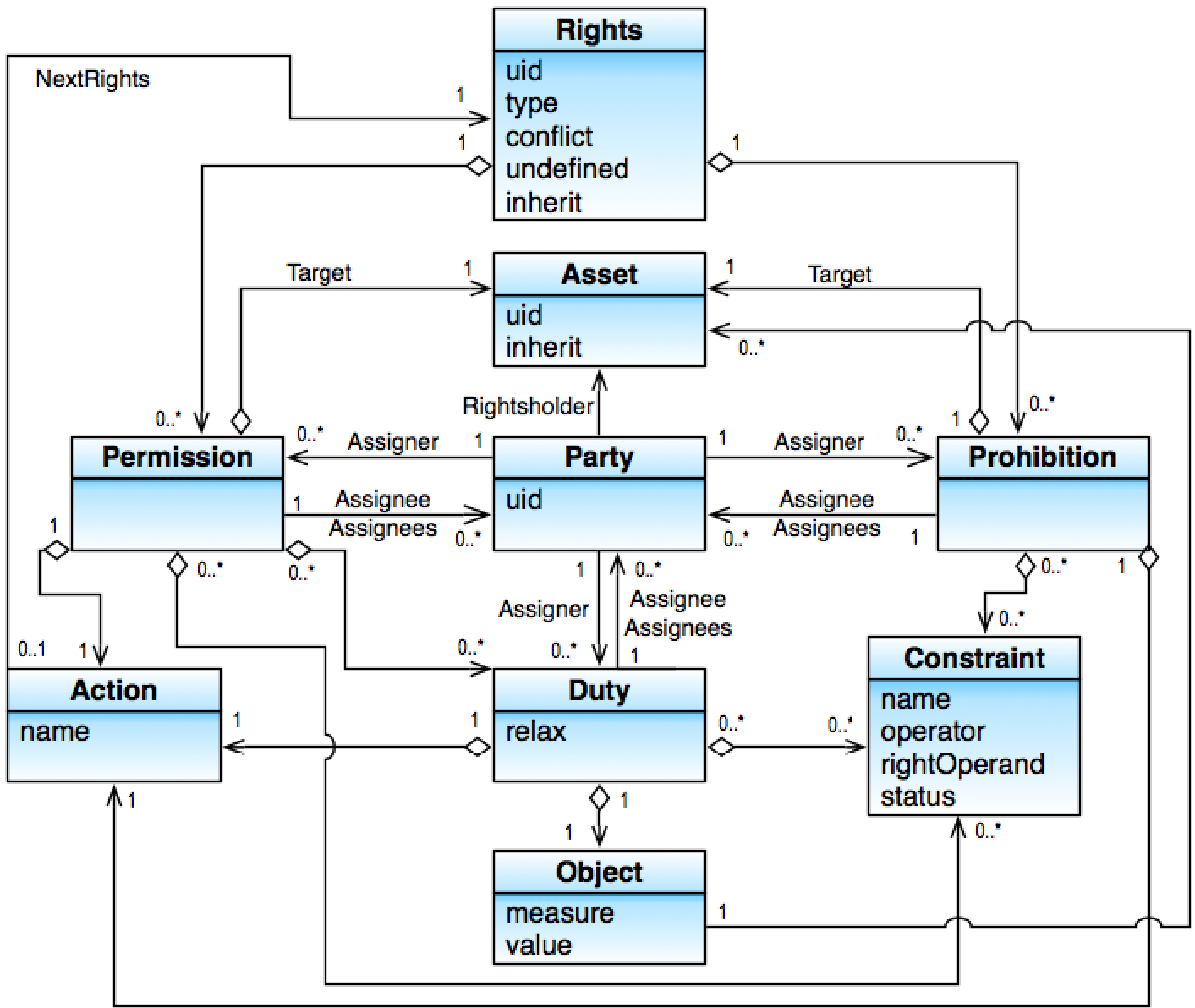
However, ODRL 2.0 is just a language; it needs an "engine." This is where Formal Contract Logic (FCL) comes in. FCL combines two advanced logical concepts:
1. The Superiority Relation (Handling Exceptions)
In social networks, rules are "defeasible"—meaning they can be defeated by better evidence.
- Rule 1 (): Normally, photos are public.
- Rule 2 (): Private photos are forbidden to non-owners. By establishing (Rule 2 is superior), the system automatically resolves the conflict without crashing or being "skeptical" (unable to reach a conclusion).
2. Reparation Chains (Handling Violations)
The real world isn't perfect. FCL uses the operator to define what happens when a rule is broken.
- Formula:
- Logic: You have an obligation to do A. If you violate A (i.e., ), you are then obligated to do B to compensate. This allows social networks to manage sanctions (e.g., "if you don't upload a profile picture, you lose access to private resources").
Validating with the "Alice Use Case"
To prove this works, the authors tackle a nightmare scenario: Alice only wants wedding photos accessible to people who are friends on both Flickr and Twitter AND have blogs she has commented on twice in the last 10 days.
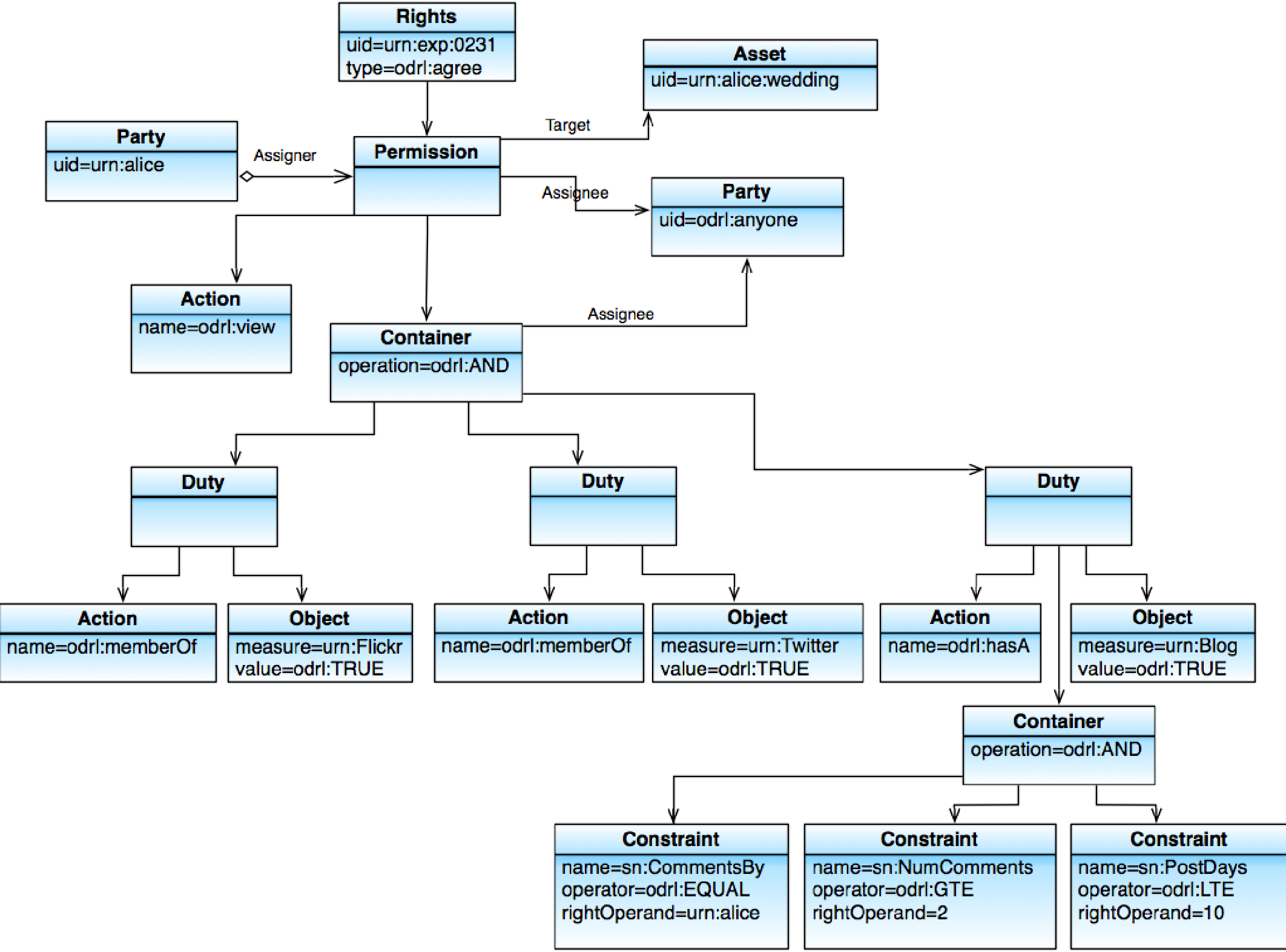
By mapping these constraints into FCL rules, the system can determine precisely whether "Bob" or "Carl" should see the photos at any given millisecond, accounting for their recent activity across platforms.
Experiments and Performance
A key concern with formal logic is scalability. If every access request takes seconds of reasoning, the social network dies.
- Efficiency: The authors demonstrate that FCL conclusions can be computed in linear time ( relative to the number of rules).
- Accountability: Unlike "Black Box" AI filters, FCL provides a constructive proof theory. If access is denied, the system can tell the user exactly which rule caused the denial and why.
Critical Analysis & Conclusion
Takeaway
The paper successfully argues that policies are normative—they aren't just switches; they are agreements. By using Defeasible Logic, the authors provide a way to handle the "messy" human side of social networks (conflicts and exceptions) within a mathematically rigorous framework.
Limitations
- User Mapping: While the logic works, how do we get average users to write "Superiority Relations"? The translation layer between a UI and FCL remains a significant hurdle.
- Ontology Matching: As noted in the future work, matching "Friendship" definitions across different platforms (e.g., Flickr vs. Twitter) remains a "formidable" challenge for Semantic Web researchers.
Future Outlook
As we move toward a decentralized Web 3.0, the ability for users to own their policies—and for those policies to be executable across various decentralized services—makes the FCL/ODRL combination a vital blueprint for the next decade of digital rights.