
CARE2: Leveraging Complex Networks to Combat Modern Epidemics
Modelling and Simulation of an Infection Disease in Social Networks
The paper presents CARE2, a distributed software system designed to model and simulate infectious disease spreading using Complex Network theory. It leverages Scale-Free and Small-World network models to identify "super-spreaders" via centrality measures, achieving highly efficient targeted immunization strategies.
TL;DR
Epidemics don't spread uniformly; they follow the intricate pathways of human social structures. This paper introduces CARE2, a robust simulation framework that uses Scale-Free and Small-World network models to pinpoint "super-spreaders." By targeting these influential nodes for immunization, the system demonstrates that a disease can be halted by vaccinating a mere fraction (under 20%) of the population, offering a strategic blueprint for public health management under resource constraints.
The Structural Weakness of Random Vaccination
Historically, epidemiologists have often resorted to random vaccination or, budget permitting, mass immunization. However, the authors argue that this is fundamentally flawed when dealing with real-world social networks.
Most social structures are Scale-Free networks, meaning they are characterized by a "Power Law" degree distribution: a few individuals (hubs) have an enormous number of contacts, while the majority have few. These networks possess a high "Attack Tolerance" against random node removal—they remain structurally sound even if 80% of nodes are removed at random. This explains why random vaccination often fails to break the chain of transmission.
Methodology: Identifying the "Super-Spreader"
The core of the CARE2 system involves calculating Centrality Measures to discover "critical elements." The paper details five mathematical lenses through which we can view "importance":
- Degree Centrality: The raw count of direct neighbors.
- Closeness Centrality: How many "steps" an individual is from everyone else in the network.
- Betweenness Centrality: Measuring how often an individual acts as a "bridge" on the shortest path between others.
- Eigenvector Centrality: Acknowledging that connections to other influential people carry more weight.
- Radius Centrality: Identifying nodes influential to the most remote parts of the network.
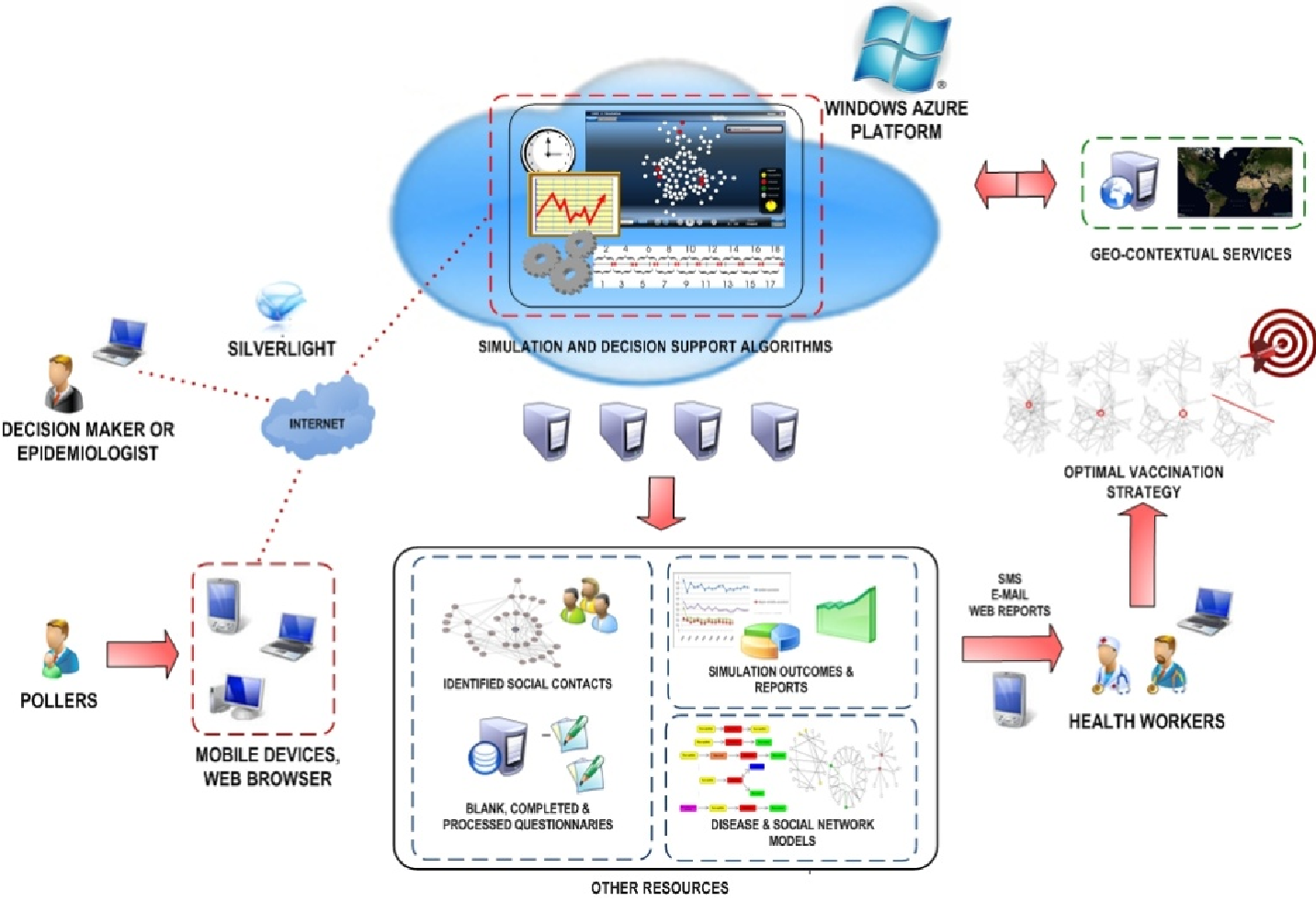
The system architecture (shown above) relies on a Service Oriented Architecture (SOA), allowing mobile clients to collect social data via questionnaires while the "cloud" handles the heavy lifting of graph generation and simulation.
The "Vaccinate Thy Neighbor" Insight
A recurring problem in epidemiology is that the full network topology is rarely known. To solve this, the authors propose a clever heuristic:
- Pick 20% of people at random.
- Ask them to name one friend/contact.
- Vaccinate the named contact.
Because "super-spreaders" have so many contacts, they are statistically much more likely to be named by a random person than an average individual is. This "structural shortcut" allows targeted immunization even in the absence of complete global data.
Experimental Results and Real-World Validation
The system was put to the test using the SARNA subsystem during the 2009/2010 Swine Flu (A H1N1) outbreak in Poland. Unlike the traditional SENTINEL system, which reported weekly, SARNA provided daily monitoring across 600 hospitals.
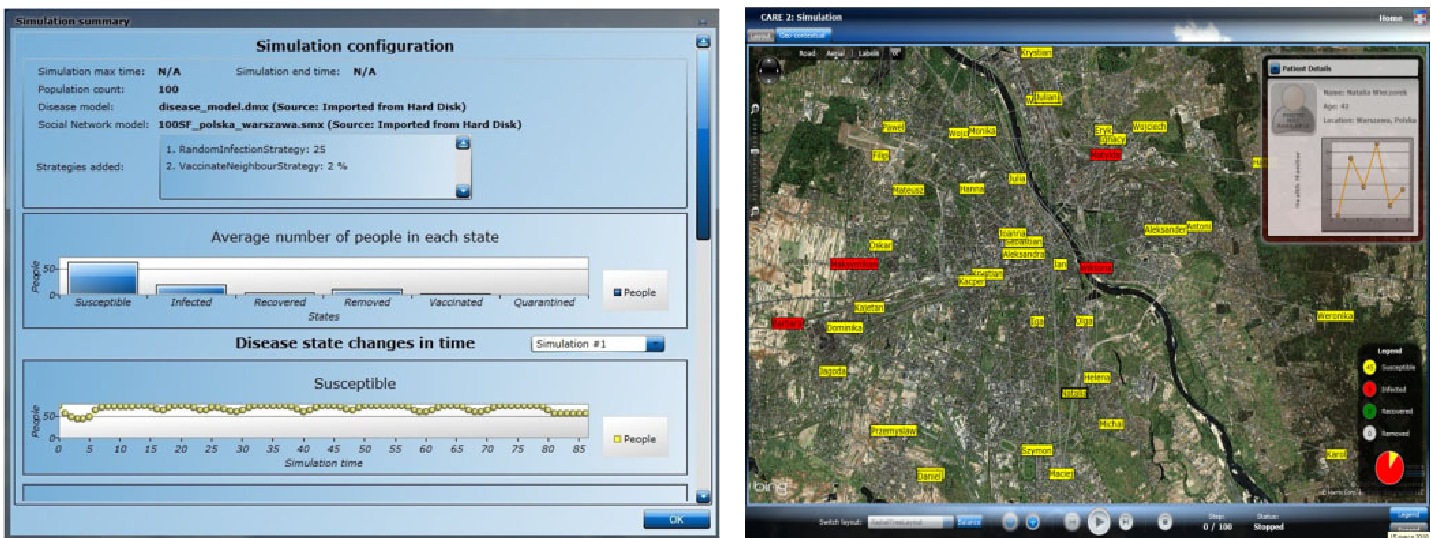
The simulations (visualized above using geo-contextual maps) confirmed that:
- Targeted Immunization (based on centrality) collapses the network throughput far faster than random removal.
- The Global Connection Efficiency (GCE)—a metric of how easily a disease can travel—drops significantly when high-betweenness nodes are removed.
Critical Analysis & Conclusion
The CARE2 project represents a sophisticated transition from theoretical graph theory to practical crisis management. Its value lies not just in the math, but in the integration of data collection (mobile) and analysis (cloud).
Limitations: The model's accuracy is heavily dependent on the honesty and accuracy of social questionnaires. In a high-panic scenario, gathering granular social topology might face significant friction. Furthermore, the model currently uses a static formal graph; incorporating temporal dynamics (how contacts change over hours or days) would be a logical next step.
Future Outlook: As we move into an era of "Big Data" and ubiquitous mobile tracking, the principles of CARE2—identifying structural hubs to maximize intervention impact—will become the gold standard for managing not just biological viruses, but the spread of digital misinformation and financial contagion as well.