
Deciphering the Pulse of Networks: A Unified Framework for Social Propagation
On Modelling Social Propagation Phenomenon
This paper provides a comprehensive review and a novel generic framework for "Social Propagation" in complex networks. It introduces a triplet-based model (i, j, t) that unifies classic Independent Cascade (ICM) and Linear Threshold (LTM) models while incorporating time-varying dynamics and push-pull communication strategies.
TL;DR
Social networks are not just static structures; they are dynamic conduits for information, rumors, and influence. This paper by Dariusz Król bridges the gap between biological epidemiology and social informatics by proposing a time-stamped triplet model . This framework unifies the two titans of propagation theory—Independent Cascade (ICM) and Linear Threshold (LTM)—while introducing "Push-Pull" mechanics to explain how information actually survives or perishes in the digital wild.
Background: Beyond the Static Graph
In social informatics, we often ask: Why do some memes die in obscurity while others trigger global movements? Most prior works rely on static graph snapshots, ignoring the temporal resolution of interactions. The author argues that propagation is fundamentally a process of "cascading behavior" where topology, complexity, and fast influence by weak ties interact over discrete time steps.
The Core Challenge: Why is Modeling Hard?
Existing models (like SIR or SIS) often struggle with two distinct social realities:
- Epidemic-type dynamics: Where an infected node influences neighbors independently (e.g., a virus).
- Cascading-type dynamics: Where activation depends on the collective reinforcement from multiple neighbors (e.g., adopting a new technology).
The "missing link" has been a unified algorithm that accounts for the Push (sender-driven) and Pull (receiver-driven) nature of these interactions.
Methodology: The Generic Triplet Model
The author defines propagation as a sequence of triplets: .
- : The source node.
- : The target node.
- : The specific timestamp of interaction.
By aggregating these triplets over an interval , the author constructs a Static Propagation Graph (a Directed Acyclic Graph or DAG). This approach reduces complexity by focusing on recorded events rather than theoretical probabilities alone.
Algorithm Architecture
The proposed generic algorithm allows for various threshold conditions. Two primary variants are explored:
- Push Variant: Mirrors the ICM. Information is "pushed" from a propagator to all neighbors if a probability threshold is met.
- Pull Variant: Mirrors the LTM. A node "pulls" influence from its neighbors, activating only when the cumulative influence exceeds its internal resistance (threshold ).
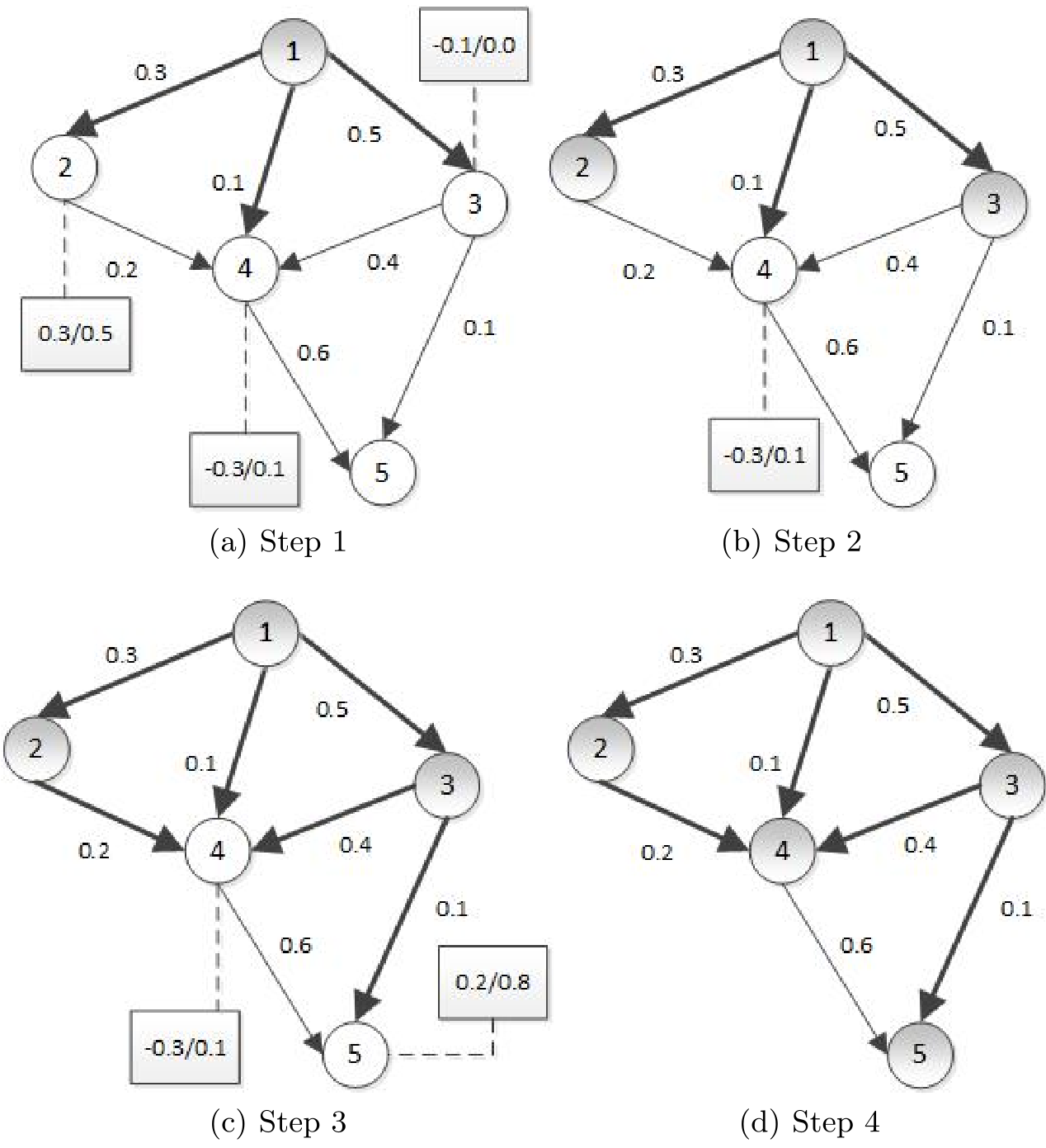 Figure 1: Step-by-step activation demonstrating how negative individual preferences can be overcome by cumulative neighbor influence (Pull variant).
Deep Dive: Influence and Preference
A unique insight in this paper is the addition of Preference Factors . In viral marketing, a user might have a negative bias toward an item (e.g., ). However, the model demonstrates that if enough neighbors adopt the item (the "Pull" effect), the social pressure can eventually overcome the negative individual preference, leading to activation. This explains the "tipping point" observed in social crises and market trends.
Experimental Insights & SOTA Comparison
The paper highlights that while LTM and ICM are functionally similar, they capture different "hub" behaviors:
- ICM is more effective at spreading through high-degree "hub" nodes.
- LTM makes it harder to activate hubs unless a significant fraction of their massive neighbor base is already active.
- Performance: Strategies combining triadic closure (friend-of-a-friend) and traffic-based shortcuts consistently outperform simple Random Walk or Breadth-First Search (BFS) strategies in fitting real-world data patterns.
Critical Analysis & Future Outlook
While the model is elegant in its simplicity, the author acknowledges a significant hurdle: Scalability. Even with greedy optimizations, "Influence Maximization" (finding the best seed nodes) in large networks takes hours.
Future Work points toward:
- On-the-fly learning: Predicting time-varying influence by mining historical logs in real-time.
- Immunization: Developing algorithms to "vaccinate" nodes against misinformation.
Conclusion
Dariusz Król’s work moves us closer to a "Path Algebra" of social influence. By treating each interaction as a discrete, time-stamped event, researchers can better predict the survival or decay of information across the complex, interdependent networks that define our modern existence.