
Modelling User Behavior Dynamics: A Physics-Inspired Embedding Approach
Modelling User Behavior Dynamics with Embeddings
The paper proposes a novel framework for modelling user behavior dynamics using distributed representations (embeddings). By defining metrics like behavior position, displacement, and velocity in a learned vector space, it quantifies how user-system interactions evolve over time across three distinct domains: lab-based data curation, structured crowdsourcing, and unstructured Wikidata editing.
TL;DR
Researchers have developed a new way to treat user interactions like moving particles in a digital space. By using behavior embeddings and metrics like displacement and velocity, this paper provides a mathematical lens to see how users learn, adapt, or lose interest as they perform tasks. Whether it's a coder in a lab or an editor on Wikidata, we can now quantify the "speed" and "direction" of their behavioral evolution.
Background: Beyond Static Patterns
In Human-Computer Interaction (HCI), we often ask: What is the user doing? We look at clicks, dwell times, and heatmaps. However, the more crucial question is: How is their behavior changing?
Most existing models are static; they categorize users into groups (e.g., "expert" vs. "novice") but fail to capture the transition between these states. This paper, presented at CIKM '20, argues that behavior is a dynamic process that should be measured over time using the same sophisticated embedding techniques used in Natural Language Processing (NLP).
The Methodology: Actions as Words, Behaviors as Vectors
The core innovation lies in the Behavior Embedding Space. The authors treat a sequence of user actions (like copy, paste, scroll) as "sentences."
1. Tokenization and Embedding
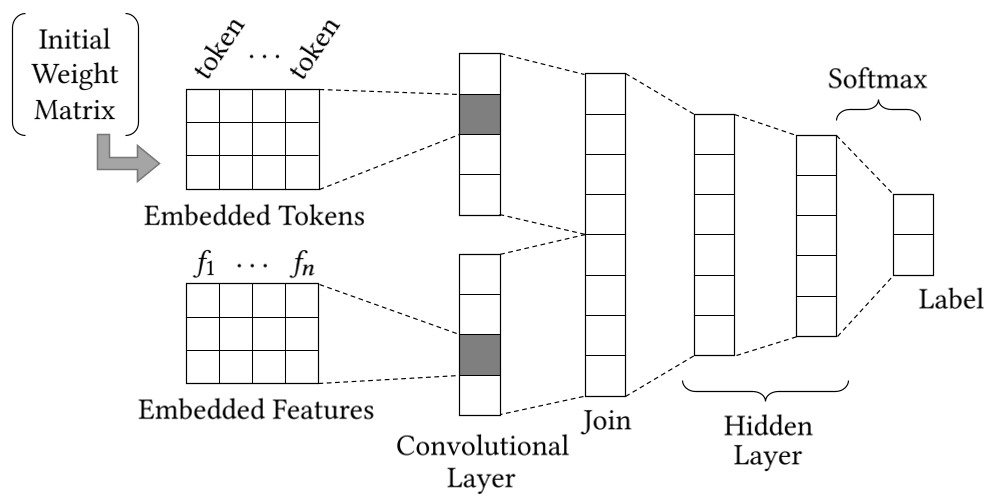
- Actions: Individual logs are grouped into -grams (e.g., 3-grams) to capture local context.
- Features: Interaction attributes (like the length of a text edit) are binned and embedded alongside actions.
- Network: A CNN-based architecture fuses these embeddings to learn a unified representation of a "step" in a task.
2. The Mechanics of Behavior
Inspired by kinematics, the authors define three measures:
- Position (): The coordinates of a user's behavior in the embedding space at a specific time.
- Displacement (): How far and in what direction the behavior has moved from the start of the task.
- Velocity (): The rate of change between two consecutive steps, highlighting sudden shifts in strategy.
Experiments: From Labs to the Wild
The model was tested on three diverse datasets to prove its versatility:
- DataCuration: Complex coding tasks (Lab).
- PowerWorker: Structured document assessment (Crowdsourcing).
- WikiData: Long-term unstructured editing.
Key Insight: The "Expert" Signature
In the crowdsourcing experiment, the data revealed that experienced workers exhibit much higher "Step Consistency." They find a strategy (e.g., specific keyboard shortcuts) and stick to it, leading to a very stable trajectory in the embedding space. In contrast, novices "wander" through the space as they struggle to find an efficient workflow.
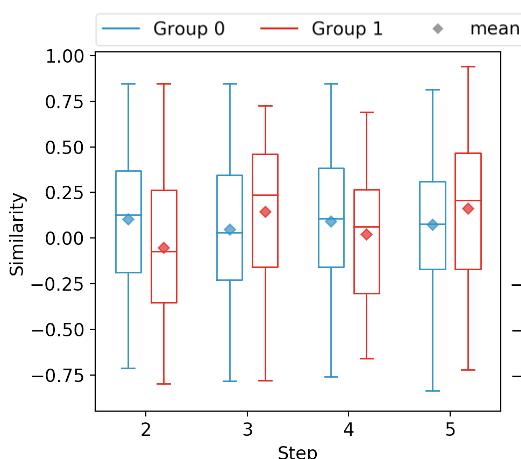 Figure 3: Comparisons of behavior position showing how high-performers (Group 1) often exhibit more converged behavioral patterns compared to low-performers.
Why This Matters: The Learning Curve
One of the most profound applications of this work is identifying the Learning Effect. By monitoring "Behavior Velocity," a system can detect exactly when a user "gets it"—the moment their velocity stabilizes or shifts toward a known expert "Position."
Conversely, if a user's velocity becomes erratic or slows down significantly, it may signal engagement loss or frustration, allowing for real-time system interventions or automated help.
Critical Analysis & Conclusion
While the paper demonstrates robust results, it acknowledges that the definition of a "step" is task-dependent. In Wikidata, a step was 24 hours; in coding, it was 20% of task completion. The choice of in -grams also creates a trade-off: higher captures richer semantics but risks data sparsity.
Takeaway: This framework transforms raw logs into a "behavioral GPS." By quantifying the dynamics of interaction, we move closer to systems that don't just react to what we do, but understand how we are evolving.
Future Work
The authors suggest that future research should explore how these dynamic measures can be used to provide user-centric training. Imagine a platform that recognizes you are struggling with a specific tool (via your behavioral displacement) and offers a tutorial tailored to your current "position" in the task.