
Beyond Digital Forms: Story Boarding and User Profiling in Web-Based Banking
Modelling Web-Based Banking Systems: Story Boarding and User Profiling
This paper introduces a conceptual framework for designing web-based banking systems using "Story Boarding" and "User Profiling." Focused on loan application processes, the authors propose a graph-based methodology to anticipate user behavior and simulate human communication skills in a digital environment.
TL;DR
Modern e-business requires more than just migrating paper forms to a browser. This paper proposes a formal modeling approach using Story Boarding (navigation patterns) and User Profiling (characterizing user needs) to bridge the gap between human interaction and automated banking systems, specifically within the complex domain of loan applications.
The Human Gap in Digital Banking
When a bank replaces a loan officer with a website, it loses the officer's ability to read between the lines—to sense a customer's confusion, fear, or lack of knowledge. Existing web design models often focus purely on database structures or hypertext links, neglecting the business logic of behavior.
The authors argue that system acceptance depends on anticipating user behavior across various dimensions:
- Knowledge: Ranging from expert investors to first-time applicants.
- Psychology: Factoring in "fear" or "bluffing" during financial assessment.
- Capability: Computer literacy and language fluency.
Methodology: The Architecture of Interaction
The core of the paper lies in its hierarchical approach to e-business system development, moving from Intention to Implementation.
1. User Profiling (The User-Grid)
Users aren't a monolith. The authors define -dimensional user profiles where each dimension (like "Risk Awareness") has a totally ordered scale.
- A User Type is then defined as a convex region within this multidimensional grid, allowing the system to adapt its "scenes" based on who is browsing.
2. Story Boarding (Graph-Based Navigation)
The system's flow is modeled as a scenario graph , where represents Scenes (web pages/states) and represents Actions (user navigation).
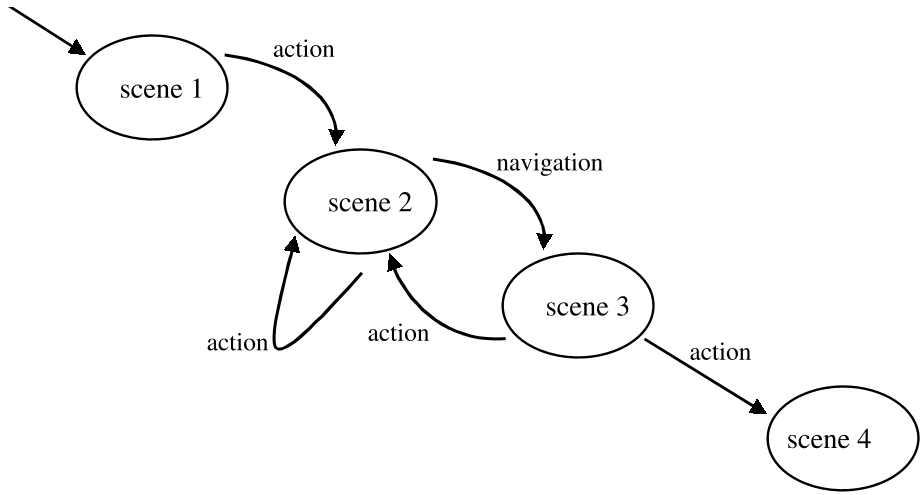 Figure 1: A basic scenario with four scenes. This graph structures how a user moves from identifying a loan to completing a budget.
Application: The Loan Lifecycle
The authors break down the loan application into four primary scenes:
- Loan Type Identification: What is the money for?
- Applicant Details: Who are you?
- Securities: What is the collateral?
- Budgeting: Can you actually afford this?
To solve the "knowledge gap," the authors introduce Sub-scenarios. If a user is flagged as a "non-expert" in their profile, the system triggers a detailed sub-graph that includes "Adviser" or "Dictionary" metaphors to help them understand loan terms.
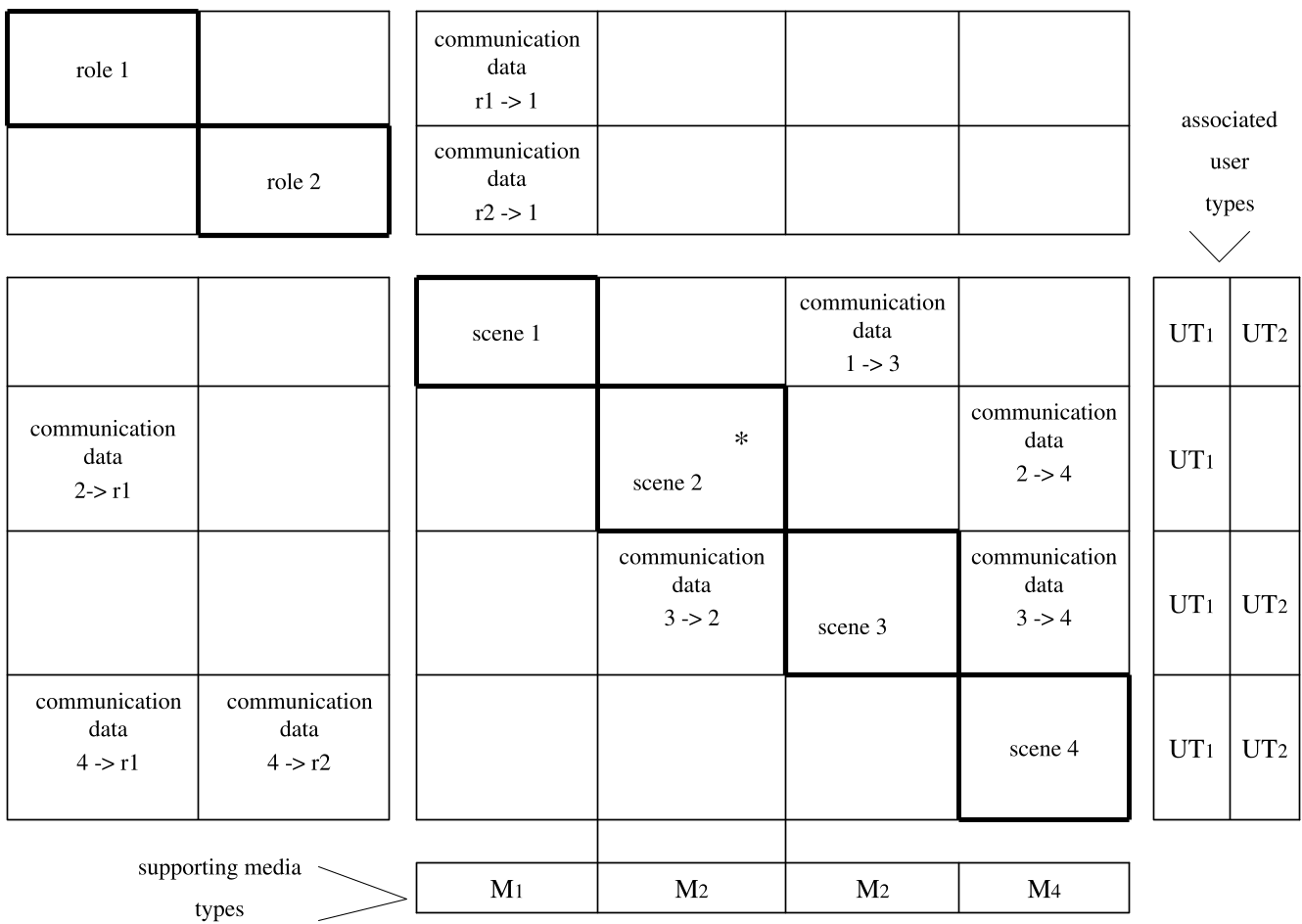 Figure 2: The adjacency matrix used to manage complex transitions without cluttered diagrams, tracking scene communication and user types.
Solving "Message Flaws"
Drawing from communication theory, the paper identifies four types of "flaws" that occur when human-to-human interaction is lost:
- Content Flaws: The user doesn't know what to say (e.g., vague loan purpose).
- Presentation Flaws: The user provides inaccurate data (e.g., overestimating income).
- Relationship Flaws: Cultural barriers or fear of rejection.
- Appeal Flaws: Misunderstanding the bank's profit-driven nature.
By anticipating these flaws, the Story Board can include transparent assessment criteria and interactive help, effectively simulating the supportive role of a bank staff member.
Critical Insight & Conclusion
This paper's value lies in its Inductive Bias: it assumes that a web system is a conversation, not just a transaction. While written in a time of early web development, the logic holds strong relevance today for AI-driven interfaces.
Key Takeaways:
- Adaptivity is Key: Systems must shift their complexity based on user dimensions.
- Communication Meta-Models: Engineering a system to recognize "fear" or "bluffing" leads to higher transparency and trust.
- Structural Engineering: Moving from ad-hoc site design to formal graph-based modeling ensures that business intentions are met without losing the user.
The authors prove that user profiling and storyboarding are not just UX design tools, but essential components of conceptual modeling for any high-stakes e-business application.