
Collaborative Networks: The Hidden Catalyst for China's Biomedical Innovation
Examining the moderating effect of technology spillovers embedded in the intra- and inter-regional collaborative innovation networks of China
This study investigates the moderating effects of intra- and inter-regional collaborative innovation networks on R&D efficiency within China's biomedical sector. By analyzing patent co-inventing data, the authors demonstrate that network characteristics like clustering and density significantly enhance the relationship between R&D personnel and innovation output.
TL;DR
Is raw R&D spending enough to drive a nation's innovation? According to this study of China's biomedical sector, the answer lies not in the amount of money, but in the structure of the networks connecting researchers. While R&D investment shows a linear relationship with output, it is the intensity of collaborative networks—both within and across regions—that acts as a powerful multiplier for human talent.
Context: Beyond the Catch-Up Phase
For decades, China relied on "imitation and reverse engineering" of overseas technologies. However, as the nation shifts toward indigenous innovation, the bottleneck has moved from "accessing knowledge" to "efficiently utilizing it." The researchers argue that a province's position in a multi-level network determines its R&D Efficiency: the rate at which R&D inputs (Personnel and Capital) are converted into Patents (Output).
The "Why": Why Network Structure Matters
The authors hypothesize that collaborative networks serve as conduits for Technology Spillovers.
- Intra-regional networks (within a province) leverage geographic proximity for face-to-face communication.
- Inter-regional networks (between provinces) provide access to heterogeneous knowledge not available locally (e.g., a firm in Zhejiang collaborating with a lab in Beijing).
Methodology & Architecture
The study utilizes a massive dataset of patent co-inventorships to map out these connections. Unlike simple counts, they look at Network Intensity through metrics like the Clustering Coefficient (how "cliquey" a group is) and Density (the number of active collaborations).
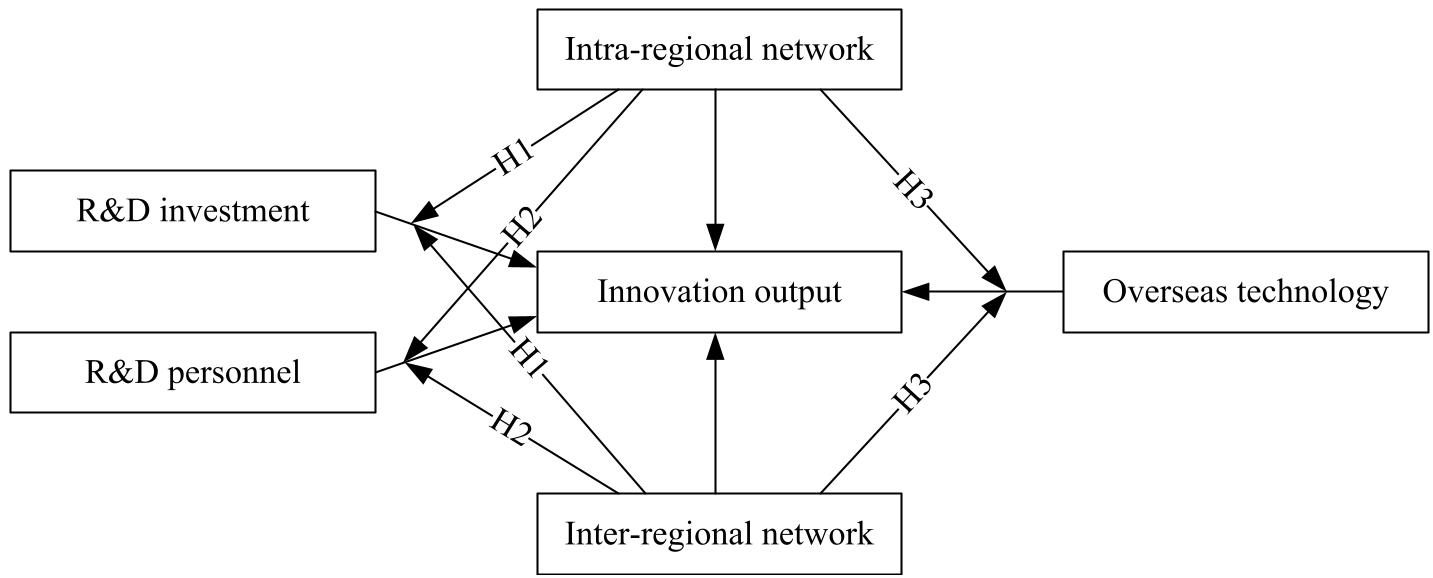 Figure 1: The theoretical framework showing how intra- and inter-regional networks moderate the flow from R&D inputs to innovation output.
Key Insights: People Over Money
The empirical results from the 31 Chinese provinces present a striking dichotomy:
1. The Human Multiplier
In both intra- and inter-regional dimensions, a high Clustering Coefficient significantly amplifies the impact of R&D personnel. When researchers are part of tight-knit, interconnected groups, their productivity skyrockets.
Intuition: Dense networks lower the "search cost" for information. A researcher in a dense network finds the "missing piece" of their puzzle faster through a peer.
2. The Capital Dead-End
Surprisingly, networks do not moderate R&D investment. More money doesn't become "more efficient" just because you have more partners. This suggest that capital investment follows a more rigid, perhaps bureaucratic allocation that doesn't benefit from the "serendipity" of social networks.
3. Taming Overseas Spillovers
Interestingly, foreign technology spillovers were found to be potentially harmful to indigenous innovation (likely due to dependency). However, high intra-regional network density reverses this effect, helping local firms absorb and build upon foreign ideas rather than just mimicking them.
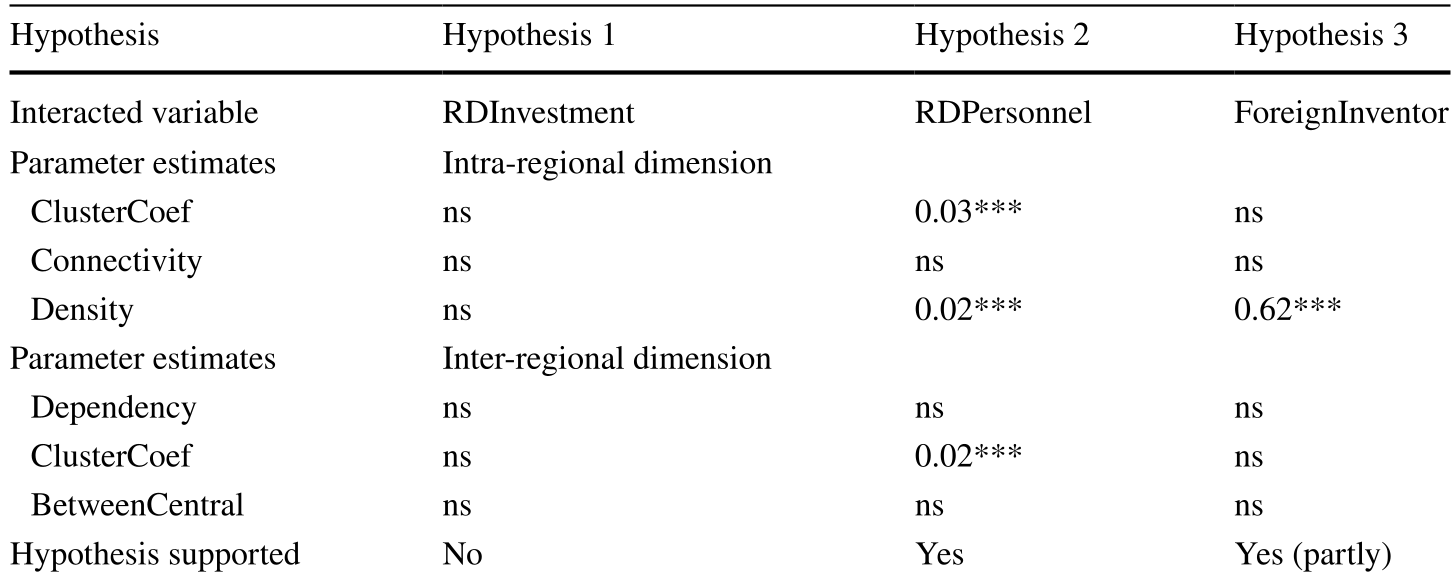 Table: Summary of Hypothesis testing, showing the strong support for R&D Personnel moderation (H2) and partial support for Overseas Technology (H3).
Critical Analysis & Policy Implications
The study highlights a core structural issue: R&D resources in China are heavily clustered in Beijing and Shanghai.
- The Lesson for Policy Makers: Simply moving "money" to lagging provinces won't work. To bridge the innovation gap, the government must facilitate the flow of people and the creation of cross-regional social ties.
- Limitations: The study is limited to the biomedical field and relies on patent data. High-stakes industries with trade secrets might not show up in patent co-inventorships, potentially hiding "informal" networks.
Conclusion
This work confirms that in the race for technological sovereignty, social capital is the real catalyst. It is the density of the web we weave between our universities and firms that determines whether a researcher’s potential is merely realized or exponentially multiplied.