
DCDM: Capturing Dynamic Information Diffusion via Community-Level Semantic Trends
A Modified Community-Level Diffusion Extraction in Social Network
The paper introduces the Dynamic Community-level Diffusion Model (DCDM), a generative framework designed to model information propagation in social networks. By integrating dynamic semantic analysis with network topology and a novel "expression trend" mechanism, DCDM achieves superior performance in predicting retweets compared to individual-level and static community-level baselines.
Executive Summary
TL;DR: The researchers propose the Dynamic Community-level Diffusion Model (DCDM), a paradigm shift from individual-centric diffusion models. By combining network topology with dynamic semantic analysis and a novel "Expression Trend" mechanism, DCDM accurately predicts how information spreads across latent communities in social networks, significantly outperforming existing SOTA methods in retweet prediction.
Positioning: This work bridges the gap between community detection and information diffusion, evolving from the legacy of models like COLD by adding temporal dynamics and relationship-aware topic distributions.
Motivation: The Shortcomings of Individual-Level Analysis
Information diffusion in modern social networks (like X/Twitter or Weibo) is notoriously difficult to model. Most prior work falls into two categories:
- Individual-level interactions: These often ignore the broader social context and the "noise" of individual behavior.
- Static Semantic analysis: These fail to capture how topics evolve or how a user's word choice is influenced by their social circle (e.g., following a trend or adopting friend-group slang).
The authors identify a critical "Concept Drift" in text streams where user preferences and word distributions change over time, rendering static models obsolete.
Methodology: The Dynamic Community-Level Approach
DCDM is built on a generative process consisting of three interconnected components:
1. User Membership Component
Acknowledging that users are multifaceted, DCDM uses a mixed-membership approach. A user isn't just in one community; they have a multinomial distribution across communities, allowing them to participate in different contexts (e.g., professional vs. personal).
2. Expression-Topic Component
This is the core innovation. Unlike standard LDA, DCDM assumes:
- Single-Topic Posts: Since tweets are short, each post is assigned one topic.
- Expression Trends: Users have three styles of topic-word distributions—initiatve habit (), friends' habit (), and others' habit (). This allows the model to distinguish between a user's original thoughts and "echo chamber" effects.
- Temporal Dynamics: Topic distributions are modeled as Dirichlet distributions influenced by the previous time step (), effectively tracking interest shifts.
3. Network Topology
The model uses a Bernoulli distribution to determine the probability of a link (and subsequent diffusion) between communities and .
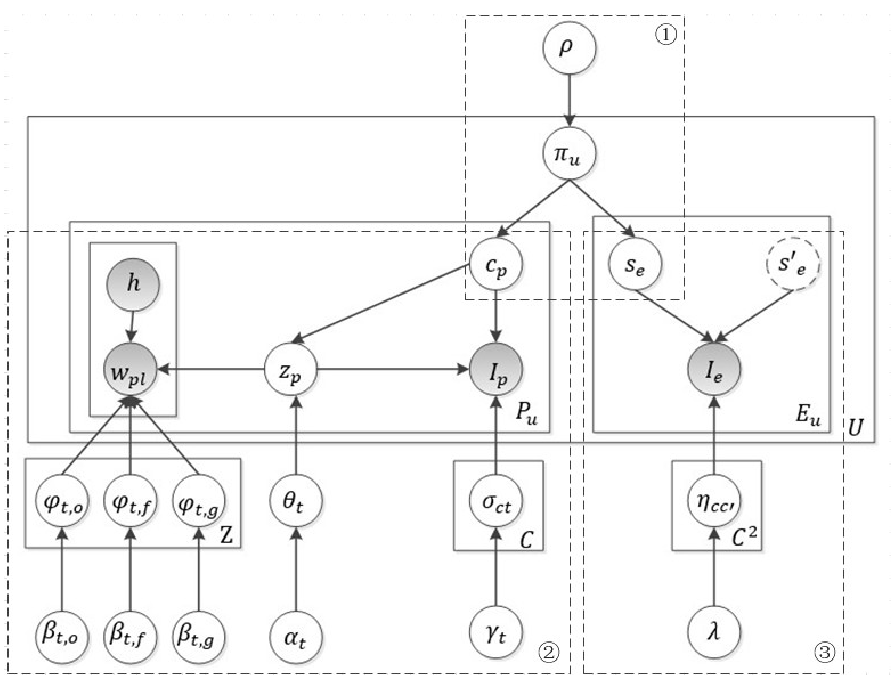 Fig 1: Graphical Model Representation of DCDM featuring the three dashed components: (1) Membership, (2) Expression-Topic, and (3) Network.
Experiments & Performance
The model was validated on a filtered Twitter dataset of 836 users with over 1,400 tweets each.
SOTA Comparison
DCDM compared against:
- COLD & HCID: Community-level baselines.
- TI (Topic-level Influence): An individual-level diffusion model.
- DCDM-ET: An ablation version without the "Expression Trend" module.
Key Results
- Predictive Accuracy: DCDM consistently dominated the Precision-Recall Curve (PRC), suggesting that identifying "Expression Trends" is vital for predicting retweets.
- Robustness to Sparsity: By operating at the community level, the model was more resilient to the sparse nature of social media links than individual-level models like TI.
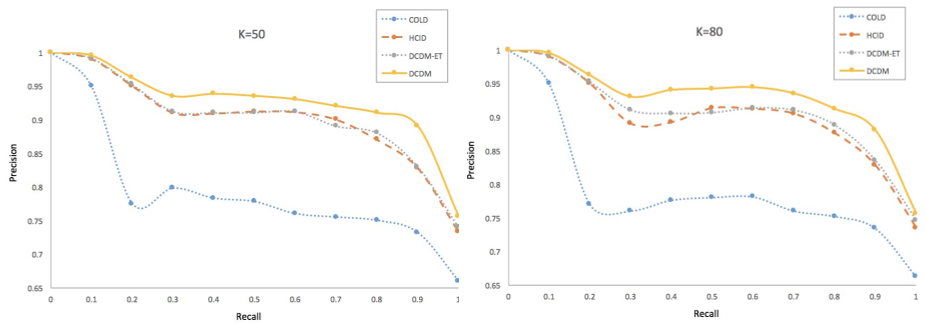 Fig 2: Precision-Recall Curve (PRC) showing DCDM outperforming all benchmarks.
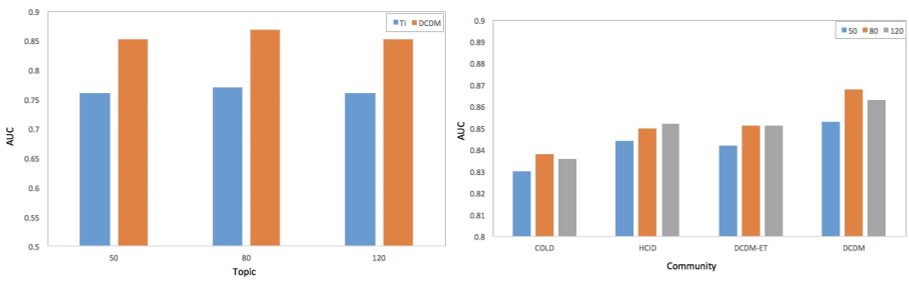 Fig 3: AUC Result showing superior performance across different topic/community counts.
Critical Insight & Conclusion
The primary takeaway is that who influences you determines how you express yourself. By segregating "expression trends" into self-driven versus friend-influenced categories, DCDM provides a more granular look at the mechanics of Virality.
Limitations: While DCDM excels at semantic capture, it relies on collapsed Gibbs Sampling, which can be computationally intensive as the number of communities and time slices grows. Future iterations might explore variational inference or amortized inference using neural networks to scale to millions of users.
Future Outlook: The concept of "Expression Trends" is a powerful inductive bias that could be integrated into modern Transformer-based recommendation systems to better handle the rapid "concept drift" found in viral social media contexts.