
MODM: Beyond Single-Objective Spread—Simulating Multi-Dimensional Information Flow in Social Networks
MODM: multi-objective diffusion model for dynamic social networks using evolutionary algorithm
The paper introduces the Multi-Objective Diffusion Model (MODM), a framework for simulating complex information spread in dynamic social networks using an Evolutionary Algorithm (EA). Unlike traditional models that focus on a single piece of information, MODM optimizes multiple objectives—score, influence, and diversity—achieving a richer and more realistic representation of information exchange.
TL;DR
Information in social networks doesn't travel in a vacuum. Most existing models fail because they only track one "flavor" of data. MODM (Multi-Objective Diffusion Model) changes the game by using Evolutionary Algorithms to simulate the simultaneous spread of independent, competing, and mutually exclusive information, evaluating individuals not just by their connections, but by their information "worth."
The Problem: The Over-Simplicity of Single Objectives
Traditional models like Independent Cascade (IC) and Linear Threshold (LT) treat users as binary switches: you are either "active" or "inactive." This creates a bottleneck in network analysis. In the real world, you might receive news, gossip, and product advice at the same time. Some information you ignore, some you adopt, and some you swap for "better" versions (competing information).
Existing heuristics also struggle with parameter estimation; they require edge probabilities that rarely exist in real data. The authors argue that a single-objective view is inadequate for the nonlinear complexity of human communication.
Methodology: Evolution as a Diffusion Engine
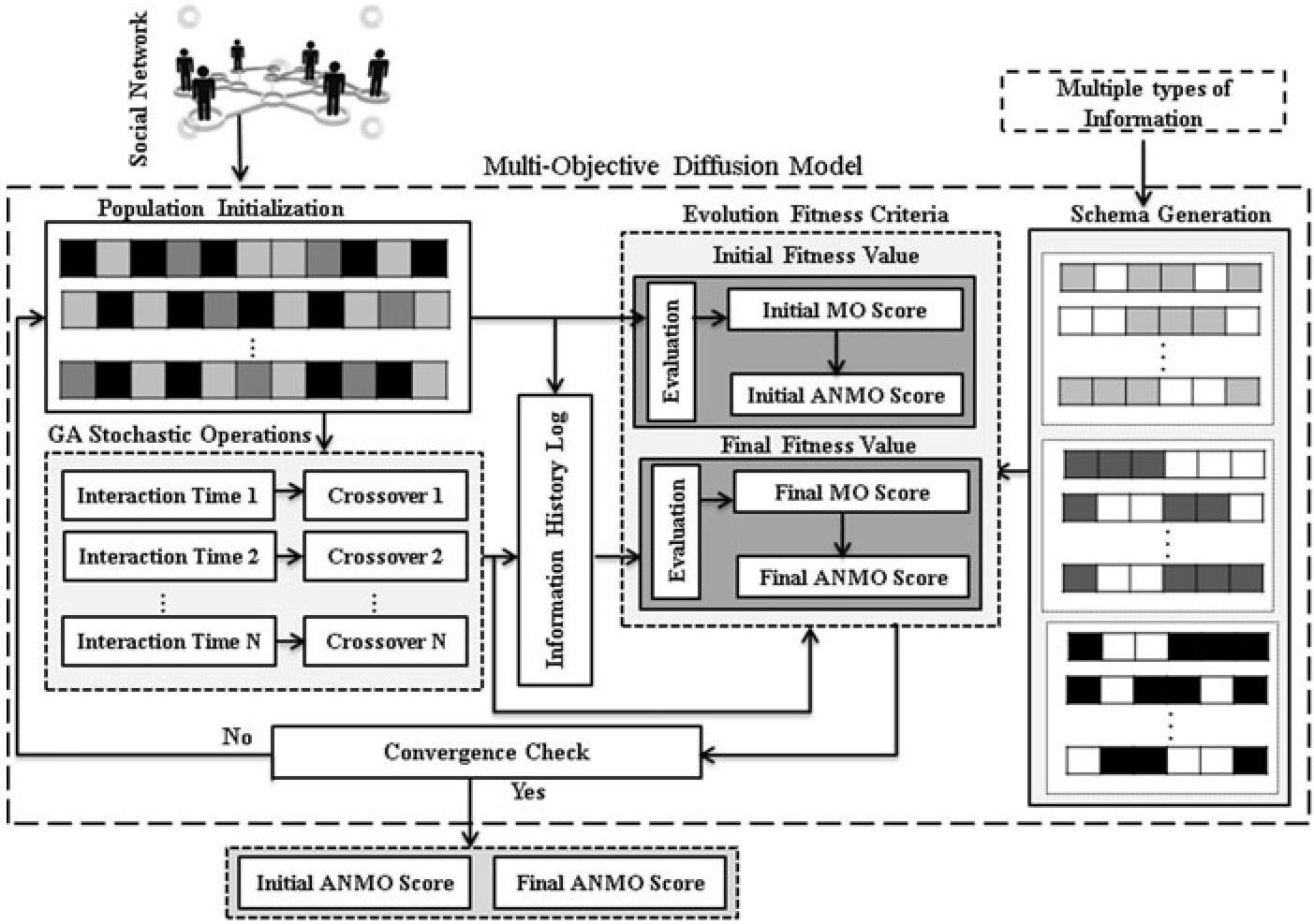
The core insight of MODM is to treat the diffusion process as a Multi-Objective Optimization Problem. Here is how it works:
1. The Genetic Representation
Each individual in the network is a chromosome (binary string). Information is encoded as specific "schemas" within that string.
- Independent: Can be held simultaneously.
- Mutually Exclusive: Choosing one blocks others.
- Competing: High-score information can replace lower-score versions.
2. Multi-Objective Fitness Function
Instead of just counting "active" nodes, MODM assesses an individual's Information Worth through three lenses:
- Score (): The inherent value of the information.
- Influence (): How many times they’ve encountered/shared it.
- Diversity (): How many different types of info they hold.
3. Stochastic Operations
The "crossover" operation in the GA models the actual interaction (e.g., an email or a conversation). When two individuals interact, they swap segments of their chromosomes, effectively "exchanging" information.
Experimental Insights: Topology vs. Information Worth
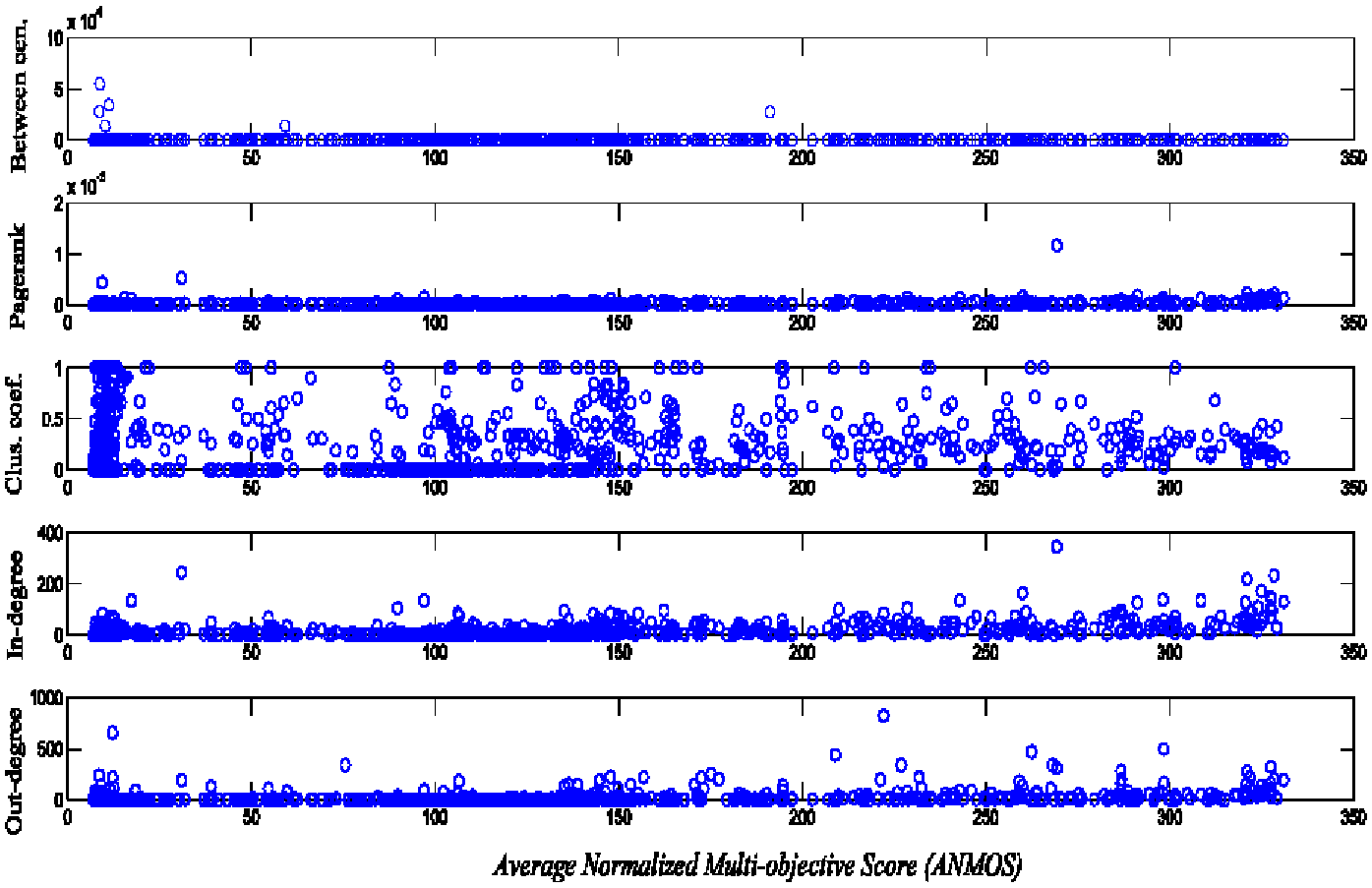
Using the Enron Email Dataset, the authors calculated the Average Normalized Multi-Objective (ANMO) score for over 80,000 nodes.
Key Result: The "Hidden" Influentials
The most striking finding was the weak correlation between the ANMO score and conventional metrics. You might assume that someone with a high In-degree (someone who receives a lot of emails) is an information powerhouse. The data says otherwise:
- Correlation with In-degree: 0.41
- Correlation with PageRank: 0.18
- Correlation with Betweenness: -0.006
This suggests that being "central" in a graph doesn't necessarily make you good at processing or diversifying information.
Critical Analysis & Conclusion
Takeaway
MODM proves that multi-objective optimization is better at identifying individuals who are "naturally" better connected for receiving diverse information, regardless of where the diffusion starts. It provides a flexible framework where researchers can weight specific objectives (Score vs. Diversity) depending on the use case.
Limitations & Future Work
While MODM is a significant leap toward realism, it still relies on fixed crossover operations. The authors suggest that Genetic Programming could be the next step—allowing the model to actually learn the diffusion rules from observed data rather than using predefined ones.
In an era of "infodemics" and complex social engineering, MODM offers a more sophisticated toolkit for understanding how ideas actually survive and thrive in the digital wild.