
MODU: Bridging the Empathy Gap for Children with MID and BIF Through Interactive Storytelling
MODU: A Story-Based Empathy Expression Training Game for Children with Mild Intellectual Disability and Borderline Intellectual Functioning
This paper introduces MODU, a story-based serious game designed to train emotion recognition and empathy expression in children with Mild Intellectual Disability (MID) and Borderline Intellectual Functioning (BIF). By integrating interactive fairy tales with face-tracking technology (Spark AR), the system provides a platform for children to practice context-appropriate facial responses within a controlled, digital learning environment.
TL;DR
Researchers have developed MODU (e'MO'tion e'DU'cation), a tablet-based serious game that transforms the traditional "reading time" into an interactive empathy training lab. Designed for children with Mild Intellectual Disability (MID) and Borderline Intellectual Functioning (BIF), MODU uses AR-powered face tracking to help children recognize and mimic the emotions of storybook characters, turning passive consumption into active social-emotional learning.
Background & Motivation: The "Hidden" Struggle of BIF
While children with severe disabilities are often identified early, those with MID or BIF (Borderline Intellectual Functioning) often appear "typically developing" during preschool. The crisis hits at school age, where a lack of ability to interpret social cues leads to aggressive behavior and social isolation.
The authors identified a critical gap: existing serious games mostly focus on Autism (ASD) or simple Emotion Recognition (pointing at a face). There was a dire need for a tool that teaches Empathy Expression—the act of physically responding to another's emotion—within a meaningful narrative context.
Methodology: The Architecture of Empathy
MODU is built on two pillars: Storytelling and Interactive Feedback.
1. The Narrative Engine
The game utilizes a simplified version of "The Goose and the Golden Egg," divided into seven scenes. Each scene is designed to trigger a specific affective response. To accommodate MID/BIF users, the UI uses large fonts, color-coded emotion words, and cartoon-style illustrations that reduce cognitive load.
2. The Empathy Game (AR Interaction)
The system uses the tablet's front-facing camera to map facial landmarks. When a character feels an emotion (e.g., the Farmer is "Sad" because the goose is gone), the child must "empathize" by making a sad face.
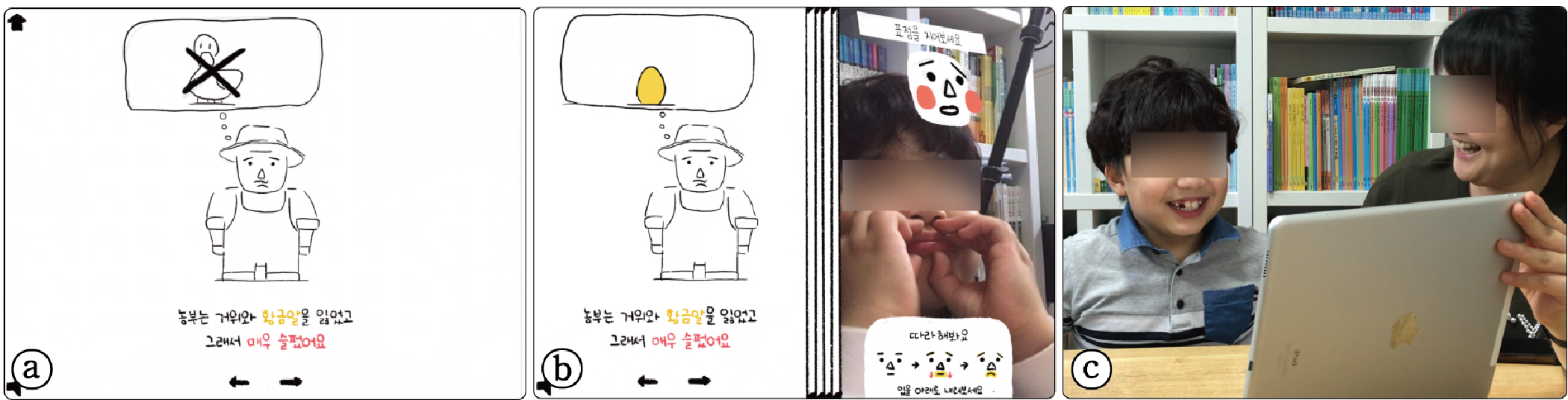 Figure 1: (a) Story scene; (b) The Empathy Game UI with facial guidance; (c) Joint play between parent and child.
Key Technical Features:
- Scaffolded Success: If a child fails to mirror an emotion, the system provides visual guides (e.g., "Lower the inside of your eyebrows").
- Real-time Avatar: A 2D avatar on the child's forehead in the video feed provides immediate visual confirmation of their facial movements.
Experimental Results: Beyond Just a Game
The study involved a case study of siblings with MID/BIF and their mother. The findings revealed a shift in the educational paradigm:
- Voluntary Engagement: Unlike paper books, which children with MID often struggle to focus on due to comorbid ADHD traits, MODU encouraged independent, voluntary play (see Figure 3).
- Reduced Parental Burnout: The mother reported that "forcing" education usually leads to burnout. MODU allowed the mother to transition from a "director" to a "co-player," improving the parent-child bond.
- Contextual Learning: The story provided a "why" for the emotion, which the mother noted was far more effective than clinical drills.
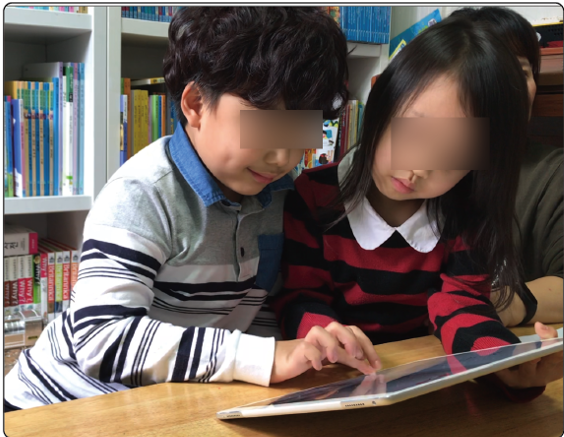 Figure 3: Children voluntarily engaging with MODU without adult intervention.
Critical Insight: Why This Matters
The brilliance of MODU lies not just in the AR technology, but in its Inductive Bias toward storytelling. For children with intellectual disabilities, social rules are often abstract and terrifying. By placing facial training within the safe "sandbox" of a well-known fairy tale, the researchers lowered the psychological barrier to social practice.
Limitations & Future Work
The current study is limited by a small sample size (a single pair of siblings). While the qualitative results are promising, larger-scale longitudinal studies are needed to see if these "in-game" empathy expressions translate to real-world playground interactions.
Conclusion
MODU proves that Interaction Design (HCI) can be a powerful bridge in special education. By merging multi-sensory feedback with the ancient art of storytelling, we can provide children with MID and BIF the tools they need to navigate a socially complex world—one golden egg at a time.