
Cracking the Black Box: Modular Neural Networks for Governing Rural Cooperatives
Modular Neural Network Rule Extraction Technique in Application to Country Stock Cooperate Governance Structure
The paper introduces a modular neural network rule extraction technique designed to transform "black-box" neural knowledge into interpretable symbolic rules. Applied to the governance of Chinese Country Stock Cooperatives, it utilize a "divide-and-conquer" architecture (GPCMNN) to analyze how administrative composition impacts corporate performance.
TL;DR
Neural networks are often criticized for being "black boxes." This paper introduces a modular framework to dismantle this box by breaking down complex datasets into sub-tasks, training individual neural modules, and then extracting transparent symbolic "if-then" rules. The researchers applied this to the governance of Chinese Country Stock Cooperatives, revealing exactly which leadership traits—like education vs. seniority—actually drive corporate profit.
Background & Motivation: The Interpretable AI Gap
While monolithic neural networks are powerful, they suffer from a lack of reproducibility and "forgetting" during initialization. More importantly, their knowledge is spread across thousands of weights, making it impossible for a human to understand why a model reached a certain conclusion.
In the domain of Country Stock Cooperatives—a unique Chinese economic pattern where farmers suddenly become capital managers—transparency is vital. To improve performance, we don't just need to predict profits; we need to extract the "rules" of success that policy-makers can follow.
Methodology: The Divide-and-Conquer Framework
The researchers utilize a Parallel Cooperative Modular Neural Network (GPCMNN) architecture. The process follows four distinct stages:
- Data Preparation (DPM): Standard cleaning and normalization using a sigmoid-based scaling to prepare socio-economic variables.
- Decomposition (DM): The task is split into sub-data sets based on attributive variables (e.g., profit levels).
- Sub-Task Nets (STN): Each module is a 3-layer feedforward network. Once trained, a specialized algorithm scans the weights () and biases to produce original symbolic rules.
- Ensemble Module (EM): Redundant or conflicting rules are filtered, and logical "OR" operations combine similar antecedents to create a final, streamlined rule set.
Architecture Overview
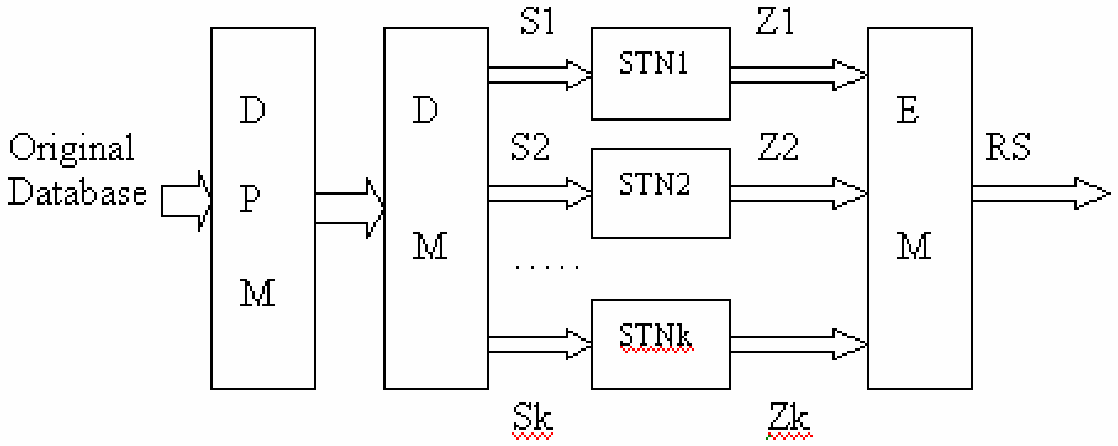 The modular approach allows for parallel training, significantly increasing efficiency compared to monolithic structures.
Extracting the "Truth" from Weights
The core innovation lies in the mathematical extraction of rules. For each hidden node , a rule is generated if:
Where represents the reliability parameter. This turns abstract floating-point weights into a concrete linguistic format:
If (Variable A > M) and (Variable B < L) -> THEN (Profit = High)
Experimental Insights: What Drives Success?
The study analyzed 300 data groups from villages in Guangzhou, exploring 22 independent variables including labor force, educational levels, and stock structures.
| Data Sets | STN Structure | No. of STNs | Final Rules (cf=1) |
|---|---|---|---|
| Basis, Stock, Profit (A, B, H) | 9-2-1 | 6 | 10 |
| Basis, Directors, Profit (A, C, H) | 11-2-1 | 6 | 16 |
Key Discoveries:
- Education is King: The educational level of the board of directors and party branch members is the strongest predictor of high capital profit.
- The Seniority Myth: Interestingly, the "working years" (seniority) of administrators were found to be nearly irrelevant to actual profit margins.
- Labor Ratio: Higher proportions of labor force and villager educational levels directly correlate with improved corporate performance.
Critical Analysis & Conclusion
This paper successfully demonstrates that modularity is not just a tool for computational efficiency, but a prerequisite for Interpretable AI. By partitioning the problem space, the authors avoided the "confusion" of monolithic training and extracted rules that provide genuine socio-economic value.
Limitations: The model relies on a relatively small dataset (300 samples) by modern standards. Furthermore, the rule extraction assumes a sigmoid hidden layer and linear output, which might limit its application to more modern activation functions like ReLU or Swish without modification.
Future Work: This technique could be revolutionary if applied to modern Legal-Tech or FinTech sectors, where understanding the logic behind a credit score or a legal judgment is just as important as the result itself.