
Re-Engineering the Green Revolution: How the GRF4-DELLA Pivot Solves the Nitrogen Dilemma
Modulating plant growth–metabolism coordination for sustainable agriculture
The study identifies GRF4 (GROWTH-REGULATING FACTOR 4) as a master transcriptional regulator that integrates plant growth with nitrogen and carbon metabolism. By modulating the balance between GRF4 and the growth-inhibitor DELLA, researchers successfully uncoupled high nutrient-use efficiency (NUE) from yield-reducing stem elongation in Green Revolution cereal varieties.
TL;DR
The "Green Revolution" gave us high-yielding semi-dwarf crops but at a hidden cost: poor nitrogen-use efficiency (NUE). This paper, published in Nature, reveals that the GRF4 transcription factor is the "missing link" that can restore nitrogen and carbon metabolism in these varieties without sacrificing their beneficial short stature. By tipping the scales of the GRF4-DELLA interaction, researchers have created rice and wheat that thrive with less fertilizer.
The Hidden Cost of Semi-Dwarfism
For decades, the agricultural industry has relied on Green Revolution Varieties (GRVs) that contain mutant alleles (like sd1 in rice or Rht in wheat). These mutations cause an accumulation of DELLA proteins, which act as "brakes" on plant growth. While this prevents plants from falling over (lodging), it also inadvertently suppresses their ability to absorb nitrogen.
The result? To get the high yields these plants are capable of, farmers must "brute-force" the system with massive amounts of nitrogen fertilizer, leading to severe water pollution and greenhouse gas emissions.
The Discovery: GRF4 as a Metabolic Master Switch
Through a rigorous map-based cloning of rice varieties, the researchers identified GRF4 as a semi-dominant quantitative trait locus (QTL) that promotes nitrogen uptake.
The Growth-Metabolism Seesaw
The core of this paper’s insight is the physical antagonism between two proteins:
- GRF4: A promoter of nitrogen assimilation, carbon fixation, and cell proliferation.
- DELLA: A growth repressor that physically binds to GRF4 and prevents it from working with its co-activator, GIF1.
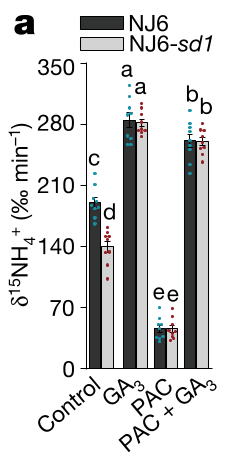 In GRVs (bottom), high DELLA levels block GRF4, leading to low NUE. By increasing GRF4 (top), the balance is restored.
Methodology: How GRF4ngr2 Bypasses the System
The authors discovered a specific "rare allele" called GRF4ngr2. This version of the gene has mutations that prevent miR396 (a microRNA) from slicing its mRNA. Consequently, the plant produces more GRF4 protein.
Molecular Mechanism
- Transcription Activation: GRF4 binds to a specific GGCGGC motif in the promoters of nitrogen-transporter genes (like AMT1.1) and carbon-fixation genes.
- Competitive Inhibition: DELLA doesn't stop GRF4 from binding to DNA; instead, it prevents GRF4 from recruiting GIF1, effectively "silencing" the activation command.
 ChIP-seq and EMSA assays (shown above) confirm GRF4's direct binding to nitrogen metabolism gene promoters.
Experimental Breakthroughs
The researchers tested their theory by introducing the high-abundance GRF4 allele into elite Green Revolution varieties of both rice and wheat.
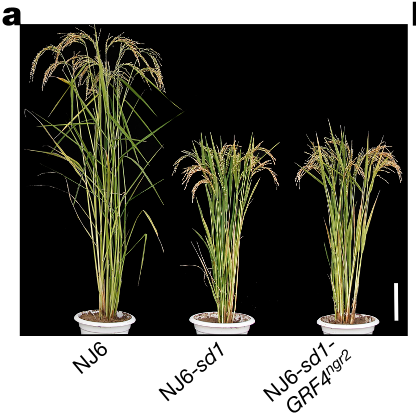
- In Rice: The NJ6-sd1-GRF4ngr2 isogenic line maintained its dwarf phenotype (lodging resistance) but saw a dramatic increase in nitrogen uptake rates and grain yield, especially under low-nitrogen supply.
- In Wheat: Transgenic wheat (KN199 variety) showed increased culm diameter (stronger stems), longer spikes, and significantly higher biomass and grain nitrogen content.
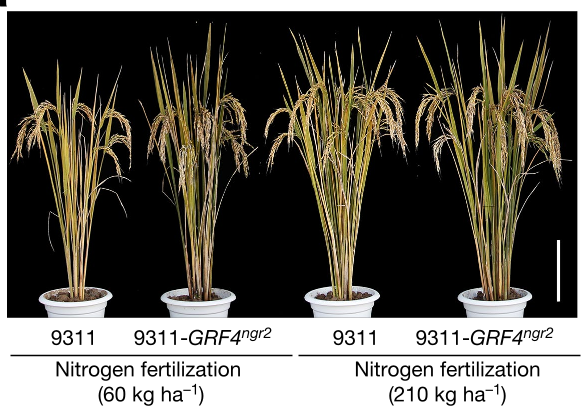 Figure 5 demonstrates that increased GRF4 boosts yield and NUE in both rice (a-f) and wheat (g-q) without causing height increases.
Deep Insight: Why This Matters
The brilliance of this work lies in uncoupling. Usually, plant height and nitrogen uptake are positively correlated—if you want more of one, you get more of the other. By understanding the specific co-regulatory mechanism of GRF4-DELLA, the authors essentially "hacked" the plant's internal logic.
They proved that biomass increases don't have to go into vertical height (which causes lodging); they can be directed into culm thickness, leaf width, and grain filling.
Conclusion & Future Outlook
This study marks a significant shift toward "Sustainable Agriculture 2.0."
- Takeaway: We no longer have to choose between high-yield dwarf crops and environmental health.
- Limitations: While GRF4 increases yield in moderate-to-low nitrogen, the long-term ecological impact of these high-efficiency varieties on soil microbial communities remains to be explored.
- Future Work: This genetic pivot (GRF4-DELLA) is likely present in many other crop species, opening the door for CRISPR-based editing of various staples to reduce global fertilizer reliance.
Primary Source: Li, S., et al. "Modulating plant growth–metabolism coordination for sustainable agriculture." Nature (2018).