
Molecular GA Pathways: The Conserved Integrators for Adaptive Plant Growth
Molecular GA pathways as conserved integrators for adaptive responses
This review article clarifies the molecular mechanisms of Gibberellins (GAs) as master integrators of plant growth and environmental adaptation. It highlights the GA/GID1/DELLA protein complex as a conserved hub that balances endogenous hormonal crosstalk with exogenous stress signals to modulate plant development.
TL;DR
Gibberellins (GAs) are not just "growth hormones"; they are the primary currency of a plant's decision-making system. This review explores how the GA/GID1/DELLA complex integrates light, temperature, and nutrient signals to decide whether a plant should grow taller to escape shade or stop growing to survive a frost.
The Core Conflict: Growth vs. Survival
For a sessile organism, growth is a gamble. Speeding up development in the wrong environment (like a drought) is fatal. The plant needs a "molecular judge" that can weigh internal signals (hormones like Auxin and ABA) against external cues (salt, cold, light). The GA signaling pathway, specifically the DELLA protein, acts as this judge.
DELLA proteins are growth repressors. When they are present, they sequester transcription factors, effectively "locking" the plant's growth programs. To grow, the plant must produce bioactive GA, which triggers the destruction of these DELLA "locks."
Methodology: The GA-GID1-DELLA Switch
The mechanism is an elegant molecular machine:
- Perception: Bioactive GA binds to the GID1 receptor.
- Conformation: Binding causes a lid on GID1 to close, creating a specialized surface.
- Recruitment: This new surface attracts the DELLA protein.
- Degradation: Once bound in a tricomplex, an E3 ubiquitin ligase (like SLY1) labels the DELLA protein for destruction by the 26S proteasome.
 Fig 1: A focus on DELLA protein domains and the molecular interaction that leads to their inactivation.
Integration of Environmental Cues
The power of the GA pathway lies in its sensitivity to the environment. The review details how every major environmental stressor "plugs into" this circuit:
- Light: Red light induces GA synthesis to trigger germination, while shade triggers GA-mediated elongation to reach the sun.
- Temperature: Warm temperatures promote GA-driven growth, while cold induces GA2ox (catabolism enzymes) to lower GA levels, stabilize DELLAs, and halt growth for protection.
- Nutrients: Iron and Nitrogen levels directly influence either the synthesis of GA or the stability of the DELLA proteins.
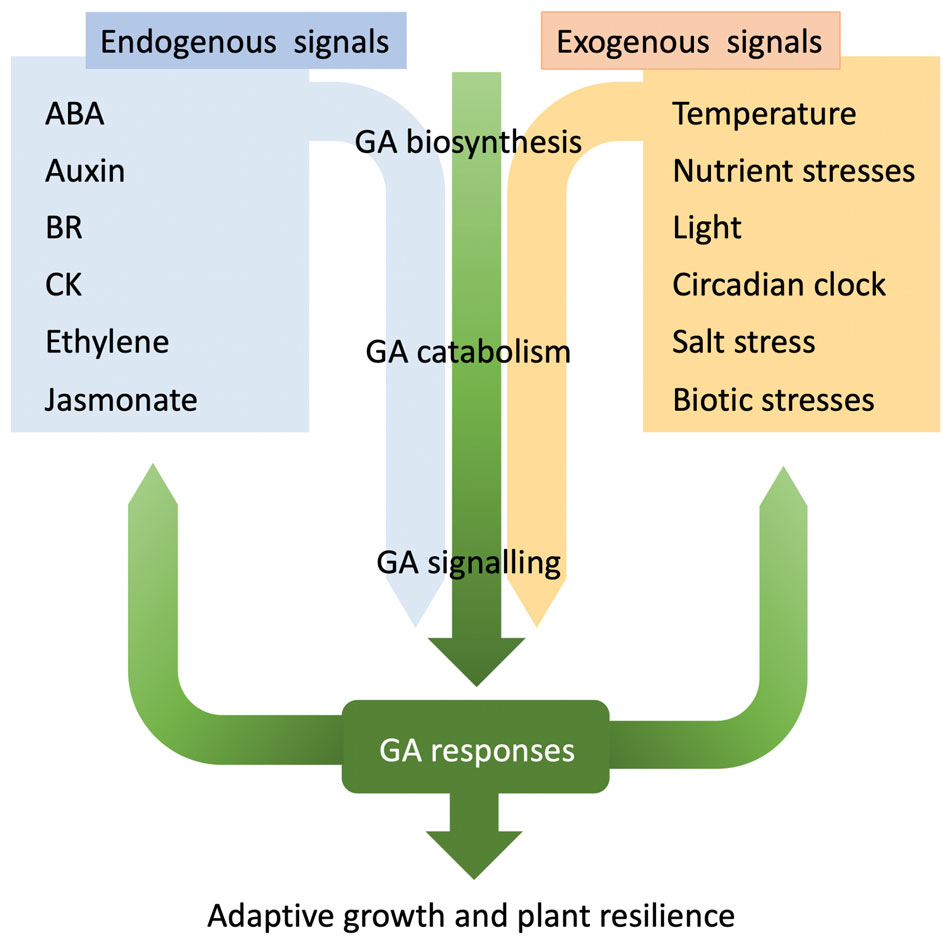 Fig 2: The complex crosstalk between endogenous hormones and exogenous stresses integrated by GA pathways.
Evolutionary Insight
Interestingly, the "logic" of growth repression existed before the "switch." Studies in mosses (Physcomitrium patens) show that while they have DELLA-like proteins that can repress growth, they lack the GID1-mediated GA sensitivity found in vascular plants. The evolution of the GA/GID1/DELLA triad was a pivotal moment that allowed plants to develop complex vascular systems and adaptive responses to move from water to land.
Critical Analysis & Future Outlook
While the GA/GID1/DELLA model is robust, the review highlights a growing frontier: GA-independent DELLA regulation. Proteins like COP1 (light signaling) and GI (circadian clock) can interact with DELLAs directly.
Takeaway for the Industry: In the face of climate change, the goal of modern agriculture is to create "climate-resilient" crops. By precisely manipulating the GA-metabolism "gatekeepers" (like GA20ox or GA3ox), researchers can potentially decouple growth from environmental stress, allowing crops to maintain yields even under suboptimal conditions.
Summary Table of Hormonal Crosstalk
| Hormone | Interaction with GA | Biological Effect |
|---|---|---|
| Auxin | Synergistic | Promotes GA synthesis to drive root/hypocotyl elongation |
| ABA | Antagonistic | Inhibits GA to maintain seed dormancy |
| Ethylene | Antagonistic | Reduces GA levels to delay flowering/growth |
| Brassinosteroids | Synergistic | Direct activation of GA synthesis genes (GA20ox1) |