
RBNN: Redefining Biomedical Event Extraction for Cystic Fibrosis via Radial Belief Networks
Extraction of the molecular level biomedical event trigger based on gene ontology using radial belief neural network techniques
This paper introduces the Radial Belief Neural Network (RBNN), a hybrid architecture designed for molecular-level biomedical event trigger extraction, specifically targeting Cystic Fibrosis research. By combining unsupervised feature learning via Restricted Boltzmann Machines (RBM) with supervised Back Propagation Neural Networks (BPNN) and Reinforcement Learning (RL) based ruleset generation, it achieves state-of-the-art performance in identifying disease-related event triggers.
TL;DR
Extracting molecular triggers from medical literature is a notoriously difficult NLP task due to the specialized terminology and complex event relations. This paper presents Radial Belief Neural Networks (RBNN), a hybrid model that uses unsupervised learning to "understand" genetic data and Reinforcement Learning to "rule" over it. Reaching 95.5% accuracy, it sets a new benchmark for identifying the molecular triggers of Cystic Fibrosis.
Background & Motivation: The "Trigger" Challenge
In biomedical text mining, an "event" is a change in the state of a protein or cell. These events are heralded by "triggers"—specific verbs like expression or stimulus. For a localized disease like Cystic Fibrosis (CF), which involves complex malfunctions of the CFTR protein, identifying these triggers is a bottleneck.
Previous researchers faced a wall: traditional models (SVM, Fuzzy Logic) yielded nearly 60% extraction error rates. The hand-crafted features used to train these models lacked the depth to navigate the intricate Gene Ontology (GO) bio-systems.
Methodology: The RBNN Architecture
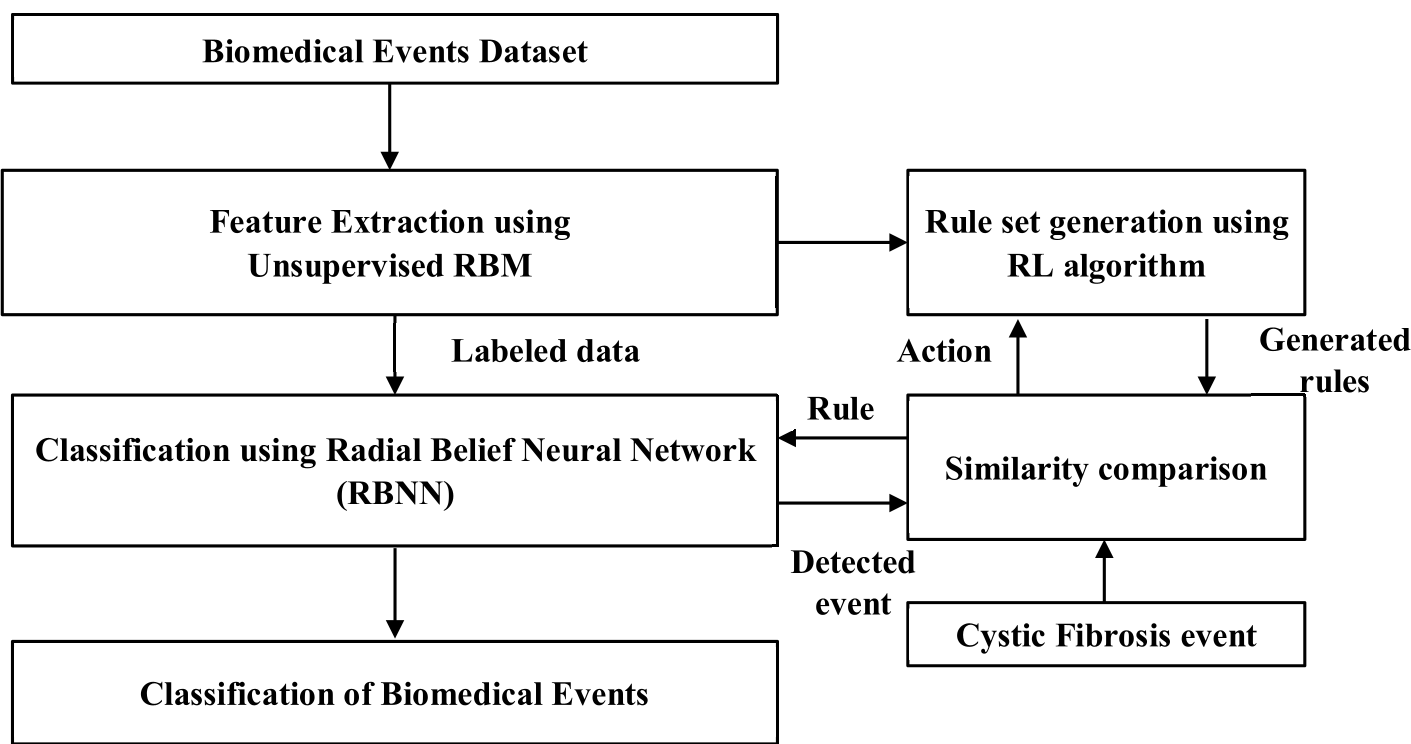
The proposed RBNN isn't just a simple neural network; it is a multi-stage pipeline designed to minimize human intervention while maximizing semantic extraction.
1. The RBM Feature Extractor (Unsupervised)
The model starts with Restricted Boltzmann Machines (RBM) stacked as a feature extractor. The RBM uses a stochastic approach to learn the joint probability distribution of input sequences (DNA structures and clinical text) without needing labels initially.
2. The RL Ruleset Generator (The "Smart" Layer)
Unlike standard black-box models, the authors added a Reinforcement Learning (RL) unit. Using an action-reward mechanism, it generates IF-THEN rules. This allows the model to justify its decisions—an essential trait for medical applications where "why" matters as much as "what."
3. BPNN Classifier (Supervised)
Finally, a Back Propagation Neural Network (BPNN) acts as the classification layer, fine-tuning the weights based on labeled data and the ruleset generated previously.
Experimental Results: Precision Meets Speed
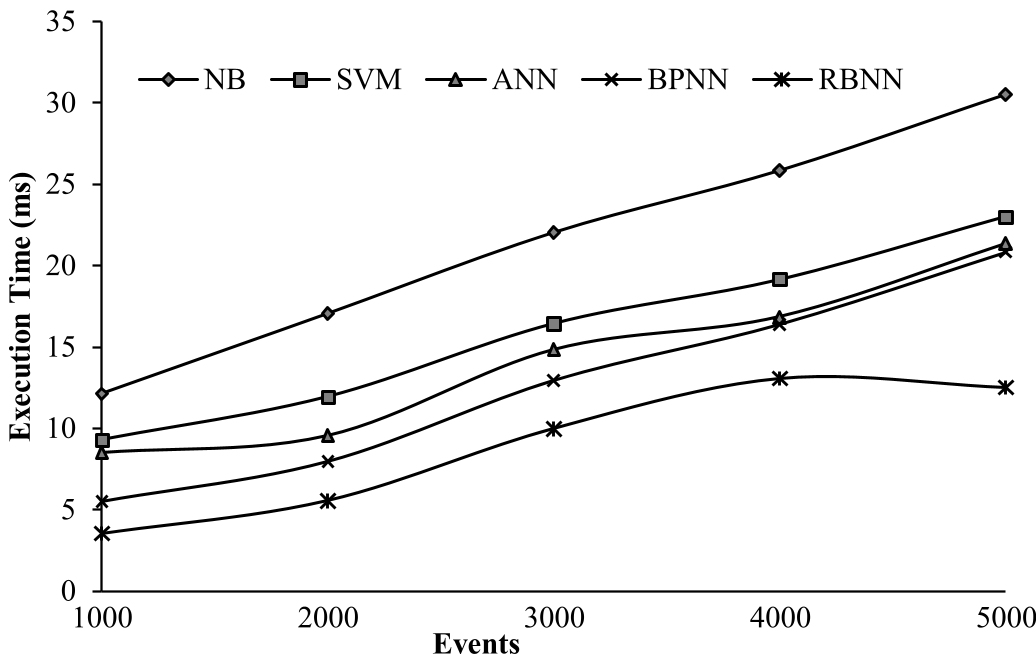
The model was validated against the CF.CSV and GENIE datasets. The results were categorized by "Events" (data volume), showing that RBNN scales better than any predecessor.
Performance Metrics
- Accuracy: RBNN reached 95.50%, compared to 81.99% for Naive Bayes and 85.01% for SVM.
- Efficiency: As the number of events increased to 5000, RBNN maintained a low Mean Absolute Error (MAE) compared to other models.
- Sensitivity: The ability to find genuine triggers was consistently higher, confirming that the RBM layers effectively captured deep semantic relationships.
Critical Analysis: Why it Works
The success of RBNN lies in its hybrid nature.
- Inductive Bias: By using RBMs for pre-training, the model gains an inductive bias about the structure of biomedical language before it even sees a label.
- Symbolic Integration: The IF-THEN rules act as a filter, preventing the neural network from "hallucinating" or making illogical local trigger associations.
Limitations
While powerful, the model’s performance degrades slightly as the event count peaks (near 5000 events), suggesting a potential memory bottleneck in the current RBM stacking strategy. Furthermore, the reliance on Reinforcement Learning for ruleset generation increases the complexity of the initial training phase.
Conclusion & Future Outlook
The RBNN model represents a significant leap for Cystic Fibrosis research, providing a bridge between raw genetic data and actionable clinical insights. Moving forward, integrating this architecture with Large Language Models (LLMs) like GPT-4 or BioBERT could potentially automate the entire pipeline from literature review to therapeutic target discovery.
Keywords: Radial Belief Neural Networks, Cystic Fibrosis, Gene Ontology, Biomedical Event Extraction, Reinforcement Learning.