
The GA–GID1–DELLA Module: Molecular Logic of the Green Revolution and Plant Evolution
Review The Molecular Mechanism and Evolution of the GA-GID1-DELLA Signaling Module in Plants
This review elucidates the molecular mechanism of the GA–GID1–DELLA signaling module, highlighting how bioactive Gibberellins (GAs) trigger the degradation of DELLA growth repressors via the GID1 receptor and the SCF-SLY1/GID2 ubiquitin-proteasome pathway. It establishes this module as a central hub for integrating environmental cues and evolutionarily traces its origin to vascular plants.
Executive Summary
TL;DR: This article provides a comprehensive synthesis of the Gibberellin (GA) perception mechanism, centered on the GA–GID1–DELLA signaling module. It details how bioactive GAs act as allosteric inducers for the GID1 receptor, leading to the targeted degradation of DELLA proteins—the "brakes" of plant growth.
Context: This work serves as a definitive technical anchor in plant biology, bridging the gap between structural biochemistry (X-ray crystallography) and evolutionary phylogeny (from mosses to flowering plants).
The "Brakes" and the "Accelerator": Problem & Motivation
For decades, the "Green Revolution" relied on semi-dwarf varieties of rice and wheat. We knew these traits were linked to GA, but the internal "switch" remained elusive. The core problem was twofold:
- Mechanism: How does a small diterpene hormone like GA trigger the destruction of a large nuclear repressor (DELLA)?
- Evolution: Why do primitive plants like mosses (Physcomitrella patens) produce GA precursors but don't respond to bioactive GAs like GA1 or GA4?
The author posits that the GA–GID1–DELLA module isn't just a linear pathway but a regulatory hub that evolved to allow vascular plants to link their stature to environmental signals.
Methodology: The "Lid" Mechanism of GID1
The most striking insight comes from the structural analysis of the GID1 receptor. Unlike the auxin receptor (TIR1), which uses the hormone as "molecular glue," GID1 undergoes a massive conformational shift.
1. The Allosteric Switch
When a bioactive GA enters the binding pocket of GID1 (an -hydrolase fold), it induces the N-terminal extension (N-Ex) to fold over the pocket like a lid.
2. Recruiting the Repressor
Only after this "lid" is closed can the DELLA protein bind to the exterior of the GID1-GA complex. This creates a high-affinity interface for the SCF-SLY1/GID2 E3 ligase, marking DELLA for destruction by the 26S proteasome.
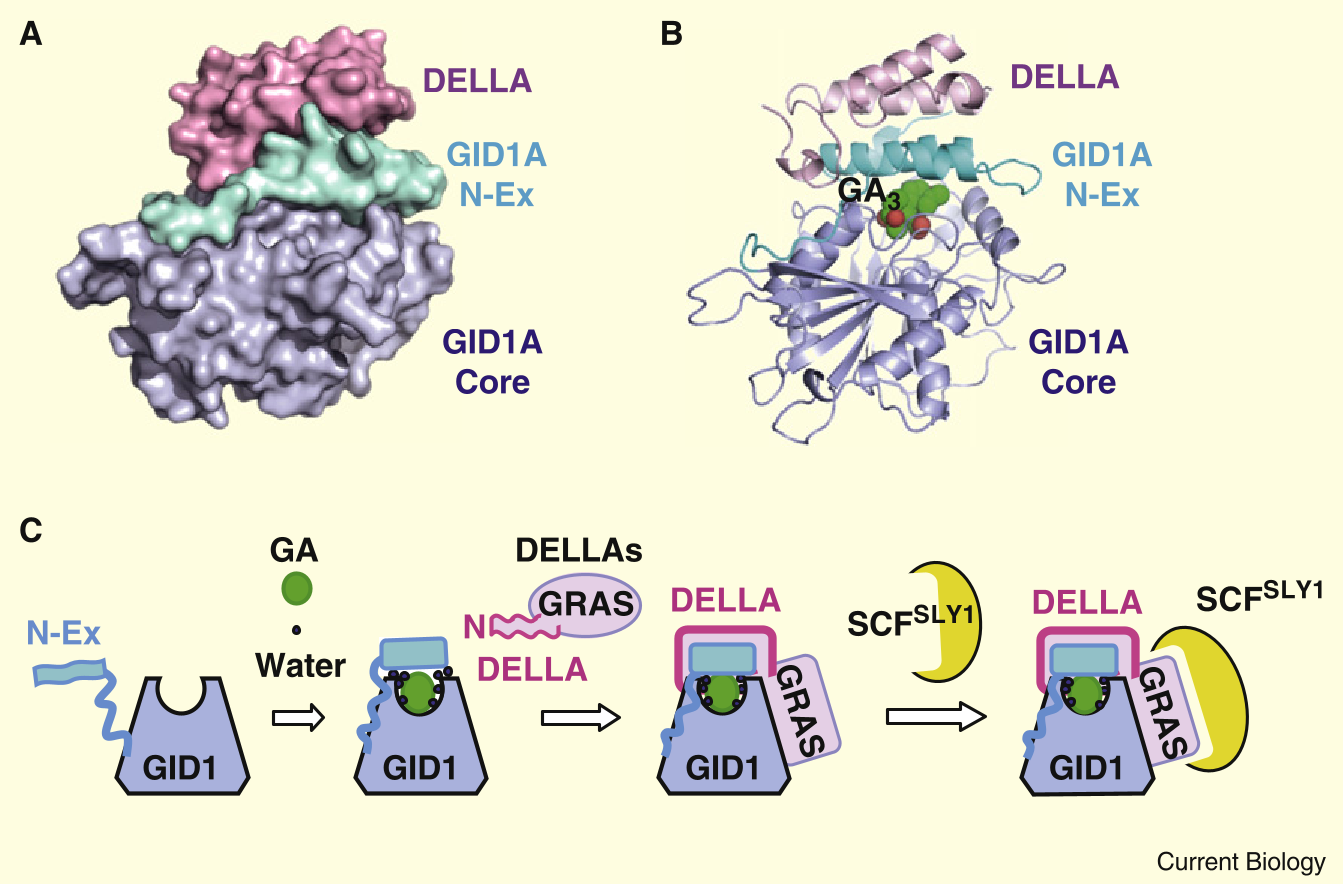 Figure: The transition from GA binding to the recruitment of the SCF-SLY1 complex via the closed-lid conformation of GID1.
Evolutionary Insights: Divergence in Land Plants
The paper highlights a fascinating evolutionary "missing link."
- Bryophytes (Mosses): They have GID1-like and DELLA-like genes, but they don't interact. Growth is regulated by unknown ent-kaurene derivatives instead of common GAs.
- Lycophytes (Selaginella): This is where the module first appears in functional form. Interestingly, lycophyte GID1s are "promiscuous"—they bind to a wider range of GAs than their sophisticated angiosperm counterparts.
Life After Degradation: The DELLA Interactome
If DELLA were only a growth repressor, the story would be simple. However, the author shows that DELLA is a multi-tool protein.
- Light Signaling: DELLA binds to PIFs (Phytochrome Interacting Factors), preventing them from activating elongation genes.
- Defense: DELLA binds to JAZ proteins, modulating the balance between growth and Jasmonic Acid-mediated defense.
- Homeostasis: DELLA actually promotes the transcription of GA biosynthetic genes (GA20ox), creating a robust negative feedback loop to maintain hormone levels.
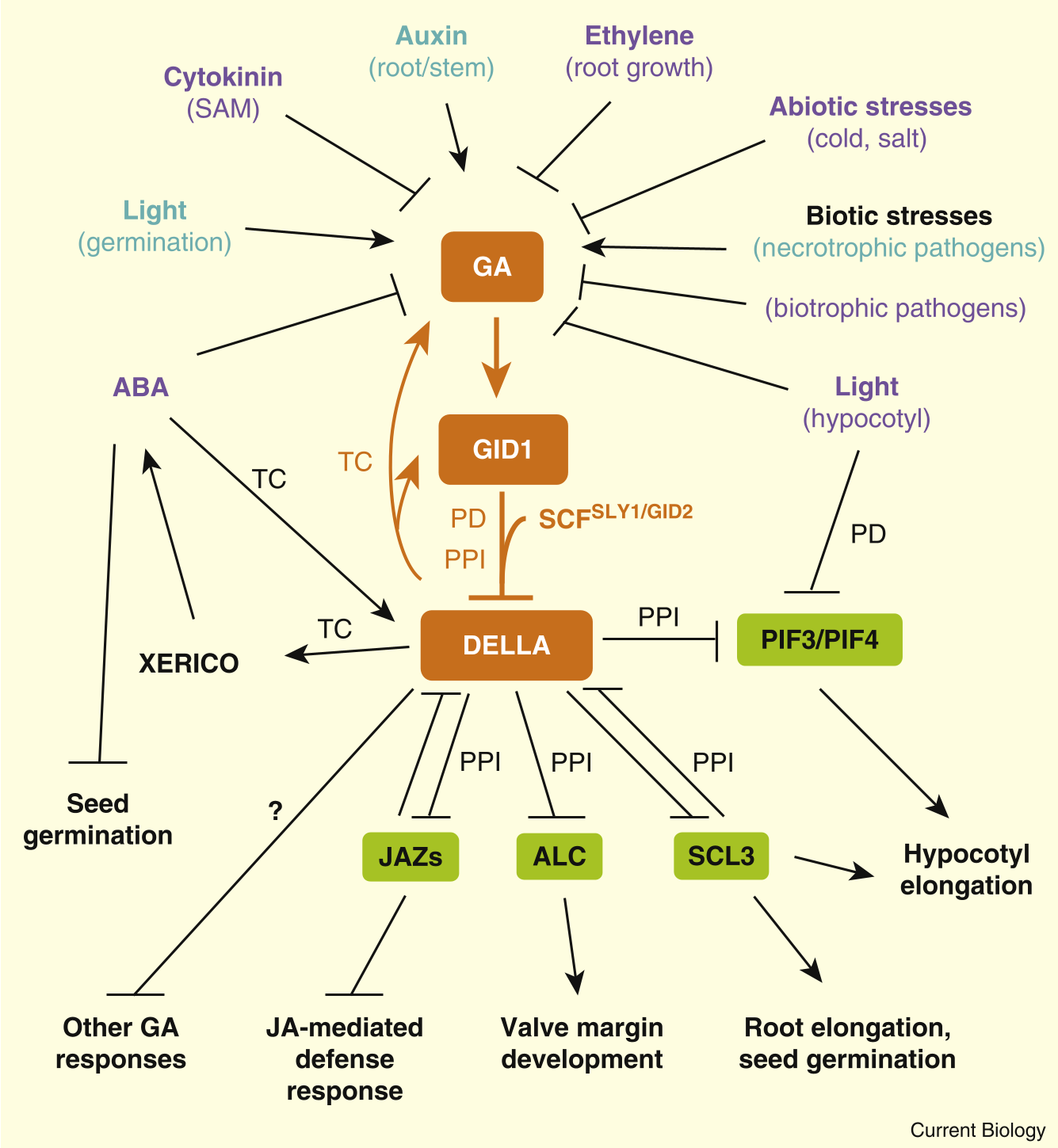 Figure: The complex crosstalk where DELLA integrates hormone, light, and stress signaling.
Critical Analysis & Future Directions
Takeaway: The "Inhibitor of an Inhibitor" logic (GA inhibits GID1's inhibition of DELLA, which inhibits growth) provides plants with a highly tunable system for plastic growth.
Limitations & Future Work:
- The "Unknown" Hormone: We still don't know the exact chemical structure of the diterpene that controls moss differentiation.
- Non-Proteolytic Pathways: Some evidence suggests GID1 can "sequester" DELLA and stop it from working even without destroying it. Understanding this could lead to more nuanced growth control in crops without relying on total protein turnover.
By viewing DELLA not just as a target for degradation, but as a scaffold for multiple transcription factors, this review redefines our understanding of how plants balance survival with expansion.