
MOI: Beyond Static Maps with "Moments of Interest" and Machine Learning
Moments of Interest: A novel cloud-based crowdsourcing application enhancing smart tourism recommendations
The paper introduces "Moments of Interest" (MOI), a novel cloud-based crowdsourcing framework and mobile application for smart tourism. It leverages Convolutional Neural Networks (CNNs) for image labeling to provide personalized recommendations based on the actual visual content of user-captured photos rather than static location data.
TL;DR
The tourism industry is evolving from "where to go" to "what is happening right now." This paper introduces Moments of Interest (MOI), a cloud-based system that uses Convolutional Neural Networks (CNNs) to analyze crowdsourced smartphone photos. By turning images into searchable "moments," the system provides real-time, personalized recommendations that capture the pulse of a city—from a sudden jazz concert to the collective "happiness level" of a specific square.
Problem & Motivation: The Fatigue of Static Data
Current smart tourism apps (like Google Maps) are excellent at finding places—restaurants, museums, or parks. However, they suffer from two major flaws:
- Data Overload: Users are overwhelmed by static lists of businesses.
- Temporal Blindness: A static POI (Point of Interest) cannot tell you if a food festival is happening at this very second or if a specific spot is currently vibrant or deserted.
The authors' insight is simple but powerful: Modern travelers take photos constantly. These photos contain latent data—labels, moods, and activities—that are far more descriptive than a 5-star rating.
Methodology: The "Memories Database"
The core of the system is a three-tier architecture designed to turn pixels into personalized suggestions.
- Crowdsourcing (Data Donors): Users contribute photos, timestamps, and sensor data (luminosity, pressure) to a cloud-based infrastructure.
- CNN Processing: Using TensorFlow-based Neural Networks, the system performs image labeling. A photo of a bike race isn't just "Location X"; it's labeled "Sports," "Competition," and "Outdoor."
- Search & Visualization: Recommendations are pushed to a map interface where markers represent dynamic MOIs.
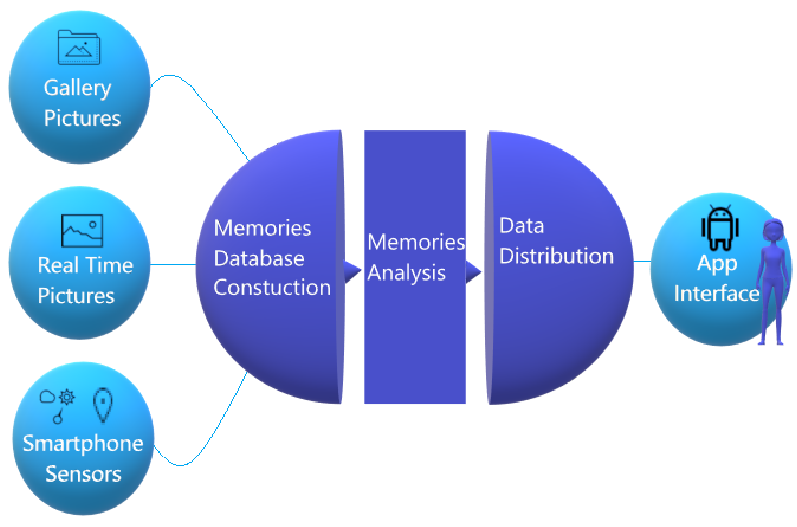 Fig 1. The workflow from image capture to cloud-based label distribution.
The CNN Engine
The paper utilizes a standard CNN stack (Convolution, Pooling, ReLU, and Fully Connected layers) to ensure high-level reasoning. By extracting low-level features (edges/curves) and building them into abstract concepts (labels), the app can categorize a "moment" with a specific degree of certainty.
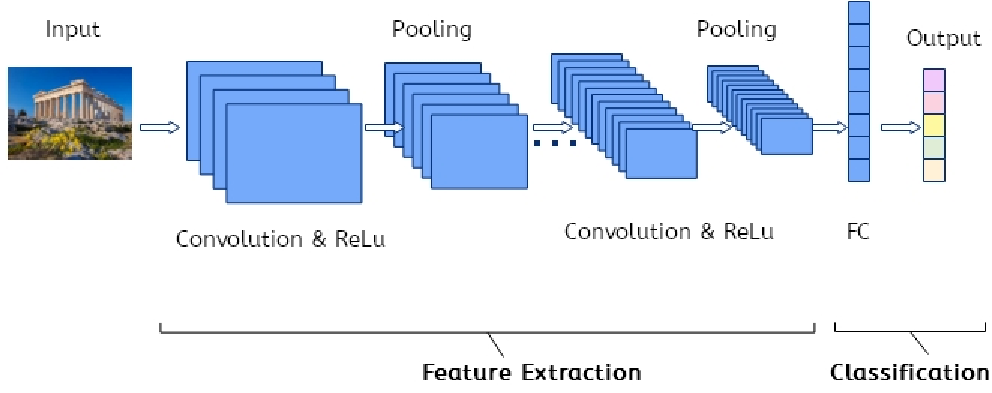 Fig 2. The deep learning pipeline used for image recognition and labeling.
Experiments & Results: Personalization in Action
The application prototype effectively demonstrates User Modeling. When a new user joins, the app can optionally scan their existing phone gallery to understand their tastes (e.g., if they have many photos of "Art," the map will prioritize "Culture" MOIs immediately).
One of the most innovative features is the Happiness Level statistics. By running face recognition on crowdsourced images, the system calculates an aggregate mood for specific locations, visualized via emoji icons.
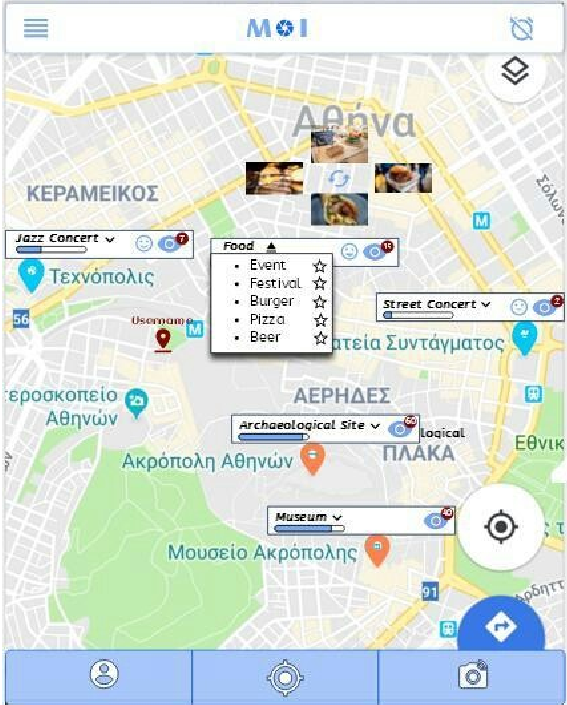 Fig 3. The user interface showing color-coded MOIs and the "eye" icon to view images from other tourists.
Critical Analysis & Conclusion
Takeaway
The shift from POIs to MOIs represents a transition from "Location-Aware" to "Content-Aware" tourism. By utilizing machine learning as the bridge between raw crowdsourced data and user experience, the system bypasses the data overload of traditional search engines.
Limitations & Future Work
- Privacy (GDPR): The authors acknowledge that handling personal photos and face recognition requires strict compliance. Future versions aim to integrate Blockchain for secure data identity management.
- Scale: The system's effectiveness depends on a critical mass of "donors." Without enough active users, the "Real-Time" aspect of MOIs may degrade.
- Oberele: Managing obsolete data (e.g., a concert that ended two hours ago) remains a challenge for database maintenance.
In conclusion, Moments of Interest provides a glimpse into a future where our devices don't just record our memories, but actively help others create their own through intelligent, real-time sharing.