
Turning Social Noise into Gold: A Smarter Approach to SNS Monetization
Monetizing User Activity on Social Networks - Challenges and Experiences
This paper presents a system designed to monetize user activity on social network sites (SNS) platforms like MySpace and Facebook by identifying posts with high commercial intent and filtering out "off-topic noise." The core method utilizes action-pattern bootstrapping to detect user intentions and a Mutual Information-based clustering algorithm to extract relevant keywords for contextual advertising.
TL;DR
Social Network Sites (SNS) are goldmines of user intent, yet most platforms struggle to convert this into revenue because static profiles don't reflect "the now." This paper introduces a specialized pipeline that identifies monetizable intentions (like seeking advice or buying products) and filters out semantic noise through Mutual Information clustering. The result? A jump from 30% to 52% in ad relevance.
The Motivation: Why Your Profile Data is "Stale"
Most SNS ads are demographic-based (age, gender, location) or interest-based (from your profile). But does liking "Tennis" on your profile in 2022 mean you want to buy a racket today? Probably not.
The real value lies in User Activity—public forum posts, group discussions, and marketplace queries. However, this data is incredibly messy. A user asking for help with a "Sony Vegas" project might mention "food poisoning" or "Merrill Lynch" in the same breath. Standard ad engines see these keywords and serve ads for "Health Insurance" or "Stocks," wasting the impression.
The Methodology: Beyond Keyword Matching
The authors propose a system architecture that focuses on How a user speaks, rather than just What they mention.
1. Intent Detection via Action Patterns
Simply seeing the word "iPhone" doesn't mean a user wants to buy one. They might be complaining about it or sharing a photo. The system uses a Bootstrapping Algorithm to learn "action patterns"—4-gram clusters like "where can I find..." or "thinking of getting...".
- The Logic: It uses the Linguistic Inquiry Word Count (LIWC) dictionary to find functional similarities between words, expanding its library of "intent-bearing" phrases automatically.
2. Eliminating Off-Topic Noise
This is the "Secret Sauce." Once a post is deemed monetizable, the system must decide which keywords actually matter.
- The Heuristic: It assumes the Title of a post is the ground truth for context.
- The Calculation: Using Mutual Information (MI)—derived from billions of web pages—it measures the semantic strength between the Title and the Content keywords. If a keyword like "food poisoning" has zero semantic relationship with the title "Camcorder," it is ruthlessly pruned.
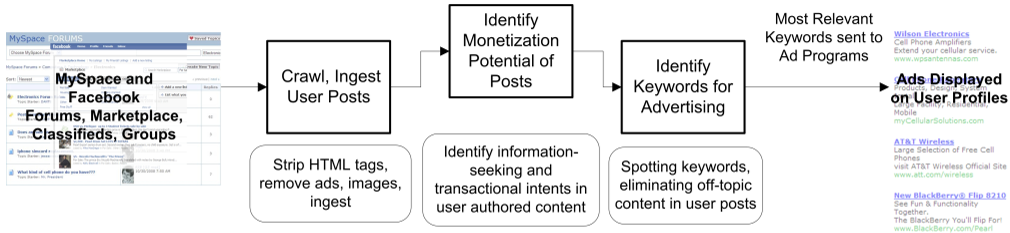 Figure 1: The pipeline from crawling user posts to generating filtered, high-relevance keywords for ad programs.
Crucial Insights: The Power of Specificity
One of the most interesting findings in the methodology is the "Maximally Constrained Context" strategy. When adding keywords to the "relevant" cluster, the algorithm prefers those that appear in specific, narrower contexts.
- Example: If the topic is "Speakers," the word "Logitech" is generic, but "Beep" (referring to a malfunction) is specific. By prioritizing specific keywords, the system generates more surgical ad responses.
Experiments & Results
The authors compared their system against a baseline of "raw content" ad generation using Google AdSense.
| Metric | Raw Content (Baseline) | Processed Keywords (System) |
|---|---|---|
| Ad Relevance | 30% | 52% |
| Unique Relevant Ads | 17% | 39% |
 Table: The semantic clustering process in action, filtering 'off-topic' noise like 'electronics forum' from a 'camcorder' query.
Critical Analysis & Future Outlook
Takeaway
This work proves that Context is King. By moving from "Who the user is" to "What the user is doing right now," platforms can significantly improve the value of their ad inventory.
Limitations
- Title Dependency: The system falls back to standard keyword extraction if a post lacks a meaningful title.
- Computational Overhead: Calculating pairwise Mutual Information for all keywords in real-time is expensive (O(MN^2) in the worst case).
- Modern Shift: In 2026, we might solve this more easily with Large Language Models (LLMs), but the paper's logic regarding "Mutual Information" remains a mathematically robust way to define "On-Topic."
The Future
For developers and marketers, the takeaway is clear: Stop looking at the profile, and start analyzing the action patterns of the live feed.