
Monetizing Milieux: Why Your Social Network Advertising Strategy is Doomed to Fail
The complex problem of monetizing virtual electronic social networks
This paper, published in the Journal of Management Information Systems, investigates the structural challenges of monetizing Electronic Social Networks (ESNs). Author Eric K. Clemons argues that treating social networks as traditional "push-based" advertising media is fundamentally flawed, proposing instead that these platforms are "milieux" or social meeting places where invasive commercialization destroys user trust.
TL;DR
Social networks are not the "new television." In this seminal strategic analysis, Eric K. Clemons argues that the rush to monetize platforms like Facebook and YouTube via traditional "push" advertising is a billion-dollar mistake. Because social networks are "milieux" (voluntary meeting places) rather than broadcast media, intrusive ads are viewed as a violation of social norms. The future of revenue lies not in ads, but in "Social Search" and requested sponsored content.
Background: The Trust Crisis
The paper positions itself at a critical juncture in the late 2000s when tech giants were making massive acquisitions (Google buying YouTube; News Corp buying MySpace). Clemons argues that these valuations were irrationally high because they were built on the "Old Media" logic of captive audiences. He suggests that advertising has entered a "Tragedy of the Commons," where every advertiser’s hyperbole has collectively poisoned the well of consumer trust.
The Core Insight: Meeting Places vs. Broadcast Mediums
The author’s most profound contribution is the distinction between a Medium and a Milieu:
- Medium (The Old Way): A unidirectional system where messages are pushed at captive viewers (e.g., TV, Radio, Newspapers).
- Milieu (The New Way): A social environment where people congregate to exchange information, assess status, and emulate peers.
If you try to sell a product at your daughter's graduation party, you'll be embarrassed and shunned. Clemons posits that "inserting" an ad into a Facebook feed or a Second Life virtual store is the digital equivalent of that social faux pas.
Methodology: The New 4 Ps of Social Networks
To understand what attracts users (and thus what might be monetizable), Clemons proposes a new framework for social network marketing:
- Personal: Content must resonate with real user interests (e.g., a support group for a specific illness).
- Participatory: The platform must encourage interaction, moving the audience from "viewers" to "actors."
- Physical: There is a latent value in the potential for virtual connections to manifest in the real world (e.g., dating sites).
- Plausible: Virtual worlds must have consistent rules to allow users to function effectively.
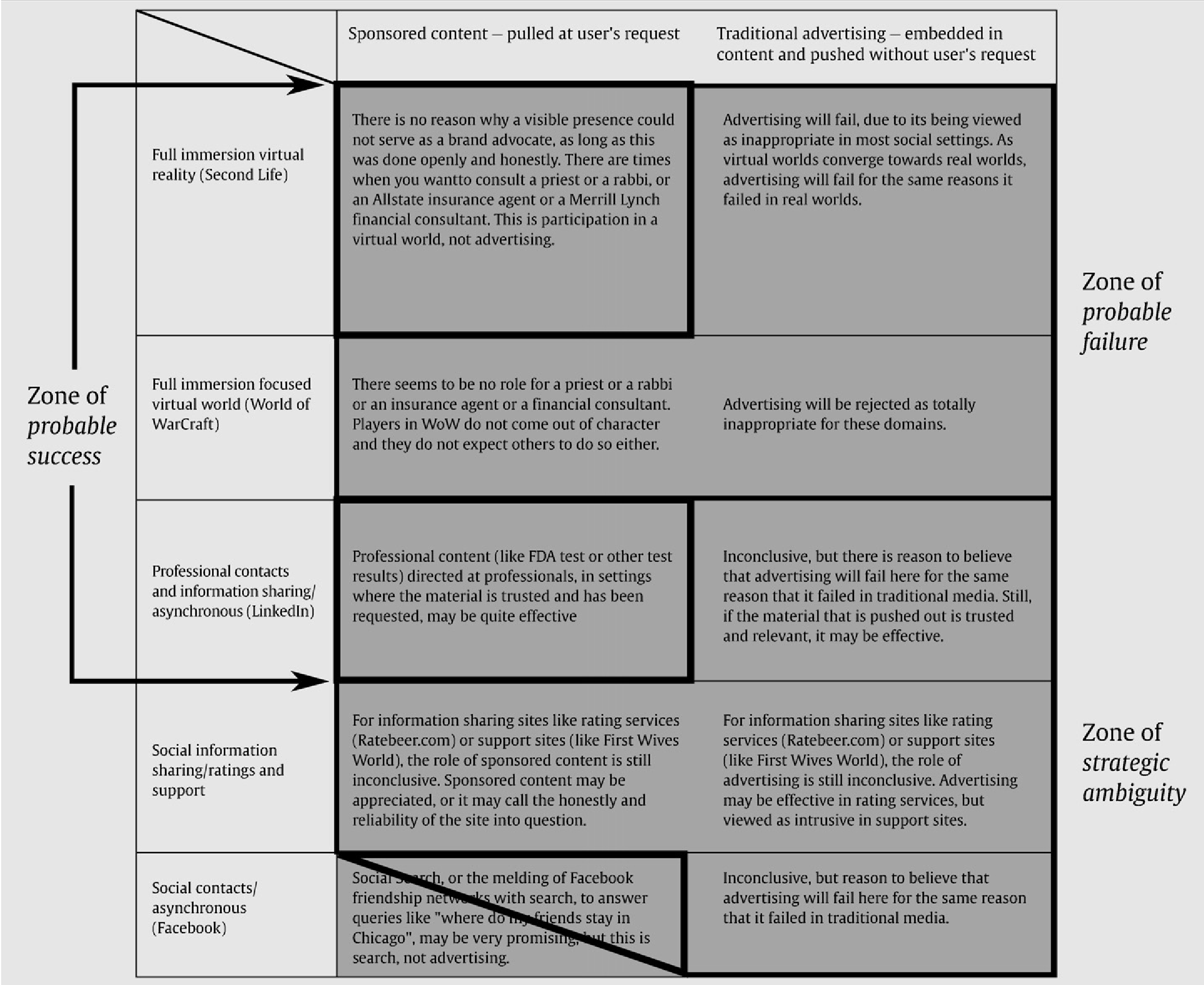 The table above illustrates the "Zones of Probable Failure/Success," highlighting that traditional push-advertising falls into the failure zone across almost all social domains.
Why "Social Search" is the Real Winner
Clemons predicts that the most potent monetization route is Resource Synergy. He points to Microsoft’s investment in Facebook not as an ad play, but as a "Social Search" play.
- Traditional Search (Google): Returns what is "paid for" or "globally relevant."
- Social Search: Returns what your friends found relevant.
This leverages the "trust" inherent in a social network without "monetizing" it in a way that feels like a betrayal.
Critical Analysis & Experiments
The paper cites fascinating experiments by Dan Ariely showing that consumers' willingness to accept a statement as "true" drops by nearly 40% if the source is identified as a corporation or a political party.
SOTA Comparison:
Compared to prior work that focused on "Click-Through Rates" (CTR), Clemons focuses on Ethnographic Salience. He argues that high CTRs might be a "flash in the pan" if the underlying mechanism erodes the social fabric of the platform.
 Standard social structures (Baboon troops to human families) demonstrate that trust is built on shared values—values that advertising often ignores.
Conclusion: The "Pull" Revolution
The takeaway for modern researchers and product managers is clear: Advertising is dying; Sponsored Content is the future.
The paper advocates for a "Pull-based" system where information is provided only in response to a user's request. As the author notes, the designers of "First Wives World" eventually decided to have zero advertising, opting instead for an "Advice Box" where sponsors could provide information only when asked.
Limitations
Written in 2009, the paper could not foresee the rise of advanced "In-feed" algorithms (like TikTok’s) that mask "push" advertising as "organic content" so effectively that users often don't perceive the same level of intrusion. However, the fundamental warning about the fragility of digital trust remains more relevant than ever in the era of AI-generated misinformation.