
MIND: Overcoming the FID Bottleneck with Monge Inception Distance
MIND: Monge Inception Distance for Generative Models Evaluation
The paper introduces Monge Inception Distance (MIND), a novel metric for evaluating generative models based on the Sliced Wasserstein distance. By replacing the Gaussian assumption of Fréchet Inception Distance (FID) with 1D optimal transport projections, MIND achieves state-of-the-art sample efficiency and robustness.
TL;DR
Researchers from Google DeepMind have proposed Monge Inception Distance (MIND), a replacement for the ubiquitous Fréchet Inception Distance (FID). By leveraging Sliced Wasserstein distances, MIND offers a metric that is 100x faster, 10x more sample-efficient, and theoretically more robust. While FID requires 50,000 samples to stabilize, MIND delivers superior discriminative power with just 5,000.
The Cracks in the FID Standard
For years, FID has been the "gold standard" for evaluating GANs and Diffusion models. However, it harbors three critical flaws:
- Statistical Hunger: It requires roughly 50,000 samples to estimate high-dimensional covariance matrices accurately ().
- Computational Bloat: Inverting and finding square roots of large matrices is slow and memory-intensive.
- Vulnerability to "Hacking": Because FID only looks at the mean and covariance, it is not a "proper distance." One can mathematically construct a "garbage" distribution that perfectly matches the first two moments of a real dataset, resulting in an FID of 0 despite having zero visual quality.
Methodology: From Matrices to Sorting
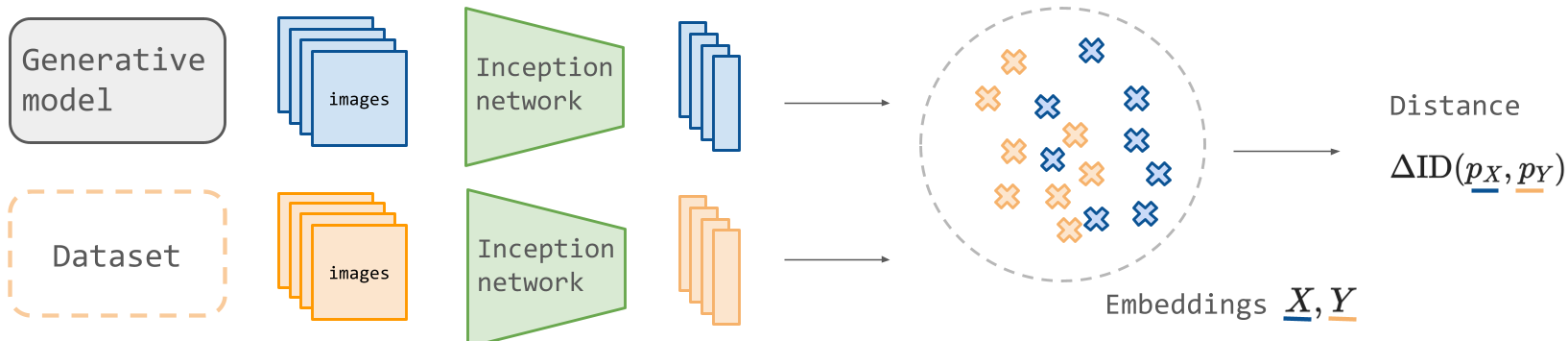
MIND moves away from the Gaussian approximation. Instead, it uses the Sliced Wasserstein distance.
The intuition is elegant: computing optimal transport in high dimensions is hard, but in 1D, it is trivial—it's just the distance between sorted arrays. MIND projects high-dimensional embeddings onto random unit directions, solves the 1D transport problem via sorting, and averages the results.
The Mathematical Core
The empirical estimate for MIND is defined as: where is a scaling factor (typically ) to keep the output magnitude comparable to traditional FID scores.
Performance: Faster, Better, Stronger
The authors conducted extensive benchmarks on ImageNet-64 training runs.
1. Sample Efficiency
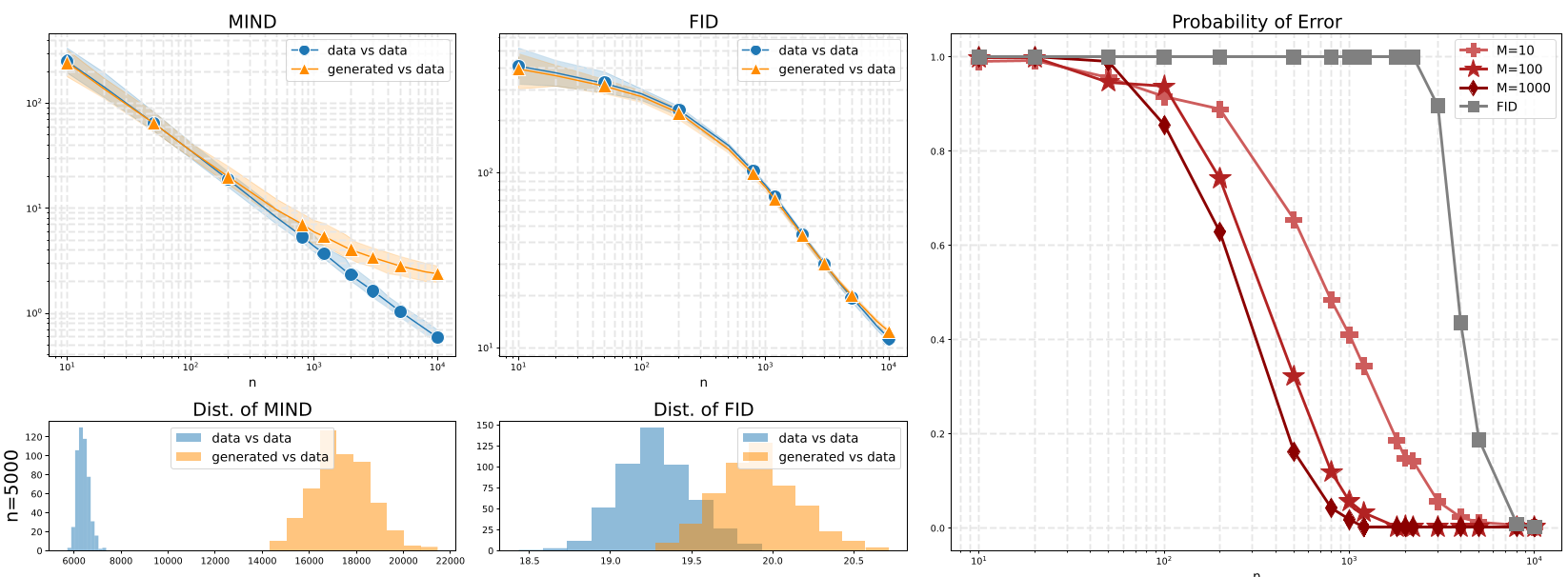
A key finding is that MIND5k (5,000 samples) correlates more strongly with the "ground truth" model quality than FID50k. This allows researchers to evaluate models 10x more frequently during training without loss of precision.
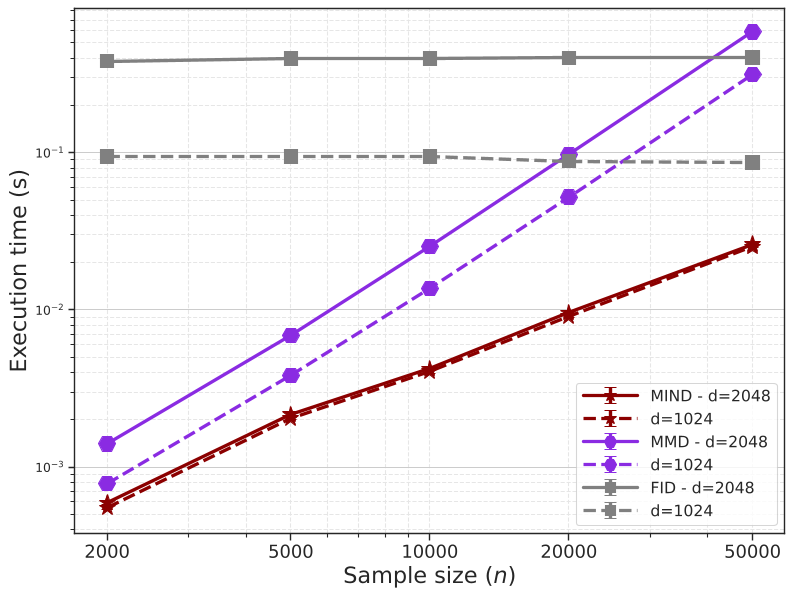
2. Computational Speed & Memory
Because sorting is and highly parallelizable on TPUs/GPUs, MIND blows FID out of the water in terms of overhead.
3. Robustness to Metric Hacking
To prove FID's weakness, the authors performed a Moment-Matching Attack. They optimized images to match the target mean and covariance. While this collapsed the FID score (suggesting a "perfect" model), the MIND metric remained significantly higher, correctly identifying that the distributions were still fundamentally different.
Critical Analysis & Future Outlook
MIND represents a shift toward Optimal Transport (OT) theory for practical ML evaluation. By avoiding the "Gaussian trap," it provides a more nuanced view of the latent manifold.
Limitations:
- Like FID, MIND is still an embedding-dependent metric. If the underlying Inception-v3 or CLIP model has biases, MIND will inherit them.
- It measures distributional distance, not individual image "beauty" or "text legibility."
Conclusion: For the practitioner, MIND is a "drop-in" upgrade. It reduces the feedback loop of model training from hours to seconds and provides a security layer against moment-matching shortcuts. As generative models scale, the efficiency of our "yardsticks" becomes just as important as the models themselves.