
Safeguarding the Digital Frontier: An Integrated Framework for Counteracting Malicious Influence in Social Networks
Monitoring and Counteraction to Malicious Influences in the Information Space of Social Networks
The paper proposes a comprehensive integrated system architecture for monitoring and counteracting malicious information influences in social networks. The framework employs a multi-level management approach combining distributed data collection, hierarchical semantic classifiers (Decision Trees), and graph-based analysis to identify attack sources, target audiences, and "viral" distribution channels.
TL;DR
In an era of information warfare, blocking a single post is no longer enough. This paper presents a robust, multi-layered architecture designed not just to flag content, but to deconstruct the entire lifecycle of a "malicious influence." By integrating distributed data crawling, hierarchical semantic classification, and social graph visualization, the authors provide a toolkit for identifying the sources—and the strategies—behind coordinated information attacks.
The Motivation: Why Keyword Filtering Fails
Traditional security systems in social networks are often "reactive" and "siloed." They might catch a specific forbidden word, but they fail to see the forest for the trees. The authors argue that current systems lack:
- Comprehensive Threat Analysis: They don't account for the "information confrontation" context.
- Perpetrator Modeling: They focus on the what (the message) but ignore the who (the attacker) and the how (the bot movement).
- Adequate Formalization: There is a lack of structured mathematical models to predict and evaluate the impact of a malicious campaign before it goes viral.
To solve this, the research shifts the focus toward "Posteriori Protection"—recognizing that the impact may have already occurred and seeking to neutralize the perpetrator's goals through a deep understanding of the distribution network.
Methodology: The Five-Pillar Architecture
The proposed system is divided into five logical components that work in a pipeline to transform raw social media noise into actionable security intelligence.
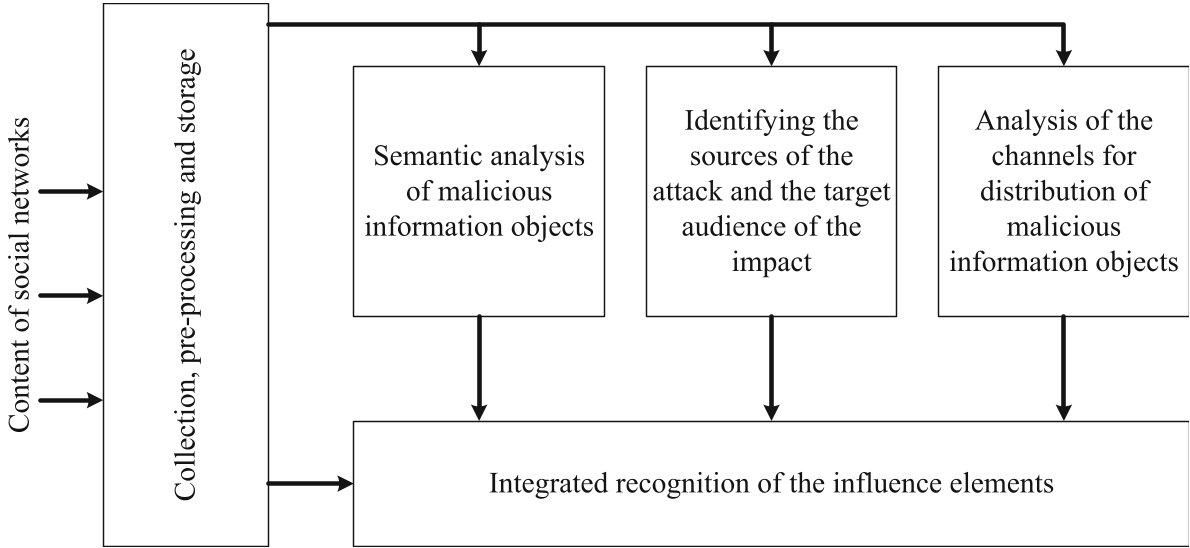
1. Advanced Data Collection
Unlike simple scrapers, this component handles the "messiness" of social media: poorly structured data, API limits, and IP blocking. It uses distributed scanners to ingest disjointed portions of information simultaneously.
2. Hierarchical Semantic Classification
The system doesn't just use one classifier. It employs a hierarchical tree of binary and aspect classifiers. It analyzes:
- The Text: Both the body and metadata (Title, Keywords, H1-tags).
- The Context: URL structure and embedded images. This approach allows the system to filter out "noise" and focus on high-risk categories like extremist propaganda or false news.
3. Source and Target Identification
By modeling the "Perpetrator," the system looks for "formal features" of bad actors, such as:
- Bot-like behavior: 24/7 activity and static profiles.
- Information Embedding: Mass dissemination of content across disconnected groups.
4. Graph-Based Channel Analysis
This is where the physical intuition of the paper shines. By building Repost Trees, the system visualizes how information travels from a central node (the source) to the "Opinion Leaders" and finally to the target audience.
Experimental Results: Precision in Action
The researchers tested their prototype on the VKontakte social network and the DMOZ web catalog.
| Category | Accuracy | Observation |
|---|---|---|
| Adult/Alcohol | >90% | Highly distinct linguistic and structural features. |
| News | 75% | Harder due to the high volatility of vocabulary. |
| Chat | 65% | Most challenging due to informal language and lack of structure. |
Visualizing the Attack
The paper utilizes graph visualization to identify the "health" or "toxicity" of information nodes.
- Green Hubs: Users/Groups creating unique, high-value content.
- Red Hubs: Bot accounts or "repeaters" that primarily repost malicious content.
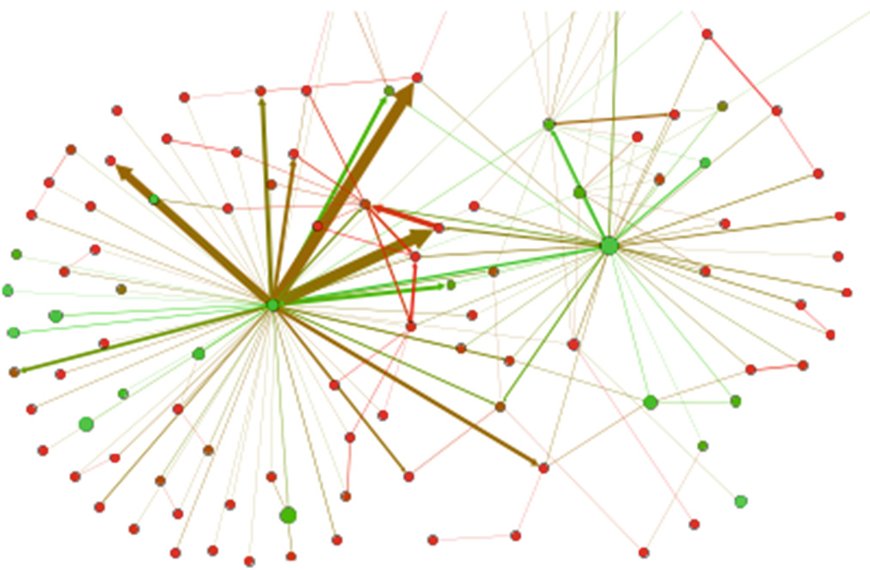
The size of the vertex represents the volume of records, while the color indicates the degree of content originality—a crucial metric for spotting bot networks.
Critical Analysis & Takeaways
The true value of this work lies in its holistic recognition. By defining an attack through four specific signs—nature of info, source, target audience, and channels—the authors move social media security into the realm of structured digital forensics.
Limitations:
- Static Decision Trees: While effective, the 90% accuracy might dip in the face of modern adversarial AI that can "camouflage" text.
- Computational Speed: The authors admit that while it works for experimental data, scaling to hundreds of millions of daily users requires more high-performance "Big Data" optimization.
The Future: This work lays the groundwork for real-time automated "situation assessment" in the information space. Future iterations will likely move toward Deep Learning (Transformers) to improve the 65-75% accuracy seen in chat and news categories, keeping pace with the evolving tactics of digital perpetrators.