
The Architecture of Influence: How "Superposters" Build MOOC Communities
Examining MOOC superposter behavior using social network analysis
This paper utilizes Social Network Analysis (SNA) and Stochastic Actor-Oriented Modeling (SAOM) to investigate "superposter" behavior in Coursera MOOC forums. It distinguishes between quantity superposters (high post volume) and quality superposters (high upvote accumulation), concluding that both types significantly drive network tie formation and act as critical information brokers.
TL;DR
In the massive, often anonymous landscape of Massive Open Online Courses (MOOCs), a tiny minority of students—termed Superposters—exert a disproportionate influence on the community. This study reveals that these users are not merely prolific; they are the structural "glue" of the course, significantly influencing how other students form connections and serving as the primary brokers of information flow.
Problem: The Ghost Town Dilemma
One of the greatest challenges in online education is the "transactional distance" between students. Without the organic interactions of a physical classroom, MOOCs rely entirely on forums. However, most forums suffer from many "orphaned threads" (questions never answered) or fragmented silos of information. While previous research suggested that high-volume posters help "forum health," we lacked a deep understanding of how these individuals change the social architecture of the course as it progresses.
Methodology: Mapping Social Evolution
The researchers didn't just look at total post counts. They categorized superposters into two distinct buckets:
- Quantity Superposters: The top 5% of participants by volume (threads, posts, comments).
- Quality Superposters: The users who received the most community upvotes (popularity).
To see how these users influenced the network over time, they used Stochastic Actor-Oriented Modeling (SAOM). This statistical method views the network not as a static snapshot, but as an evolving system where "actors" (students) make decisions to form ties based on the attributes of others.
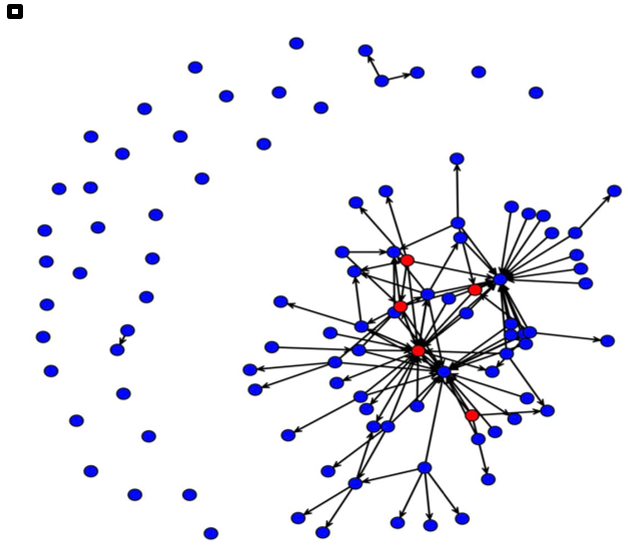 Figure 1: Visualization of a MOOC discussion network. Red nodes represent identified quantity superposters, showing their central positioning compared to peripheral, disconnected students.
Key Insights: Brokerage and Tie Formation
The study yielded two major findings that redefine how we view "power users" in digital learning:
1. The Gravity of Superposters
Using the RSiena package to model longitudinal changes, the researchers found that superposting status is a social magnet. In almost all courses analyzed, the fact that a student was a "Quantity Superposter" significantly increased the likelihood of others forming ties with them. Essentially, these users create a "center of gravity" that pulls the community together.
2. Information Brokerage Capital
By calculating Betweenness Centrality, the authors measured "brokerage capital"—the ability of a user to stand between two students who wouldn't otherwise be connected.
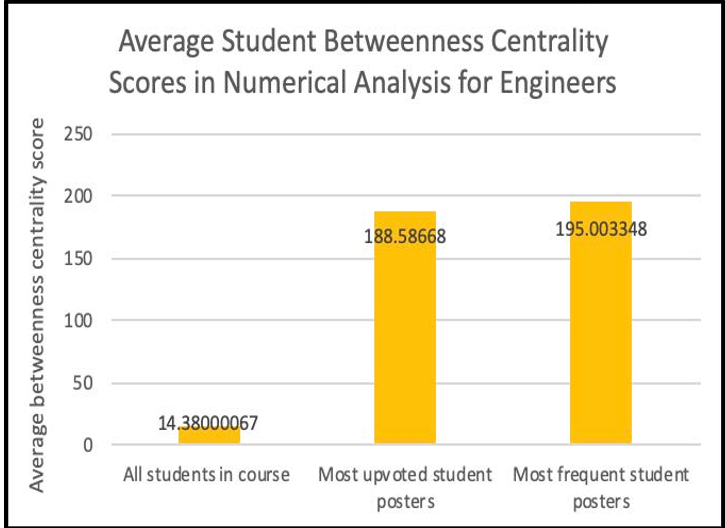 Figure 2: Superposters (both Quality and Quantity) exhibit dramatically higher betweenness centrality than the average student, indicating their role as information gatkeepers.
As shown in the charts, the "brokerage capital" of superposters dwarfs that of the average student. They are the bridges that prevent the forum from dissolving into isolated, unhelpful fragments.
Critical Analysis & Conclusion
This work confirms that superposters are the "unsung heroes" of MOOCs. By bridging gaps and providing consistent engagement, they compensate for the lack of instructor-led interaction.
Takeaway for Designers: Instead of worrying that a few loud voices might dominate the forum, course designers should find ways to empower these users. Gamification (badges, leaderboard) and early identification of these "quality" contributors could be the key to maintaining "forum health" in massive scale environments.
Limitations: The study relies on meta-data (votes/counts) rather than content. A "quality" superposter is defined by upvotes, but a user could theoretically get upvotes for being funny or controversial rather than helpful. Future research incorporating NLP (Natural Language Processing) could bridge this gap by analyzing the actual sentiment and pedagogical value of the posts themselves.