
MS-EM: Filtering the Emotional Noise for Reliable Crisis Recommendations
Mood-Sensitive Truth Discovery For Reliable Recommendation Systems in Social Sensing
The paper introduces MS-EM (Mood-Sensitive Expectation Maximization), a principled truth discovery framework for social sensing. It jointly estimates the correctness and mood neutrality of claims alongside the reliability and mood sensitivity of human sources to provide trustworthy recommendations during emergency events.
TL;DR
In the chaos of a terrorist attack or natural disaster, social media is flooded with "moody" tweets—emotional outpourings that carry little factual weight. This paper presents MS-EM, a first-of-its-kind truth discovery model that separates emotional bias from objective facts. By jointly modeling source reliability and mood sensitivity, it improves the accuracy of recommendation systems by up to 20% compared to traditional "mood-blind" algorithms.
The "Emotional Noise" Problem
When a disaster strikes (like the Brussels Bombings), systems using "human sensors" (Twitter users) face a unique challenge. Previous SOTA methods assumed that if many people say the same thing, it’s likely true. However, in social sensing, massive volumes of data are often purely emotional (e.g., "Why is the media ignoring Istanbul?").
If a recommendation system cannot distinguish between a mood-neutral claim (e.g., "The Prime Minister says no link found yet") and a mood-sensitive claim (e.g., "This is a government hoax!"), it risks recommending useless or inflammatory content to decision-makers.
Methodology: The MS-EM Framework
The core innovation of this work is treating Mood as a hidden variable alongside Truth. The authors define:
- Source Reliability (): Probability a source provides a true claim.
- Source Mood Sensitivity (): Probability a source provides an emotional claim.
Multi-Dimensional Estimation
Unlike standard EM algorithms that only look at a Source-Claim Matrix, MS-EM uses a Source-Mood Matrix derived from "moody" keywords. The model structure creates an interdependence: as the algorithm identifies a source as frequently "moody," it discounts that source's contribution to factual "Truth," even if their claims are frequent.
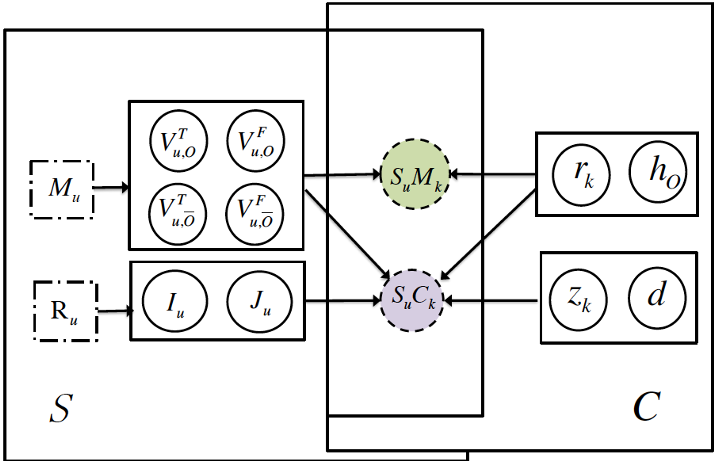 Figure 1: The MS-EM Model Structure showing the interplay between Source-Mood and Source-Claim variables.
Experiments & Results
The authors tested MS-EM against several heavyweights: Voting, TruthFinder, and Regular EM. They used real-world data from four major events:
- Brussels Bombing (2016)
- Paris Attacks (2015)
- Oregon Shooting (2015)
- Baltimore Riots (2015)
Performance Gains
MS-EM consistently outperformed all baselines. In the Brussels Bombing dataset, the gain in F1-measure was a staggering 20% over the best-performing baseline. This suggests that "mood" is not just a minor variable but a fundamental component of data quality in social sensing.
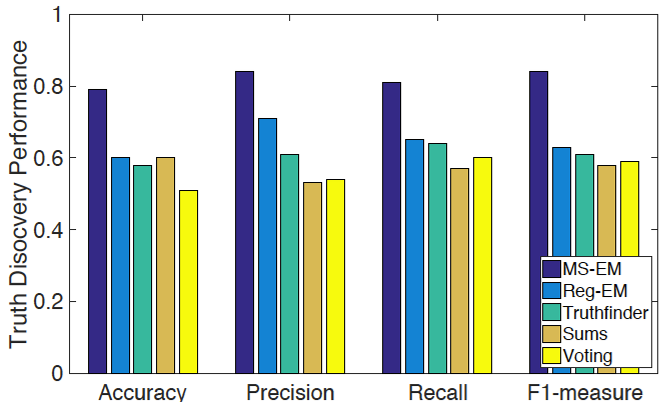 Figure 2: Truth Discovery Results on the Brussels Bombing Dataset, showing MS-EM outperforming across all metrics.
Efficiency
One of the practical strengths of MS-EM is its convergence speed. The algorithm typically reaches a stable estimate within 5-10 iterations, making it viable for near-real-time emergency response applications.
Critical Insight & Conclusion
The genius of this paper lies in its movement away from the "Rational Sensor" assumption. In the real world, human sensors are emotional. By mathematically formalizing "Mood Sensitivity," the authors have provided a robust analytical foundation for the next generation of reliable social recommendation systems.
Limitations: The reliance on a pre-defined list of "moody words" for the Source-Mood Matrix might miss subtle emotional cues (sarcasm, slang). Future work integrating Deep Learning-based sentiment analysis into the EM E-step could further enhance detection accuracy.