
More Than Words: Decoding Social Intelligence from Nonverbal Vocal Cues
More Than Words: Inference of Socially Relevant Information from Nonverbal Vocal Cues in Speech
The paper introduces methods for Social Signal Processing (SSP) to infer social information from nonverbal vocal cues. It specifically utilizes prosodic features and turn-taking patterns to distinguish between professional and non-professional speaking styles (journalists vs. non-journalists) and to automatically recognize social roles in broadcast media and meeting environments.
TL;DR
In human interaction, "how" we speak often carries more weight than "what" we say. This paper demonstrates that machines can decode high-level social information—such as whether a person is a professional journalist or what specific role they play in a meeting—solely by analyzing nonverbal cues like pitch, rhythm, and turn-taking patterns. By utilizing SVMs and Social Affiliation Networks, the researchers achieved performance levels comparable to human listeners.
Background: The Social Signal Processing Frontier
Most AI speech systems excel at transcription (Speech-to-Text). However, humans are masters of Social Signal Processing (SSP). We can detect a journalist's polished tone or a project manager's dominant speaking pattern without understanding a single word. This paper positions itself as a bridge between sociology and computer science, proving that these "latent" social attitudes have measurable, physical signatures in audio data.
Problem: The Hidden Complexity of Style and Role
The fundamental challenge in SSP is that social signals are often "noisy" and context-dependent.
- Ambiguity: A politician might sound like a journalist due to media training.
- Unstructured Data: In meetings, roles are fluid compared to structured radio broadcasts.
- Feature Gap: Moving from short-term audio windows (milliseconds) to long-term social traits (minutes) requires a sophisticated statistical bridge.
Methodology: From Physics to Psychology
1. Spotting the Professional Voice (Prosody)
To distinguish journalists, the authors focus on Prosody. Instead of looking at raw pitch or energy, they calculate the Entropy of these features over long intervals.
- Insight: High entropy in prosody suggests a more dynamic, "trained" speaking style used by professionals to keep the audience's attention.
- Classifier: A Support Vector Machine (SVM) with a Radial Basis Function (RBF) kernel is used to draw the boundary between professional and casual styles.

2. The Geometry of Conversation (Turn-Taking)
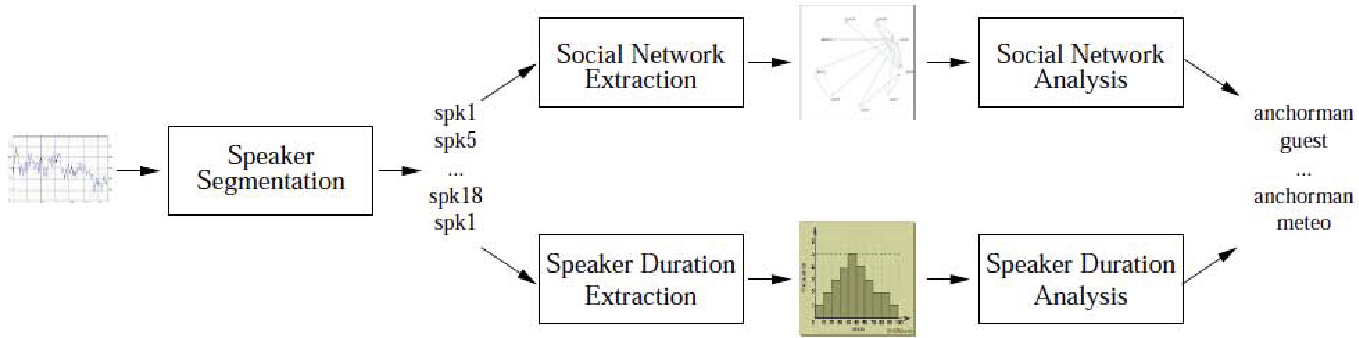
For role recognition, the authors ignore the audio content entirely and look at the "who and when."
- Social Affiliation Networks (SAN): They treat a conversation as a bipartite graph where nodes are "Actors" (speakers) and "Events" (time segments).
- Bayesian Modeling: By combining the SAN tuple (who was active when) with the total speaking time (), they use a Bayesian framework to predict roles such as Project Manager, Anchorman, or Guest.
Experiments & Results
The findings confirm that nonverbal cues are surprisingly legible to machines:
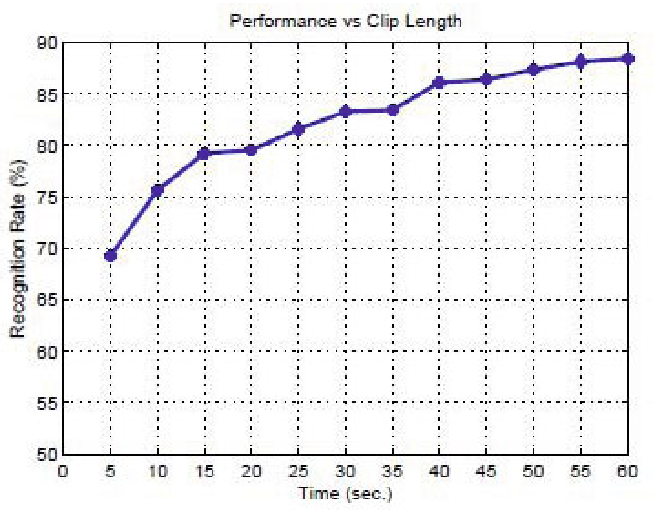
- Human vs. Machine: In the journalist detection task, the machine's 88.4% accuracy was indistinguishable from (and slightly higher than) the average human performance of 82.3%.
- The Importance of Length: The system's accuracy improves significantly as the audio clip length increases, allowing for a more stable entropy estimation.
- Structured vs. Unstructured: The system performed best on broadcast news (C1/C2), where roles are rigidly defined. Performance dropped in meetings (C3), highlighting that in informal settings, turn-taking is less indicative of status.
Critical Insight: Why Does This Matter?
This paper proves that Inductive Bias—specifically the choice to use entropy and social networks—allows simple models to capture phenomena that we usually think require complex "understanding."
The limitation is the reliance on "clean" turn-taking data. The 10% performance drop when moving from manual to automatic speaker segmentation shows that the system is sensitive to the underlying "Who-is-Speaking" (Diarization) accuracy.
Future Outlook
As we move toward more "Socially Intelligent" AI, the lessons from this paper are vital. Future research will likely integrate these nonverbal vocal cues with LLMs (verbal) and computer vision (visual) to create a holistic "Social AI" capable of navigating human nuances in real-time.
Takeaway for the Reader: To understand a conversation, stop focusing just on the words. Look at the rhythm of the turns and the energy of the voice; the "social math" is hidden in plain sight.