
Morpho Challenge 2007: Beyond Simple Word Segmentation
Morpho Challenge Evaluation Using a Linguistic Gold Standard
This paper presents the evaluation results of Morpho Challenge 2007, a competition focused on unsupervised machine learning algorithms for morphological analysis across Finnish, German, English, and Turkish. The winning methods, notably the Bernhard and Monson algorithms, demonstrated that statistical approaches can effectively discover morphemic structures without human supervision, achieving high F-measures by matching word pairs in a linguistic gold standard.
TL;DR
Morpho Challenge 2007 shifted the paradigm of unsupervised language processing from simple string splitting to abstract morphological analysis. By evaluating how well algorithms could identify shared "meaning units" (morphemes) across different word forms in Finnish, Turkish, German, and English, the challenge proved that statistical models can recover complex linguistic structures without manual labeling.
Background & Motivation: The Problem with Rules
Languages are living organisms, and their "building blocks"—morphemes—don't always appear as clean, sequential segments. In English, we see "foot" become "feet"; in Finnish or Turkish, a single word can contain an entire sentence's worth of information.
Building morphological analyzers manually for every language is a bottleneck for global AI. The authors argue that if a machine can learn to identify that "boots" and "booting" share a common root purely by looking at large text corpora, we can rapidly scale up technologies like Information Retrieval (IR) and Speech Recognition for any language on earth.
Methodology: The "Shared Morpheme" Intuition
The core technical challenge in evaluating unsupervised models is that the machine doesn't know what to call a morpheme. It might label the root of "climbing" as morpheme_784.
To solve this, the organizers used a word-pair matching strategy:
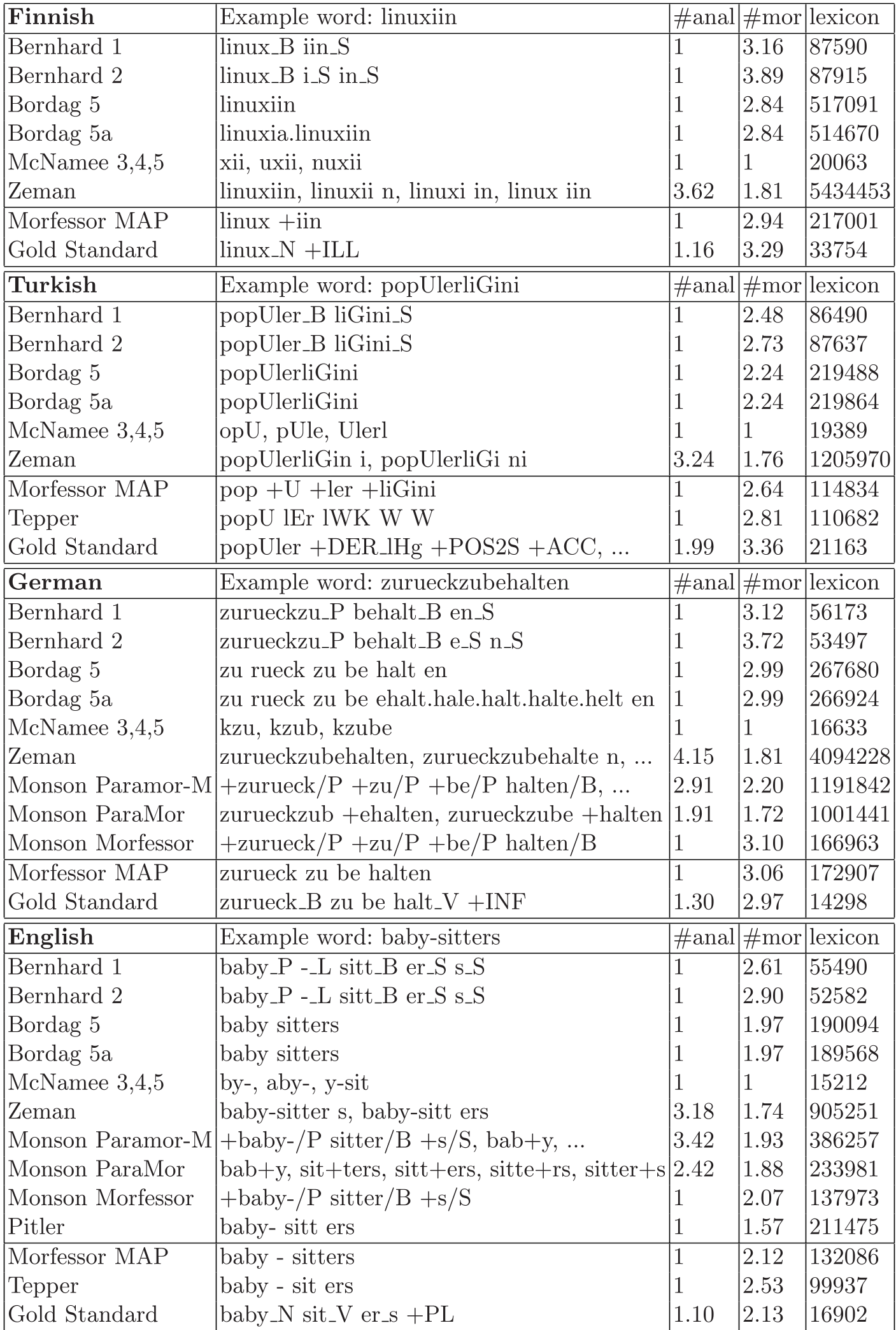
- Evaluation by Association: Instead of checking if the machine used the correct label (e.g., "+PLURAL"), they checked if the machine correctly identified that two words (e.g., linuxin and linuxia) share the same base.
- Language Diversity: By testing on Finnish (highly agglutinative), Turkish (complex suffixes), German (compounds), and English (relatively simple), they ensured the "Inductive Bias" of the models wasn't language-specific.
Analysis of the Results
The experiments revealed a massive variance in performance based on language typology:
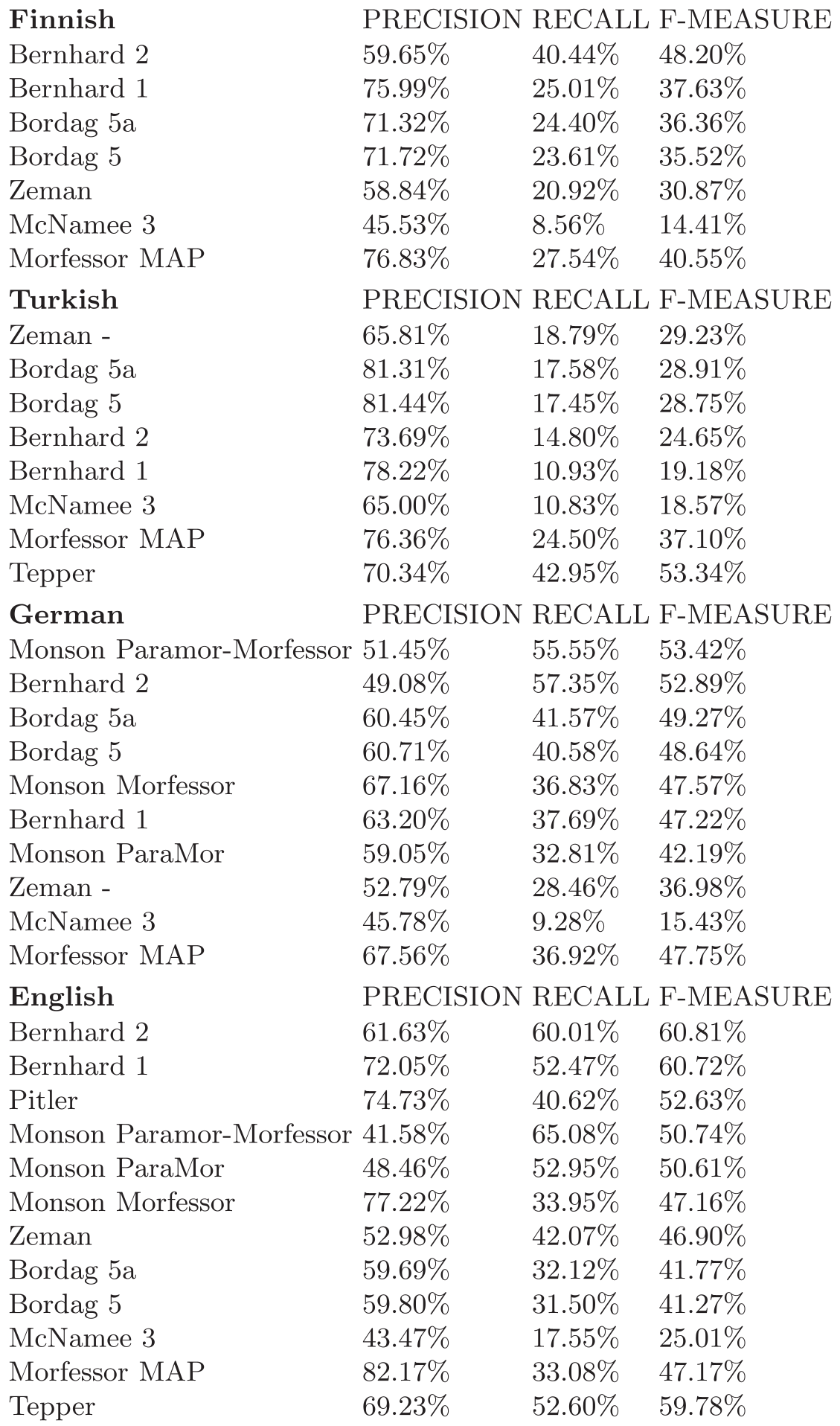
- The English Success: Algorithms like Bernhard 2 achieved over 60% F-measure, suggesting that in languages with limited inflection, statistical patterns are very reliable.
- The Turkish Hurdle: Turkish proved significantly harder than in previous years. Even the best submission barely hit a 30% F-measure. This highlights the difficulty of unsupervised systems in handling massive suffix chains where the "state-space" of word forms is nearly infinite.
- Precision vs. Recall: Many algorithms achieved high precision (getting the segments they found "right") but low recall (missing many valid linguistic connections).
Critical Insight: Why Bernoulli and Morfessor Won
The top-performing models (Bernhard and the reference Morfessor) succeeded because they leveraged probabilistic priors. The Morfessor MAP (Maximum A Posteriori) approach uses a Minimum Description Length (MDL) principle—it tries to find the most compact lexicon that can explain the entire corpus. This "compression-as-intelligence" approach remains a cornerstone of modern subword tokenization (like BPE or WordPiece) used in LLMs today.
Conclusion & Future Outlook
Morpho Challenge 2007 demonstrated that while we can detect where a word breaks, the real frontier is clustering. Future research must move beyond surface strings and incorporate contextual information (using the sentences surrounding the word) to understand that "feet" and "foot" are functionally identical despite sharing no letters.
For practitioners, this paper serves as a reminder that the "subword" units we use in models today (like the ones in GPT-4) have deep roots in these early unsupervised statistical competitions.