
Beyond Structures: How Social Status Shapes the Micro-Topology of Networks
Motif-Based Analysis of Social Position Influence on Interconnection Patterns in Complex Social Network
This paper introduces a "coloured motif" analysis framework that integrates structural triad detection with social position centrality. By applying this to a large email-based network (5,700+ nodes), the authors quantify how individual importance influences local interconnection patterns and communication roles.
TL;DR
This study bridges the gap between local network structures (motifs) and individual importance (social position). By "colouring" nodes based on their status in a large email network of 5,700+ users, the researchers discovered that high-status individuals are surprisingly lonely in their local subgraphs, while low-status "weak links" perform the heavy lifting of bridging network clusters.
Context & Motivation: Why Structure Isn't Enough
In complex network science, Network Motifs—small subgraphs like triads—are the "DNA" of a network. They tell us if a network is a social circle, a biological system, or a power grid. However, standard motif analysis is "blind" to the identity of the nodes. It treats a CEO and an intern the same way if they occupy the same corner of a triangle.
The authors argue that to truly understand a social network, we must consider Social Position (SP). Inspired by bioinformatics, they propose that by layering status onto structure, we can see the "socio-dynamic" rules that govern how people actually communicate.
Methodology: The Art of Coloured Triads
1. Defining Social Position
The authors use a recursive measure of social position where a user's importance is inherited from their neighbors, weighted by the intensity of communication.
Nodes are then binary-classified:
- White Nodes: High SP (Top ~29%).
- Black Nodes: Low SP (Bottom ~71%).
2. Coloured Motif Extension
The study analyzes 13 types of directed triads. By adding the two colors, each structural motif (like a feed-forward loop) can manifest in diverse status configurations, such as "two bosses and one subordinate" vs. "two subordinates and one boss."
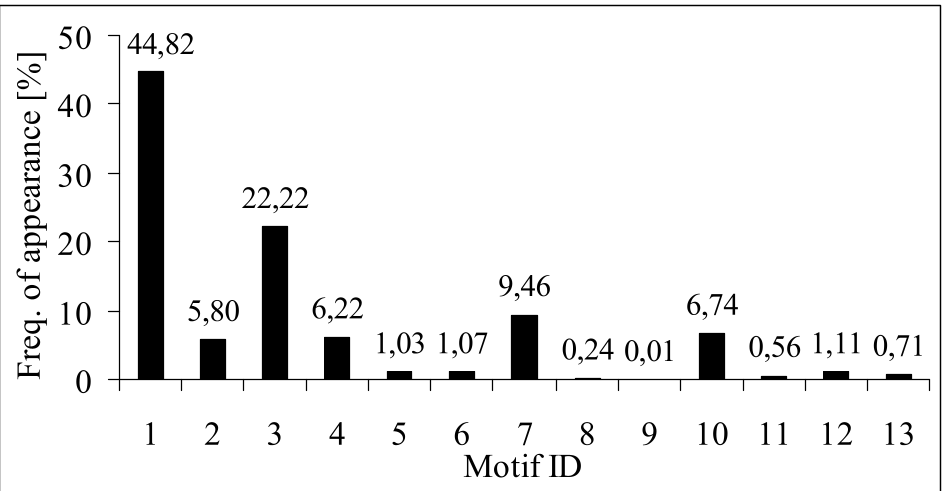 Figure: The 13 fundamental directed triads analyzed in the study.
Key Insights: Who Really Holds the Network Together?
The experiments on the Wroclaw University of Technology (WUT) email logs yielded several counter-intuitive findings:
1. The Isolation of the Elite
One might expect high-status "hubs" to form tight-knit cliques. The data says otherwise. Motifs consisting entirely of White nodes (3W) are extremely rare (peaking at only 5.5%). Instead, high-position nodes are almost always embedded in motifs with low-position subordinates.
2. The "Weak Link" Bridge
In "middleman" structures (like Motif 7, which bridges different clusters), the broker is a Black node (low SP) in 72% of cases. This validates the "Strength of Weak Ties" theory: individuals with lower social position are the ones connecting disparate groups, acting as the structural glue of the university.
3. Broadcasting vs. Importance
The study found that "broadcasting" nodes—those who send many one-way emails—rarely have high social positions. In e-mail networks, mere activity does not equal authority.
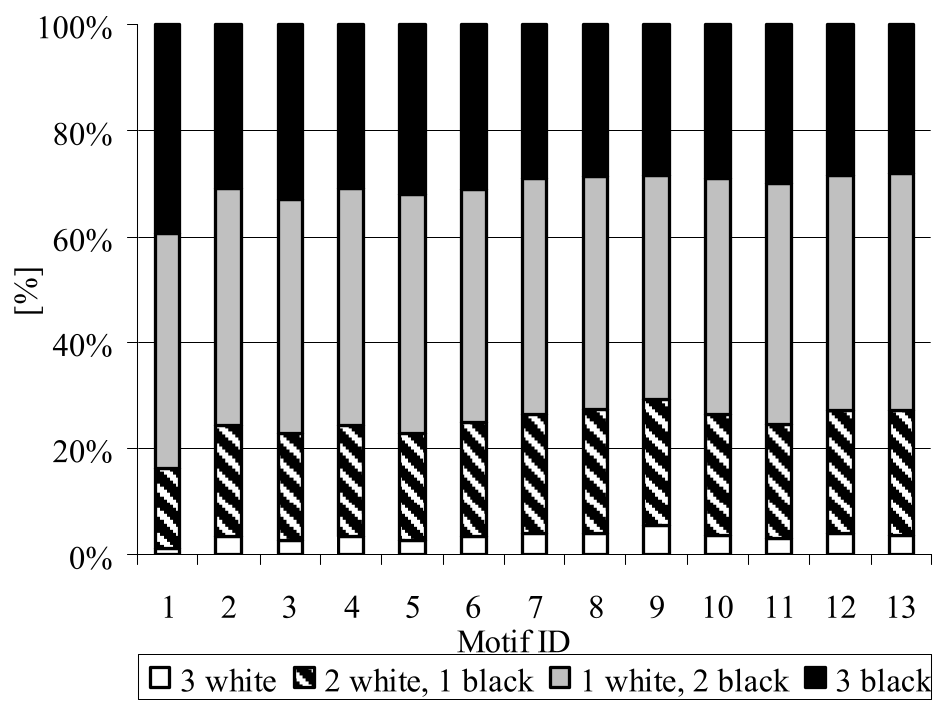 Figure: The percentage distribution of status combinations across the 13 motif types.
Critical Analysis & Conclusion
Takeaways
- Computational Efficiency: Motif sampling is far faster than calculating global metrics, making this "coloured" approach viable for massive datasets (millions of nodes).
- Functional Identification: We can now distinguish between an "executive loop" and a "departmental broadcast" just by looking at the status-triad profile.
Limitations & Future Work
The study uses a binary "Black/White" color scheme. Future work could benefit from a fuzzy logic approach or a continuous gradient of colors to better represent the nuances of social hierarchy. Additionally, as the authors note, the next frontier is dynamics: how these coloured motifs change over an academic year or when the network is under stress.
In conclusion, this paper successfully demonstrates that in the world of social networks, who is in the triangle matters just as much as the triangle itself.