
Motif-based PageRank: Capturing Higher-Order Social Influence
Ranking Users in Social Networks with Motif-based PageRank
The paper introduces Motif-based PageRank (MPR), a novel ranking framework that enhances the classic PageRank algorithm by incorporating higher-order network relations through motifs (small subgraphs). It achieves significantly improved user ranking performance on social networks like DBLP, Epinions, and Ciao, outperforming standard PageRank and other centrality baselines.
TL;DR
Social influence is more than just who you know—it's about the structure of your community. This paper proposes Motif-based PageRank (MPR), an evolution of the classic PageRank algorithm. By shifting focus from simple edges (Who follows whom?) to complex motifs (How do groups interact?), MPR achieves a massive leap in ranking accuracy, particularly in trust-based and academic networks.
Background: The Limits of First-Order Thinking
Since its inception, PageRank has been the gold standard for measuring authority in graphs. However, most implementations treat a link as a simple "vote" of confidence. In social science, we know that Triadic Closure (the "friend-of-a-friend" effect) implies a much stronger bond than a stray follow from a stranger.
The authors argue that conventional PageRank is "structure-blind." It treats all neighbors equally regardless of whether they form a tight-knit cluster or are isolated nodes.
The Core Insight: Motifs as Higher-Order Relations
A motif is a "graphlet" or a small subgraph pattern (e.g., a triangle, a feed-forward loop). The authors use these motifs to redefine the weight of a connection.
 Fig 1: A trust network snippet (a) and 7 types of 3-node motifs (b). Note how M6 represents a mutual trust triangle.
The Workflow of MPR
- Motif Selection: Choose a pattern (e.g., M6 triangle) relevant to the domain.
- Matrix Construction: Instead of a standard adjacency matrix , construct a motif-based matrix where entries represent how many times users and appear together in that specific motif.
- Hybridization: Combine the original edge weights with motif weights using a control parameter :
- Rank Computation: Execute PageRank on the new transition matrix .
Methodology: From Triangles to Complex Subgraphs
The paper doesn't stop at simple 3-node triangles. They explore Anchor Motifs (where only specific nodes in the pattern matter) and scale up to 4-node and 5-node motifs.
For larger motifs, simple matrix operations become computationally prohibitive. To solve this, the authors employ a sampling-based approach to estimate motif frequencies, making the algorithm feasible for large-scale social networks with tens of thousands of nodes.
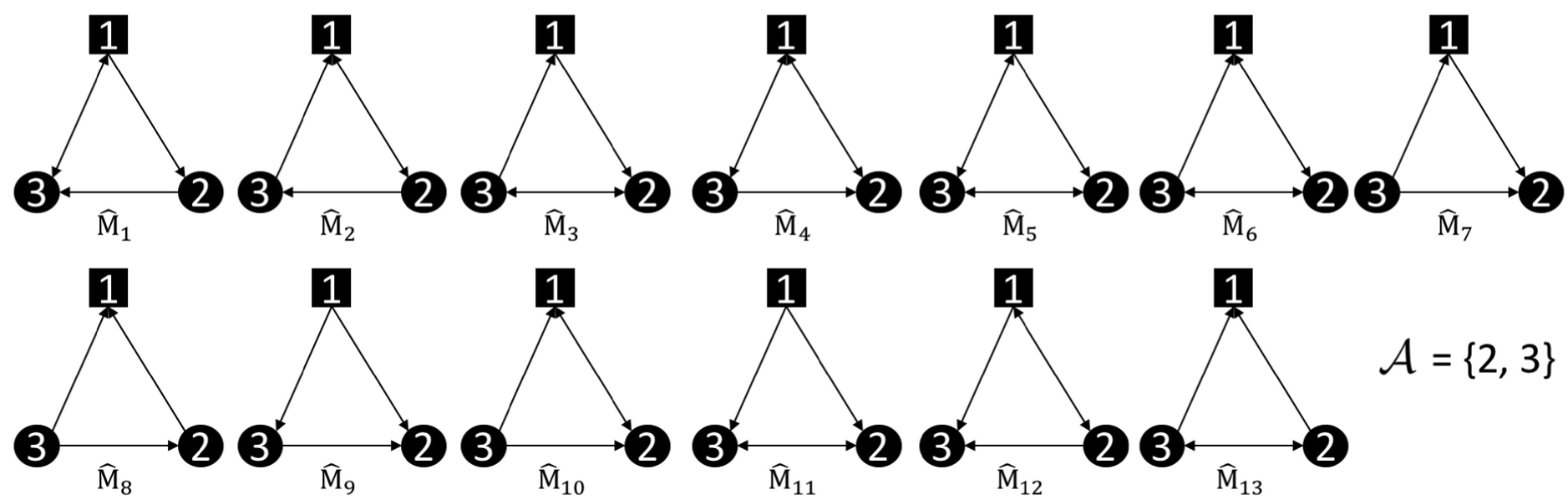 Fig 2: 13 variations of 3-node anchor motifs used to refine influence granularity.
Experiments: Superior Ranking Performance
The researchers tested MPR on three datasets: DBLP (Academic), Epinions, and Ciao (Product trust).
Key Findings:
- Significant NDCG Gains: In the Ciao dataset, MPR outperformed binary PageRank (BPR) by a staggering margin, moving NDCG@10 from 0.83 to 0.99.
- Domain Sensitivity: Different motifs work better for different networks. For example, "mutual citation" motifs might be more valuable in DBLP than in a consumer review site.
- Diminishing Returns for Size: While 4-node motifs often provided the best results, 5-node motifs sometimes introduced noise, suggesting that "smaller" motifs like triangles are the most robust indicators of social strength.
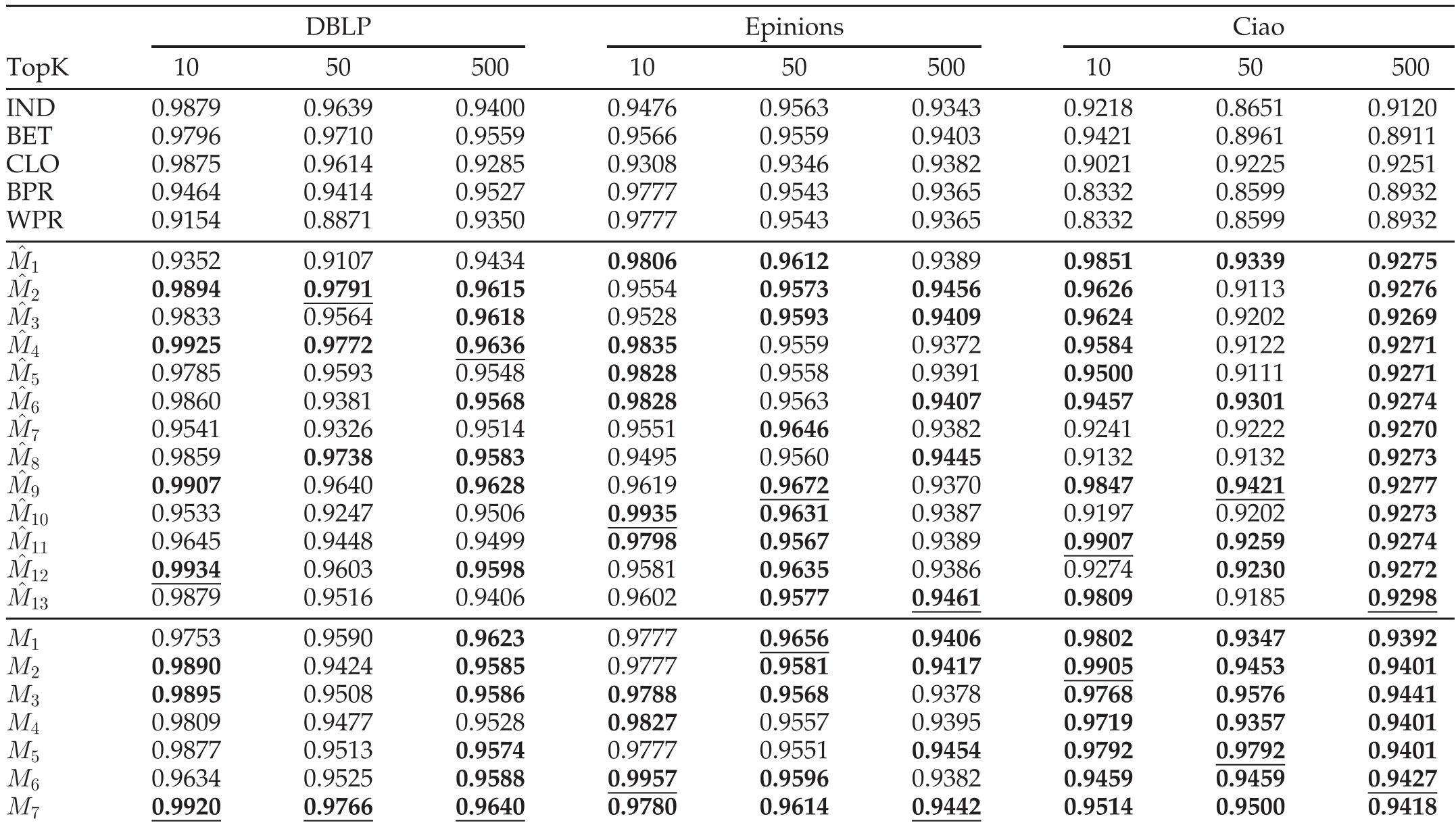 Table 1: MPR consistently beats baselines like Indegree (IND), Betweenness (BET), and standard PageRank (BPR/WPR).
Conclusion & Critical Insight
The brilliance of Motif-based PageRank lies in its ability to inject "social intuition" into a mathematical algorithm. By recognizing that the context of a connection (is it part of a community triangle?) is as important as the connection itself, MPR provides a much clearer picture of who truly holds authority in a network.
Limitations: The primary challenge remains motif selection. Currently, it requires a "data-driven pipeline" to find the best-performing motif for a specific domain. Future research into automatically learning these motifs (perhaps via Graph Neural Networks) could make this framework even more powerful.