
Motive: Tracking the Roots of Motion in Video Generation
Motion Attribution for Video Generation
Motive (MOTIon attribution for Video gEneration) is a gradient-based data attribution framework specifically designed to isolate and quantify the influence of training clips on the temporal dynamics of video generation models. Evaluated on billion-parameter models like Wan2.1 and LTX-2B, it achieves a 74.1% human preference win rate by guiding data curation that improves motion smoothness and physical plausibility.
TL;DR
While video generation models have reached staggering levels of realism, we still don't fully understand which training videos teach a model to roll, bounce, or explode. Motive is the first scalable framework that attributes a model's motion behavior back to its training data. By isolating temporal dynamics from static scenery, it enables researchers to curate high-impact datasets that improve motion quality by over 10% while using 90% less data.
The "Static Bias" Problem in Video Attribution
In the world of image generation, data attribution tells us which training photos influenced a generated object's texture or style. However, if you apply these methods to video, they fail. Why? Because existing methods treat time as just another spatial dimension. They get distracted by the static background or the color of a ball rather than the physics of how that ball bounces.
Traditional attribution is also a "memory killer." Storing raw gradients for a billion-parameter model across thousands of video frames is practically impossible for most research labs.
Methodology: The "Motion Mask" and Scalable Projections
Motive solves these issues through a two-pronged strategy: Motion Saliency and Dimensionality Compression.
1. The Motion-Weighted Gradient
The core insight is to reweight the loss function so the model only "cares" about the pixels that are moving.
- Detection: It uses AllTracker to compute optical flow for every pixel.
- Masking: It creates a latent-space mask where dynamic pixels retain 100% weight, while static background pixels are attenuated.
- Result: The resulting gradient reflects the model's "temporal learning" rather than its "scenery learning."
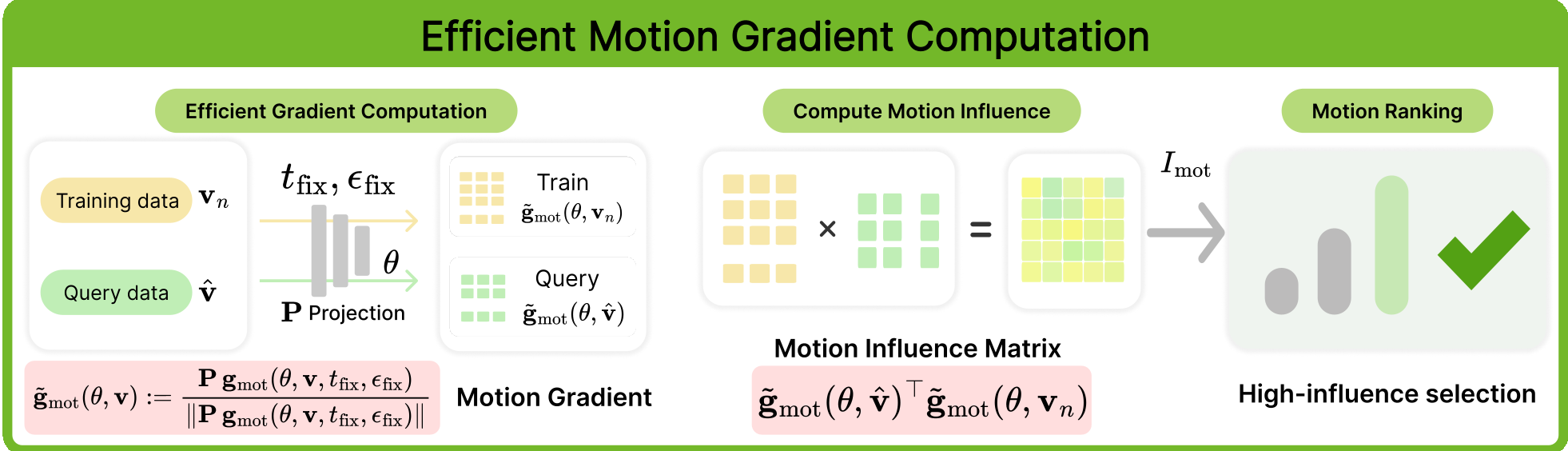 Figure 1: The Motive pipeline—from motion tracking to projected gradient similarity.
2. Making it Scale
To handle models like Wan2.1 (1.3B) and LTX-2B, the authors employed:
- Single-Timestep Estimation: Instead of averaging gradients across the whole denoising path, they found that a fixed midpoint (t=751) provides a stable ranking.
- Fastfood Projection: They use a structured Johnson–Lindenstrauss projection to squash a billion-dimensional gradient into a compact 512-dimensional vector without losing the "influence geometry."
Experimental Proof: Better Motion with 10% of the Data
The authors tested Motive by selecting the "most influential" 10% of videos from datasets like VIDGEN-1M to fine-tune base models.
Performance Metrics
The results on VBench were striking. The Motive-selected subset significantly outperformed random selection and even beat "Full Fine-tuning" (using 100% of the data) in dynamic intensity.
| Metric | Base Model | Random (10%) | Full FT (100%) | Motive (Ours 10%) |
|---|---|---|---|---|
| Dynamic Degree | 39.6% | 41.3% | 42.0% | 47.6% |
| Motion Smoothness | 96.3% | 96.3% | 96.3% | 96.3% |
Qualitative Edge
Where the base model might produce a "jittery" or static response to a prompt like "floating leaf," the Motive-enhanced model generates smooth, physically plausible fluid dynamics because it was trained on clips prioritized for their motion information.
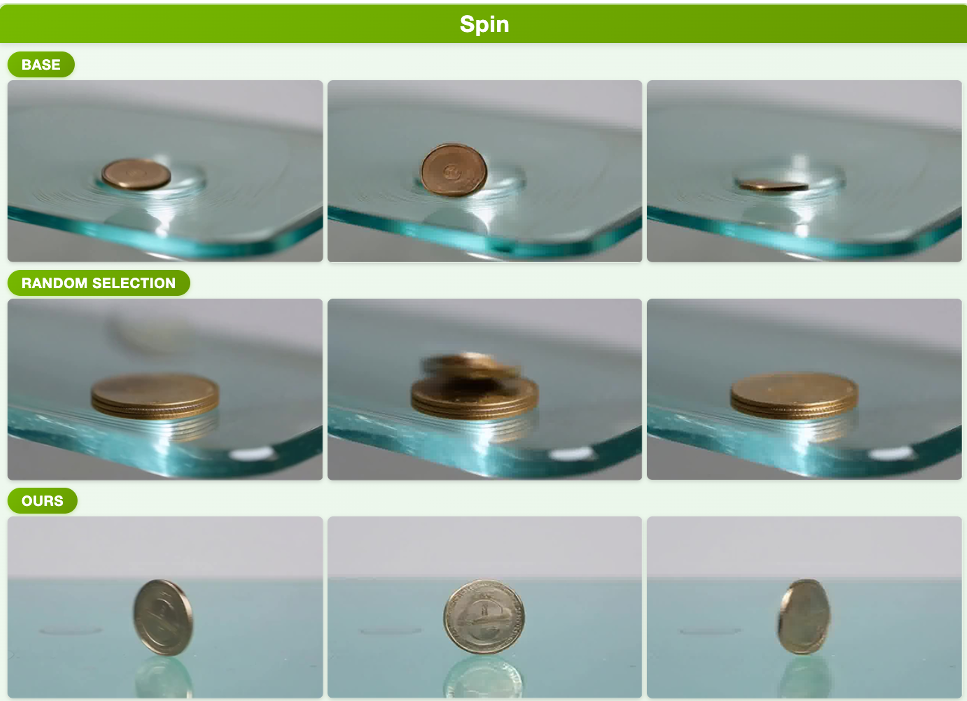 Figure 2: Qualitative comparison showing Motive's superior temporal consistency in complex deformation tasks.
Critical Insight: It's Not Just About "High Motion"
One might think Motive just picks the fastest-moving videos. The authors proved this wrong. By analyzing the "Motion Magnitude" distribution, they found that many high-influence clips actually have relatively low overall movement. Motive isn't a "motion filter"—it's an influence engine. It identifies clips that specifically help the model reduce its loss on temporal tasks, regardless of their raw speed.
Conclusion
Motive marks a shift from "brute-force" video training to "surgical" data curation. As we move toward World Models and AI that understands physical laws, the ability to trace motion back to data will be indispensable for debugging "hallucinated physics" and building more controllable generative systems.
Future Outlook
The next frontier for Motive is applying this to Audio-Visual sync and World Models, where the goal is to understand how seen actions create heard sounds or predicted future states.