
Predicting Success in Motion: How Wearables and AI Shape the Future of Embodied Learning
Motion-Based Educational Games: Using Multi-Modal Data to Predict Player’s Performance
This paper presents a multi-modal data (MMD) approach to predict student performance in Motion-Based Touchless Games (MBTG) for mathematics. By fusing gaze, physiological, and skeletal data through ensemble learning, the researchers achieved high-accuracy performance predictions (F1-score of 0.946) and demonstrated the feasibility of early prediction using only 50% of gameplay data.
TL;DR
Researchers from the Norwegian University of Science and Technology (NTNU) have developed a machine learning framework that predicts a student's success in educational motion-based games with over 90% accuracy. By analyzing eye movements and physiological signals (like heart rate and skin conductance), the system can foresee if a child will answer a math problem correctly within the first 47 seconds—paving the way for "proactive" AI tutors that intervene before a student even fails.
Background: Beyond the Keyboard
Motion-Based Touchless Games (MBTG) like those played on the Kinect have moved from living rooms to classrooms. While we know they are engaging, the big question remains: Can we use the data generated by a child's body to understand their learning process in real-time?
Current educational assessment is often "lagging"—it tells you what happened after the task is done. This paper shifts the paradigm toward "leading" indicators, using Multi-Modal Data (MMD) to catch struggle or success as it happens.
The Experiment: Math in Motion
The study involved 26 children playing two custom-built math games:
- Marvy Learns: A geometry game where players sort 3D shapes.
- Sea Formuli: An arithmetic game involving operations with decimals and fractions.
To capture the "full picture" of the learner, the team synchronized three powerful data streams:
- Gaze: Eye-tracking glasses to monitor attention and cognitive load.
- Physiological: Wristbands (Empatica E4) measuring heart rate (HRV), skin temperature, and electrodermal activity (EDA).
- Skeleton: Kinect sensors tracking 25 physical joints.
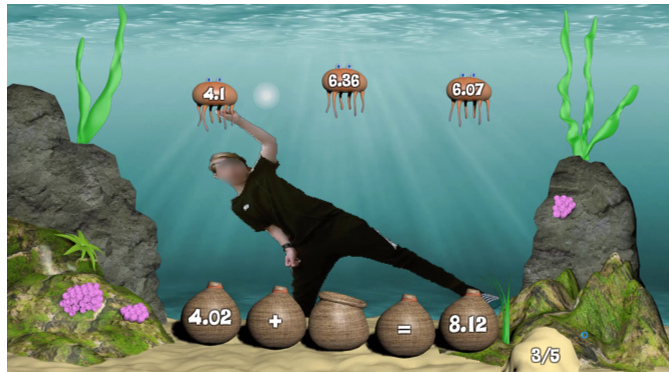 Figure 1: A player navigating a geometry problem in Marvy Learns.
Methodology: The Power of Fusion
The researchers didn't just look at one sensor. They tested seven different combinations of data using an Ensemble Learning approach. This method aggregates predictions from multiple algorithms (SVM, Gaussian Processes, and Model Trees) to ensure robustness.
They also tested Early Prediction. Could they predict the outcome using only the first 50% of the time spent on a question?
Key Results: Gaze + Physiology > Everything Else
The findings yielded a surprising technical insight: More data isn't always better.
- The Winner: The combination of Gaze and Physiological data was the champion, achieving an F1-score of 0.946.
- The Skeleton Paradox: Surprisingly, adding skeletal data (body movement) reduced the prediction accuracy. While the body is used to play the game, the eyes and the heart are what reveal the "internal" state of learning.
- The "Half-Time" Miracle: Using only half the data (first 47 seconds) only resulted in a minor 20% drop in relative improvement compared to the full duration. This means early intervention is highly feasible.
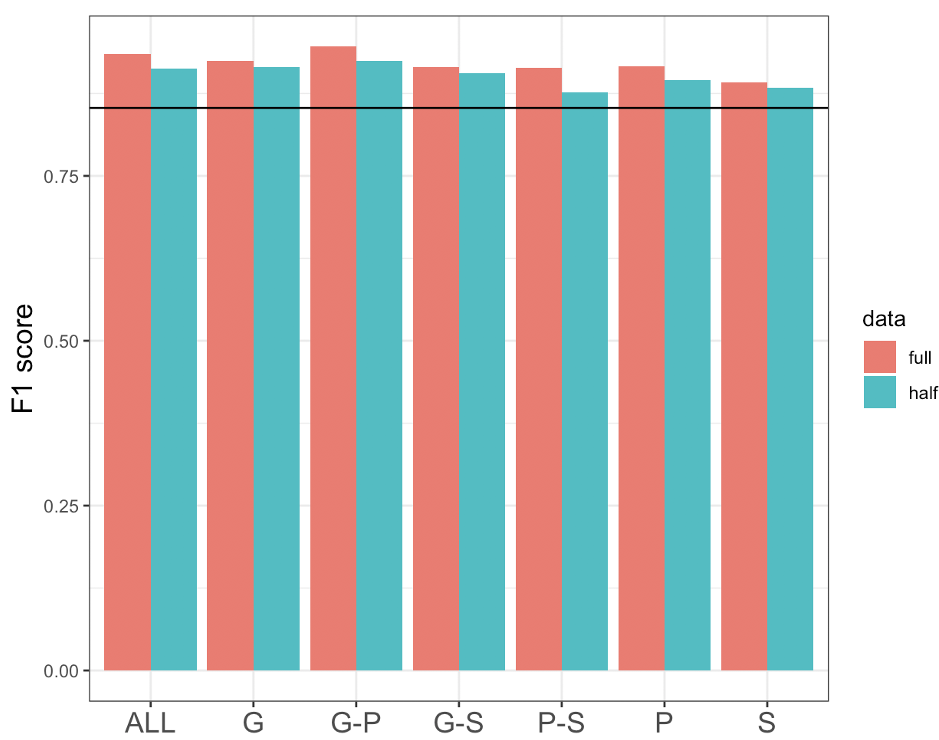 Figure 2: F1-scores comparing various data combinations across full and half-time segments.
Deep Insight: Why Why Does This Work?
Why are gaze and physiology so predictive?
- Gaze serves as a proxy for Cognitive Load and attention. Where a student looks (or lingers) tells us if they are scanning for answers or are confused by the UI.
- Physiological signals like EDA (sweat gland activity) are tied to arousal and stress. A spike in EDA might indicate "Aha!" moments or extreme frustration.
- Skeleton data, while great for interaction, is often too noisy or "task-dependent" to serve as a clean indicator of internal mathematical thinking.
Future Outlook: Proactive Classrooms
This research moves us closer to the "Fitbit for Learning." Imagine a classroom where:
- AI Scaffolding: A game detects a student's rising stress and narrowing gaze via their wristband and glasses, offering a hint before they give up.
- Dynamic Difficulty: The game prepares a harder or easier follow-up question 30 seconds before the current round ends, keeping the student in the "Flow" state.
- Teacher Dashboards: An instructor sees a real-time heatmap of which students are 40 seconds away from failing a specific concept, allowing for immediate human intervention.
Conclusion
The study proves that MMD is a powerful tool for decoding human learning. While skeletal tracking is vital for the fun and embodiment of the game, the true secrets of student performance are hidden in the rhythm of the heart and the movement of the eyes. By harnessing "Early Prediction," we can transform educational games from static tools into responsive, intelligent learning partners.