
Beyond Scaling: Why We Can Tell a Child’s Motion Apart from an Adult’s
Is the Motion of a Child Perceivably Different from the Motion of an Adult?
This research presents the first systematic study on whether human viewers can perceptually distinguish between child (ages 5-9) and adult motion. Using a point-light display paradigm and markerless motion capture, the authors demonstrate that naive observers identify the correct age group at better-than-chance levels.
TL;DR
Is a child just a small adult? In the world of animation, the answer is a resounding "No." This study by researchers at the University of Florida explores the perception of biological motion, proving that humans can distinguish a child’s movement from an adult’s even when physical size is factored out. By using "point-light displays," the research highlights that the essence of being a child is written in the velocity and coordination of movement.
The "Mini-Adult" Fallacy in Animation
For decades, the animation and gaming industries have relied heavily on adult motion capture. When a child character is needed, the common practice is often to take an adult’s motion and scale it down. However, professional animators have long intuited that children don't just look different—they move differently.
The technical challenge has always been: Why? Is it just because they are shorter? Is it their body proportions (like a larger head-to-body ratio)? Or is there something fundamental in their neuromuscular system? This paper isolates the "motion" component to see if movement alone carries the signature of age.
Methodology: The Point-Light Paradigm
To strip away visual distractions like clothing, skin, or height, the researchers used Point-Light Displays (PLDs). This classic psychological tool represents the human body as 20 glowing dots on a black background.
Data Collection
- Capture: Used Microsoft Kinect (markerless mocap) to record 4 children (ages 5-9) and 4 adults.
- Actions: Six specific movements: Wave, Walk, Run, Jump, Jumping Jacks, and "Fly like a bird."
- Normalization: This was the critical step. The researchers scaled every actor to a canonical height. If you saw a 5-year-old and a 30-year-old on screen, they would appear to be the exact same size.
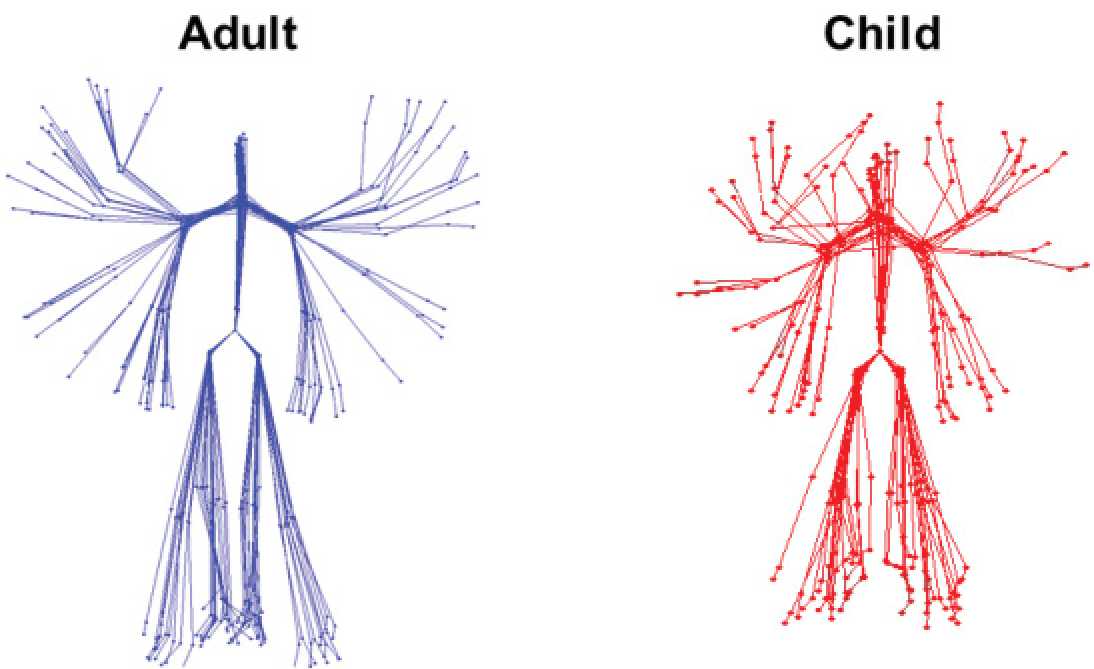 Figure: The visualization of joint angles and velocities, pelvis-aligned to highlight dynamic differences.
The Perception Test
The researchers conducted a "two-alternative forced-choice" task. Naive viewers watched the dots and had to guess: Child or Adult?
Before the main test, they ran a "sanity check" (Pre-experiment) to ensure the motion wasn't just perceived as random noise. Unsurprisingly, people are incredibly good at recognizing biological motion—accuracy was over 90% when distinguishing a human from a "scrambled" version of the dots.
Key Results: We Can Feel the "Youth"
The main experiment revealed that viewers were correct 66.1% of the time. While not perfect, it is statistically significant and matches accuracy levels found in studies distinguishing gender or emotion through motion.
What were the cues?
- Velocity: Children’s motions were found to be more rapid. They completed the same number of repetitions in less time than adults.
- Coordination: In "Jumping Jacks," coordination was a major "age cue." The less coordinated or "messier" the movement, the more likely viewers were to label it a child.
- Action Sensitivity: Highly dynamic actions (running and walking) were easier to categorize than static actions (waving).
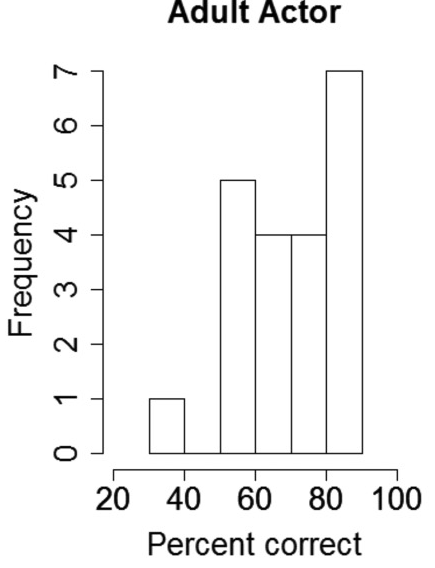 Figure: Accuracy across participants. Almost every viewer performed better than a 50/50 guess.
Why This Matters for the Future
This research has profound implications for Avatar Realism. If you are building a VR social platform or a Triple-A game featuring child characters, simply "shrinking" an adult performance will likely fall into the "Uncanny Valley."
The Takeaway for Developers:
- Authentic Mocap: There is no substitute for capturing actual children if you want authentic "child-like" energy.
- Motion Synthesis: For procedural animation, developers should focus on increasing jitter/uncoordination and increasing relative joint velocity to simulate younger characters.
Final Thoughts
The study concludes that child motion is a distinct category of biological movement. While older children (ages 8-9) begin to move more like adults, the "unfiltered energy" and unique coordination of younger children (ages 5-6) are unmistakable—even when they are reduced to a few glowing dots on a screen.
Limitations and Future Work
The authors acknowledge that using only male adult actors and a small sample size are limitations. Future research could investigate if parents are better at this task than non-parents, or if children themselves are more sensitive to these motion cues when interacting with avatars.
Note: This study represents a milestone in "Applied Perception," bridging the gap between biomechanics and computer animation.