
Fusion of MHSV and TCBV: Achieving Robust View-Independent Action Recognition
Motion History of Skeletal Volumes and Temporal Change in Bounding Volume Fusion for Human Action Recognition
The paper introduces a view-independent human action recognition framework that fuses Motion History of Skeletal Volumes (MHSV) with Temporal Change in Bounding Volumes (TCBV). By combining global volumetric descriptors with local skeletal dynamics, the method achieves SOTA performance on benchmark datasets like IXMAS and i3DPost.
TL;DR
This research presents a robust 3D human action recognition system that combines Motion History of Skeletal Volumes (MHSV) and Temporal Change in Bounding Volumes (TCBV). By leveraging the geometric stability of skeletons and the structural dynamics of partitioned body volumes, the approach achieves nearly 90% accuracy on top-tier benchmark datasets, proving highly effective for view-independent surveillance and monitoring.
Problem & Motivation: The Limits of 2D and Standard 3D Volumes
Most traditional action recognition systems rely on 2D images, which are inherently "view-variant"—meaning the system might fail if the camera angle changes. While 3D reconstruction helps, standard Motion History Volumes (MHV) are notoriously sensitive to the "noise" or artifacts generated during 3D reconstruction (visual hull errors). Furthermore, representing a whole action as a single 3D block often misses the fine-grained temporal changes of specific body parts like legs versus arms.
The authors' insight was twofold:
- Skeletonization: By reducing 3D volumes to skeletons, they eliminate the surface noise of the visual hull while retaining the core motion intent.
- Part-based Temporal Analysis: By tracking the bounding boxes of three distinct body segments (head, torso, legs), they capture the "rhythm" of the action better than a global volume could.
Methodology: The Dual-Stream Architecture
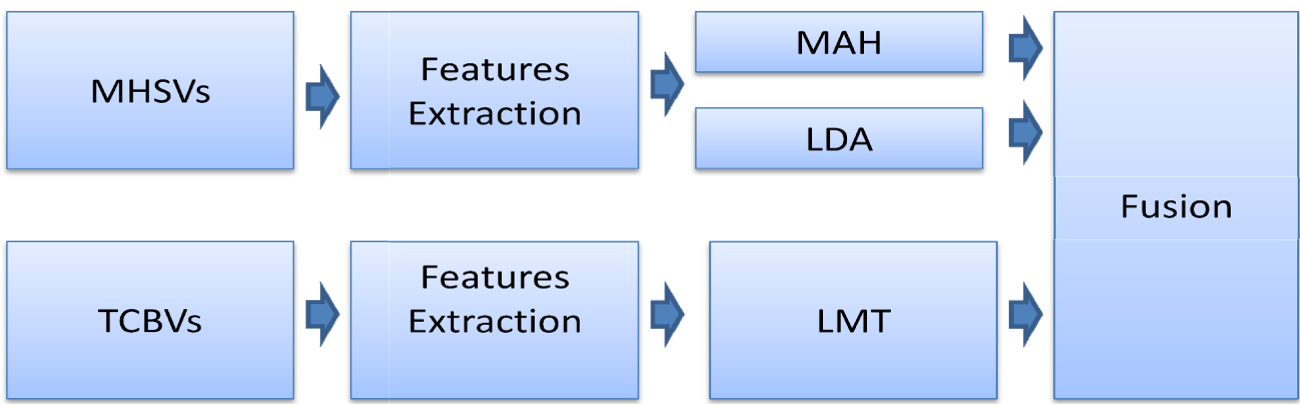
The proposed architecture is a textbook example of Decision-Level Fusion.
1. Motion History of Skeletal Volumes (MHSV)
Instead of using the full volume, the system computes the "singularities" in the Euclidean distance field to extract a 1D skeleton.
- Rotation Invariance: They transform the world coordinates into Cylindrical Coordinates and apply a 3D Fourier Transform. This ensures that if a person performs a "wave" while facing north or east, the feature vector remains nearly identical.
- Classification: They employ Linear Discriminant Analysis (LDA) and Mahalanobis distance to handle the high-dimensional skeletal history.
2. Temporal Change in Bounding Volumes (TCBV)
This stream focuses on the "envelope" of the motion.
- The volume is aligned using PCA (making it scale and orientation invariant) and divided into Head, Body, and Legs.
- Seven temporal curves are generated (representing dimensions of the sub-volumes over time).
- LMT (Logistic Model Trees): These curves are classified using a hybrid of decision trees and linear regression.
Experiments & Results: The Power of Fusion
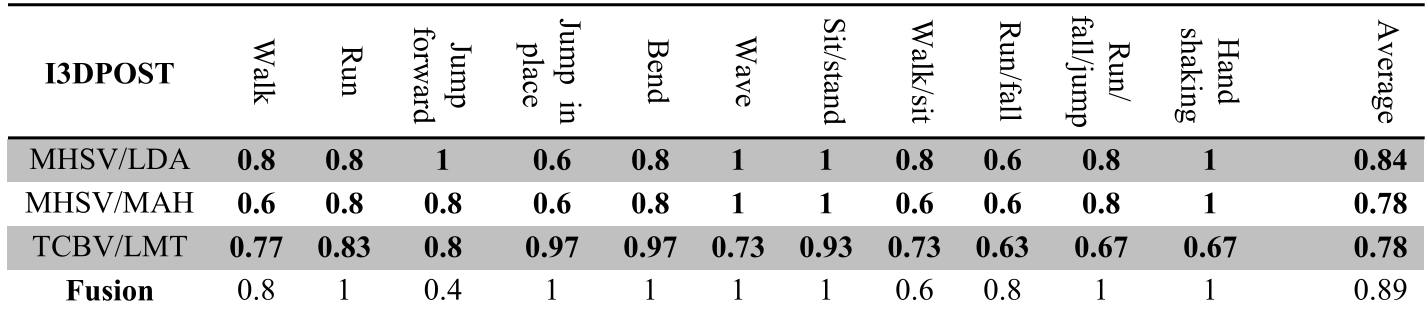
The researchers tested their method on the IXMAS and i3DPost datasets. The standout finding was that while MHSV or TCBV performed well individually (around 78-83%), the Majority Vote Fusion pushed the performance to the SOTA level.
| Dataset | MHSV (LDA) | TCBV (LMT) | Fusion (Ours) |
|---|---|---|---|
| i3DPost | 83.6% | 78.18% | 89.1% |
| IXMAS | 81.67% | 79.17% | 88.48% |
Key Ablation Insight
The fusion is particularly effective because MHSV captures the "shape" of the motion history, while TCBV captures the "rhythmic expansion/contraction" of body parts. Actions like "Jump in place" showed massive improvements (from 0.6 to 1.0 accuracy in i3DPost) when the two features were combined.
Critical Analysis & Conclusion
Takeaway
The study demonstrates that skeletonization is a powerful pre-processing step for 3D action recognition, effectively acting as a high-pass filter that removes reconstruction noise. The use of cylindrical Fourier transforms is a mathematically elegant solution to the problem of view-invariance.
Limitations & Future Work
- Automation: While the authors argue for automation, the 3D voxelization process still requires significant computation.
- Complexity: Performance tends to drop as the number of action classes increases (e.g., from 11 actions to 13).
- Future Path: Integrating these skeletal motion histories into a Deep Learning pipeline (like a 3D-CNN or Transformer) could further automate the feature extraction process and improve performance on even more complex activities.
Overall, this work provides a solid foundation for robust, multi-view action recognition in real-world 3D environments.