
CoPS: Revolutionizing Content Sharing in Mobile Social Networks via Collective Bidding
Motivating content sharing in mobile social network through collective bidding
This paper introduces CoPS (Content Pricing and Sharing), an incentive-driven framework for Mobile Social Networks (MSNs) using collective bidding. By leveraging the broadcast nature of wireless communication, it enables users to share high-value digital content during ephemeral encounters while distributing costs among multiple recipients.
TL;DR
Mobile Social Networks (MSNs) often struggle with the "Selfish Node" problem—users want to receive data but are reluctant to pay the energy and time costs to share it. CoPS (Content Pricing and Sharing) introduces a collective bidding auction that allows multiple receivers to split the cost of a single wireless broadcast. This approach reduces data collection delays by 80% and significantly cuts down on individual user expenditure.
Background: The Exhibition Paradox
Imagine you are at a massive tech exhibition. You want to visit every booth, but time is limited. You meet a peer who has already visited 10 booths you missed. They have the data, but why should they waste their battery and time sharing it with you for free?
Mainstream incentives usually assume the provider wants to spread the word (like an advertiser) or uses a simple 1-to-1 credit system. However, in high-density, ephemeral events, these models fall short because they don't account for the cost-sharing potential of wireless broadcasting.
The Core Innovation: Collective Bidding (CoPS)
The brilliance of CoPS lies in its transition from a simple "buy-sell" transaction to a crowdfunded broadcast.
1. Preference-Aware Valuation
Before bidding, a user (the Principal) calculates their interest in a content piece using a feature vector comparison: If the similarity exceeds a personal threshold , the user identifies as a potential buyer.
2. The Auction Mechanism
Instead of the agent setting a price, the principals propose bids based on their perceived value. The Agent (provider) only triggers the broadcast if: Where is the cost of sharing. This ensures Individual Rationality: no one shares at a loss, and no one pays more than their valuation.
 (Note: This optimal bidding strategy is refined through numerical approximation derived from the Irwin-Hall distribution to ensure the sum of bids covers the cost efficiently.)
Experimental Validation
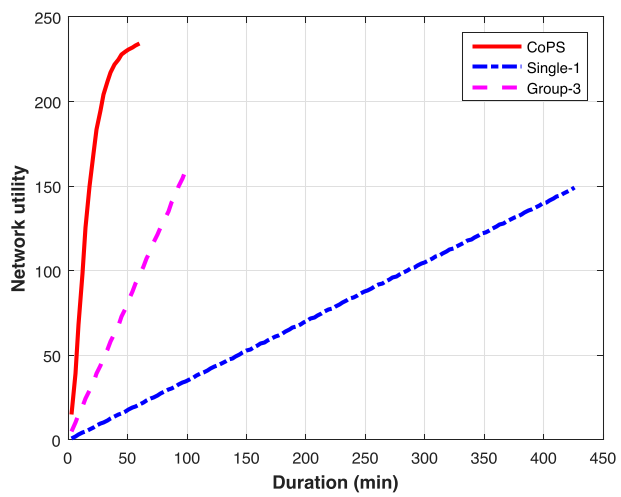
The authors compared CoPS against two baselines: Single-1 (Individual visits to every booth) and Group-3 (Collaborative groups of three).
Delay and Cost Efficiency
The results were striking. By opportunistic sharing, users didn't need to physically travel to every stand.
- Time Delay: CoPS achieved an 80% reduction compared to the Single-1 baseline.
- Financial/Resource Cost: Because costs are shared among co-located peers, the cost per user dropped by ~40%.
Critical Insight: Why it Works
The "Secret Sauce" of this methodology is the Broadcast Nature of Wireless Communication. In a traditional market, selling to 10 people costs 10x more effort. In MSNs, broadcasting to 10 people costs nearly the same as broadcasting to one. CoPS exploits this "zero marginal cost" of additional recipients to make content cheaper for everyone, thereby increasing the total Network Utilization.
Conclusion & Future Outlook
CoPS successfully aligns individual greed with collective benefit. By treating content sharing as a cost-sharing game rather than a simple trade, it unlocks massive efficiency in crowded environments.
Limitations: The model assumes users are honest about their valuations and that contact rates follow a Poisson distribution. Future work could introduce Robustness against Strategic Misreporting (making the auction "Truthful") and exploring how Blockchain could handle the micropayments in a trustless environment.
Main Technical Takeaway: In broadcast-capable networks, the most efficient incentive is not a fixed price, but a collective threshold that triggers shared benefits.