
MCoST: Solving the Trust and Incentive Paradox in Mobile Social Networks
Motivating Content Sharing and Trustworthiness in Mobile Social Networks
This paper introduces MCoST, a novel mechanism for motivating content sharing and ensuring trustworthiness in Mobile Social Networks (MSNs). It combines collective bidding and cost-sharing game theory with a distributed cryptographic hash-chained review system to achieve high network utilization and resilience against malicious behaviors.
TL;DR
In ephemeral settings like exhibitions, Mobile Social Networks (MSNs) often struggle with two conflicting issues: users' lack of motivation to share content due to costs, and the risk of receiving malicious data from strangers. MCoST (Motivating Content Sharing and Trustworthiness) tackles this by combining an Auction-based Collective Bidding model with a Distributed Hash-Chained Review system. It cuts content collection time by 86% and creates a tamper-proof ecosystem where sybil attacks and negative review rejections are easily detected.
The Problem: The High Cost of "Strangers"
Imagine you are at a massive tech exhibition. You want to see everything, but time is limited. You encounter a stranger who has already collected high-quality data from a booth you missed. Why would they share it with you? Sharing consumes battery, memory, and effort. Conversely, why would you trust their file? It could be malware or fake information.
Existing solutions are often insufficient:
- Prior Works: Focus on "reward-based" dissemination but ignore the initial cost to generate the content.
- Trust Metrics: Many rely on "familiarity," which doesn't work for strangers meeting for the first time.
- Blockchain: Heavy, requires global consensus, and assumes all nodes are fully connected—impossible in the "hop-by-hop" world of MSNs.
Methodology: The MCoST Framework
1. Collective Bidding & Cost Sharing
To solve the incentive problem, MCoST treats content sharing as a game. Instead of one-to-one selling, the content provider (Agent) uses the broadcast nature of wireless signals. If multiple peers (Principals) are interested, they bid collectively.
- The Logic: If the sum of bids covers the transmission cost (), the broadcast proceeds. This reduces individual costs for receivers while compensating the provider.

2. Hash-Chained Trust Evaluation
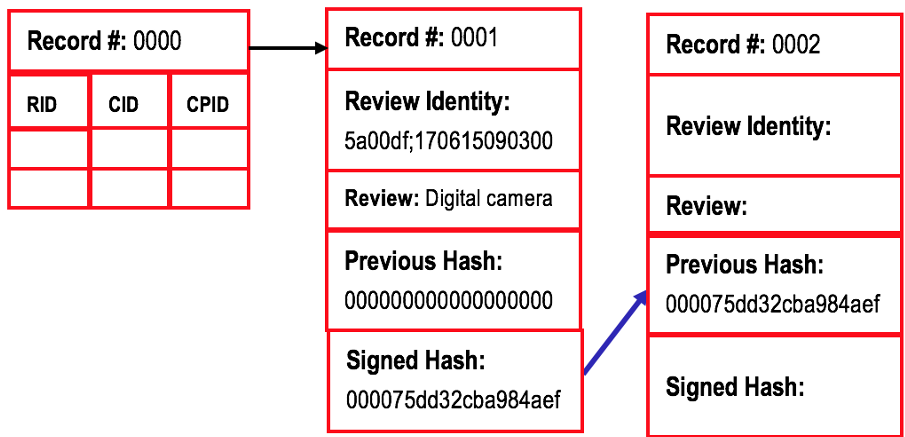
How do we ensure the reviews are real? MCoST uses a simplified "local blockchain" approach. Each content's metadata includes a Review History (rh) and a Hash-Chain of Ratings.
- Immutability: Every review record is signed with a private key and contains a hash of the previous record. If a provider tries to delete a bad review or change a 1-star to a 5-star, the cryptographic chain breaks.
- Rejection Resilience: Users also share a summary of which contents they have reviewed. If a provider tries to hide a review entirely (Rejection Attack), a future encounter can detect the missing entry by checking their own updated review history.
Experiments: Superior Efficiency & Security
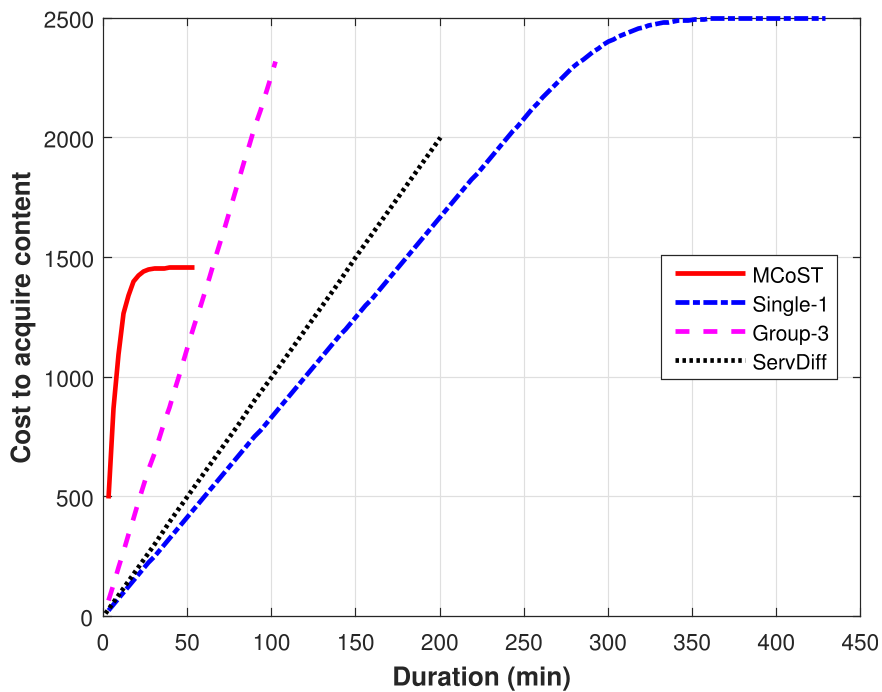
The researchers simulated a 250m x 250m exhibition with 200 users. The results were staggering:
- Extreme Efficiency: Compared to the "Single-1" (manual visiting) baseline, MCoST reduced collection delay from hours to minutes (86% reduction).
- Financial Viability: Bidding strategies optimized the cost by 40%.
- Robust Security: Unlike previous models like MobiFuzzyTrust, which fail against sybil attacks, MCoST identifies 100% of multi-identity and self-review attempts.
Depth Insight: The "Why" behind the Success
The brilliance of MCoST lies in its Hybrid Trust Metric. It doesn't just look at reviews; it calculates trustworthiness () using:
- Reputation Score (RS): From the tamper-proof hash chain.
- Familiarity Score (FS): Based on prior successful interactions.
- Similarity Score (SS): Based on shared interests (tags).
By applying an inverse sigmoid function to account for "Time Decay" (older reviews matter less), the system mimics human social evolution.
Limitations & Future Outlook
While MCoST is a leap forward, it assumes users are willing to register with an "Exhibition Organizer" to get secret codes for key generation. In a truly wild, unauthorized MSN, this "root of trust" might be missing. Future research could explore Self-Sovereign Identity (SSI) to remove this last bit of centralization.
Regardless, MCoST provides a blueprint for any decentralized application—from disaster relief communication to local community mesh networks—where trust and incentives must coexist.