
EnergyWiz: Breaking the "One-Size-Fits-All" Barrier in Social Energy Conservation
Motivating domestic energy conservation through comparative, community-based feedback in mobile and social media
The paper introduces EnergyWiz, a mobile and social media-integrated application designed to foster domestic energy conservation. It moves beyond "one-size-fits-all" feedback by leveraging comparative feedback mechanisms—specifically eco-visualizations, temporal self-comparison, and social comparisons (normative, one-on-one, and ranking)—integrated with Facebook.
TL;DR
Saving energy at home is often a boring, invisible, and lonely task. EnergyWiz is a mobile application that transforms mundane electricity data into a social experience. By integrating with Facebook and offering five types of comparative feedback—from competing with friends to checking if you're "greener" than your neighbors—the study identifies how different psychological triggers can motivate different types of users to go green.
Background: Beyond the Mundane Meter
While smart meters have become common, most people don't know what to do with a raw "kWh" reading. This paper identifies a critical gap in Sustainable HCI: the lack of engagement. The researchers argue that to change behavior, we must move from simple data display to persuasive technology that taps into our social nature.
The Core Challenge: Why Current Monitors Fail
The authors point out three primary pain points:
- Cognitive Overload: Making sense of CO2 emissions or energy units is mentally taxing.
- The Alone Factor: Energy saving is traditionally a private, isolated activity.
- One-Size-Fits-All: A financial incentive might work for some, while environmental impact or social status works for others.
Methodology: The EnergyWiz Framework
EnergyWiz was designed using a "theory-driven" approach, focusing on five distinct types of comparison:
- Explanatory (Eco-Visualizations): Translating energy into "number of trees" or "laptops powered."
- Temporal: Comparing your current usage to your own past performance (History).
- Normative: Comparing you to the "average" neighbor.
- One-on-One: Direct "Challenges" against Facebook friends.
- Ranking: Global leaderboards among similar households.
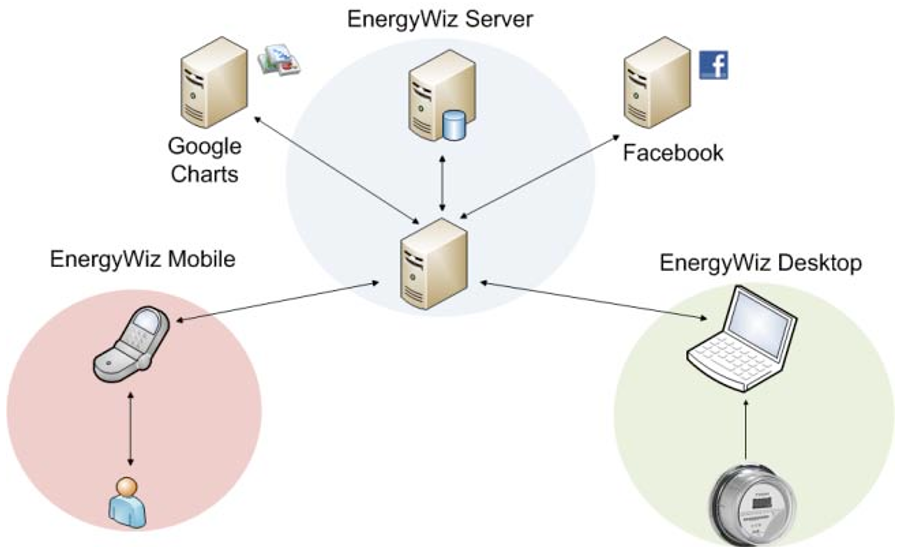 Figure: The "Challenge" and "Neighbours" interfaces show how social context is embedded into energy data.
Key Insights: What Actually Motivates People?
The study’s findings challenge the assumption that "neighbors" are the best comparison point:
- Friends > Neighbors: For competition, users preferred challenging people they actually knew and liked (friends) rather than anonymous neighbors, as the emotional connection drove higher engagement.
- The Similarity Paradox: Users were skeptical of neighbor comparisons because "their lifestyles might be different." For benchmarking to be effective, users demanded comparison with highly similar households (e.g., same number of kids, same appliances).
- Units Matter: Experienced users preferred kWh, while beginners were more motivated by Money or CO2 visualizations.
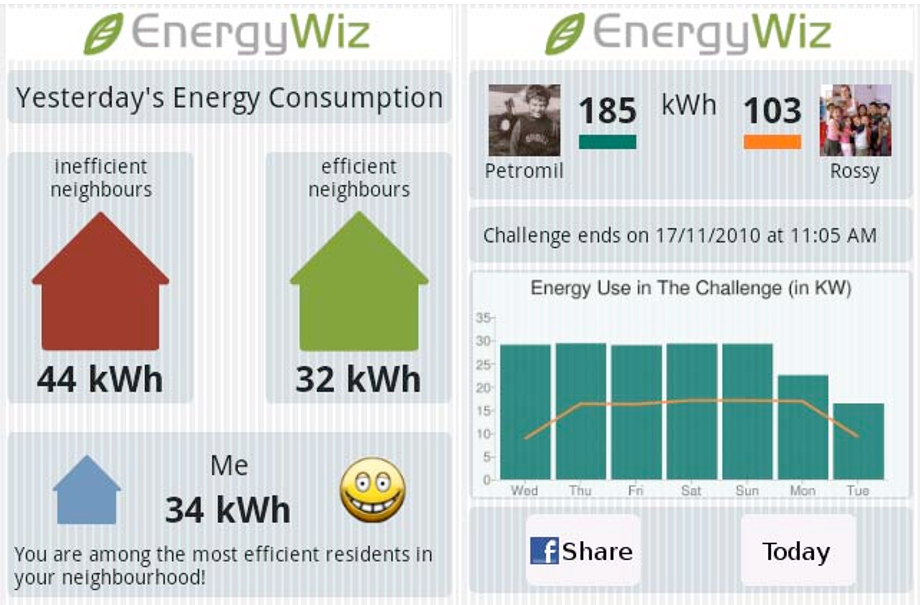 Figure: The technical setup connecting the home Smart Meter (AMI) to the Cloud and the Mobile App.
Critical Analysis & Conclusion
The true value of this research lies in its motivation-specific design guidelines. It highlights that a "social" energy app isn't just about a leaderboard; it’s about creating communication channels.
Takeaway: Future energy apps should act more like a "social coach." While EnergyWiz proved that social media can make saving energy "fun," the authors admit the "last mile"—providing specific, actionable hints on how to save that energy (e.g., "Turn off your dryer now")—remains the next frontier.
Limitations: The study was conducted primarily on young, tech-savvy males. However, as the first adopters of smart home technology, this demographic provides a vital "vanguard" perspective for future product development.