
Fight or Unite: How Gameplay Mechanics Shape Crowdsourcing Motivation
Motivational Difference Across Gameplay Mechanics: An Investigation in Crowdsourcing Mobile Content
This study investigates how collaborative and competitive gameplay mechanics influence player motivation in mobile crowdsourcing games. By comparing two virtual-pet-themed apps ("Collabo" and "Clash") against a non-game control ("Share"), the research demonstrates that game-based approaches significantly enhance enjoyment, immersion, and socializing in georeferenced metadata collection tasks.
TL;DR
Is it better to make users compete or collaborate when you need them to collect data? This study reveals that while both increase engagement over traditional apps, competition fuels a sense of achievement and skill development, whereas collaboration is the engine for task efficiency and information retrieval.
Background: The Crowdsourcing Engagement Gap
Crowdsourcing is the digital era's solution to massive data tasks—tagging images, translating text, or mapping real-world locations. However, the "labor model" (like Amazon Mechanical Turk) often lacks the intrinsic spark to keep users coming back. Enter Crowdsourcing Games (Human Computation Games). They attempt to turn labor into play.
The researchers identified a critical unknown: Gameplay Mechanics. Specifically, does it matter if we are working together to "save a pet" or fighting each other to "own" it?
Methodology: The Virtual Pet Experiment
The researchers developed three distinct Android apps to test their hypotheses:
- Share (Control): A standard map-based content sharing tool.
- Collabo (Collaborative): Players form teams to "feed" starving virtual pets through comments and ratings.
- Clash (Competitive): Players duel for ownership of location-specific pets by generating higher-quality content.

The study utilized a between-subjects design where 73 participants were assigned one app for a week, ensuring the "novelty effect" wore off and true behavioral patterns emerged.
Key Results: Achievement vs. Efficiency
The data revealed a fascinating "motivational divide":
1. The Power of the Duel (Competition)
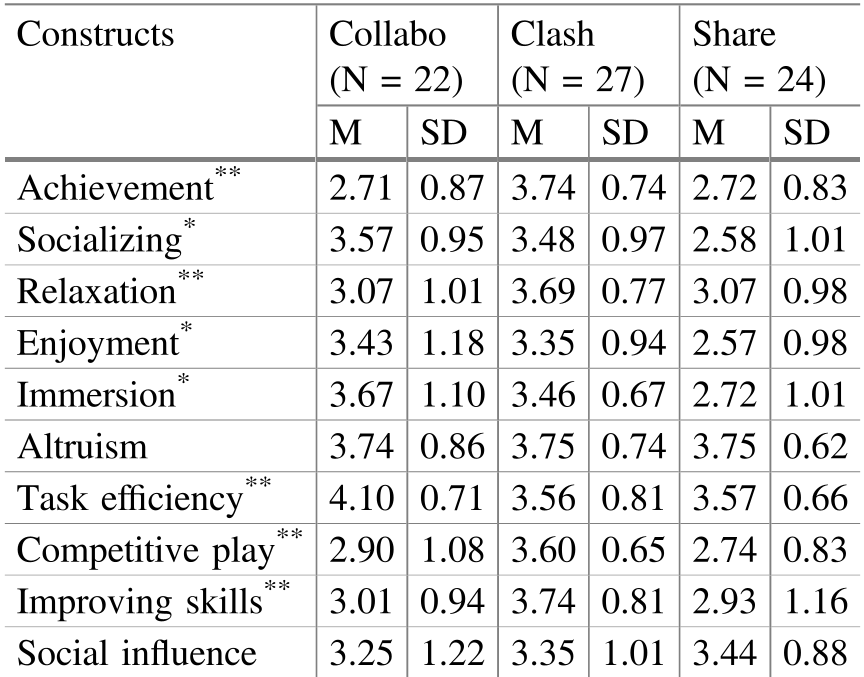
Participants in the Clash group felt a much stronger sense of Achievement. Why? Winning a duel provides a unique reward that isn't diluted by a team. Interestingly, competition also scored higher for Relaxation—the researchers suggest the intense focus required to win allows players to "escape" real-world stress more effectively.
2. The Power of the Team (Collaboration)
Collabo won significantly on Task Efficiency. When users perceive sharing as a collaborative act, they are more likely to use the tool to seek and retrieve information (e.g., asking/answering questions).
3. Games vs. "Work"
Unsurprisingly, both games crushed the non-game app "Share" in categories like Enjoyment, Immersion, and Socializing.
Critical Insight: The Designer’s Dilemma
The most striking takeaway is the Trade-off.
- If your crowdsourcing project requires users to sharpen their skills and produce high-quality, "winning" entries, Competition is your best friend.
- If your project relies on rapid information exchange and high-volume data retrieval, Collaboration is the superior architecture.
Conclusion & Future Work
This paper proves that gamification isn't just a "fun" skin—it's a structural choice that dictates how and why people contribute. However, the study is limited by its student-heavy demographic and a single domain (location comments).
The next frontier? Hybrid Mechanics. Finding the "Sweet Spot" where a game can offer the efficiency of collaboration with the high-octane achievement pull of competition. For digital libraries and mobile content creators, the message is clear: the rules of the game matter as much as the game itself.