
Beyond the Desk: Why We Check Social Media on the Go
Motivations for accessing social networking services on mobile devices
This research-article, "Motivations for Accessing Social Networking Services on Mobile Devices," identifies four primary drivers for mobile SNS usage: Social Connection, Awareness, Diversion, and Following Notifications. Conducted in South Korea, it highlights how real-time push alerts fundamentally transform SNS into a "companionship" experience, distinguishing them from traditional mobile web services.
TL;DR
This seminal study explores the psychological and situational triggers behind mobile Social Networking Service (SNS) usage. By analyzing user behavior in the highly connected market of South Korea, researchers discovered that mobile SNS is less about productivity and more about a persistent sense of "companionship" facilitated by real-time push notifications.
Context: The Shift to Mobile Ubiquity
In 2012, the transition from desktop-centric social media to mobile-first interaction was in full swing. However, the industry lacked a clear taxonomy of why users were constantly glancing at their phones. This paper situates itself as a bridge between Human-Computer Interaction (HCI) and social psychology, moving beyond "what" people do to "why" they do it.
The "Why": Four Pillars of Mobile Social Motivation
The researchers adapted existing frameworks to identify four distinct motivations that drive us to unlock our screens:
- Following Notifications (34%): The most frequent trigger. Push alerts (SMS-based or app-based) create a "messenger-like" urgency, making users feel that social events require immediate attention.
- Social Connection (29%): Driven by the need to share "micro-moments," such as photos of food or quick status updates. Interestingly, mobile devices also serve as tools for co-located sharing—passing the phone around to friends.
- Awareness (22%): A habitual, often mindless desire to stay current. This is the "social grooming" aspect—checking updates before getting out of bed or during a lunch break just to feel connected to one's circle.
- Diversion (13%): The classic "boredom killer." Using SNS to fill "empty time" during commutes or while waiting for a meeting.
Methodology: The Diary of a Connected Life
The study utilized a User Diary method, where participants logged their sessions in real-time. This provided high-fidelity data on the duration and context of usage that retrospective interviews often miss.
 Figure 1: The interfaces of Me2day and Cyworld, the primary platforms analyzed in the South Korean study.
Key Insight: The Power of Push Alerts
One of the paper's most significant contributions is the analysis of Cross-Medium Alerts. In South Korea, SNS updates were often pushed via SMS. This turned the SNS from a static "destination" into an "active solicitor."
- Hyper-coordination: Users engaged in "lightning meetings"—ad-hoc gatherings arranged instantly based on location-tagged posts.
- The Companionship Effect: Even when not actively chatting, knowing what others were doing provided a sense of "co-presence." As one participant noted, checking feeds during a long commute made the journey feel shorter and less lonely.
Experimental Results: Frequency and Duration
The study quantified the "micro-snacking" nature of mobile SNS. Unlike PC-based social media, which involves longer, deeper sessions, mobile sessions are goal-oriented and fleeting.
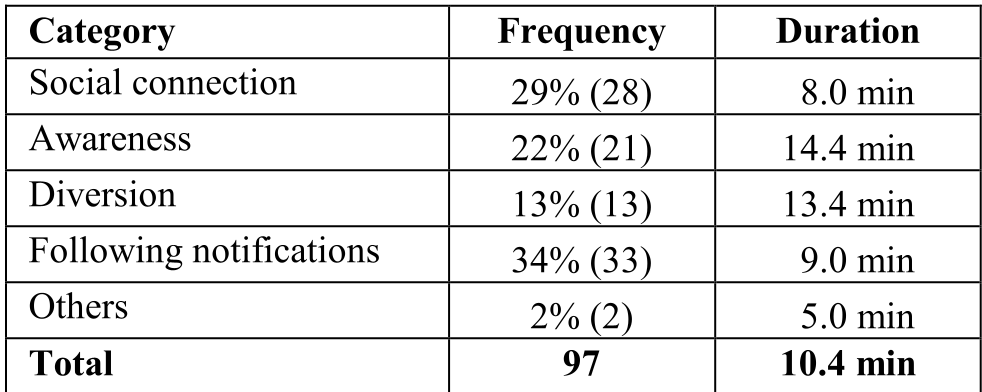 Table 1: Distribution of mobile SNS sessions. Note that sessions triggered by notifications and social connection are significantly shorter than those for diversion or awareness.
Critical Analysis & Future Outlook
While the study is a foundational piece in mobile HCI, it highlights a stark contrast with modern SNS:
- Absence of Productivity: In 2012, users rarely used SNS for "productivity" or "curiosity" (information seeking). Today, platforms like LinkedIn or Twitter (X) have become primary news and professional nodes, suggesting these motivations have since merged with the mobile experience.
- The Intrusiveness Trade-off: The study touched on "notification fatigue," a theme that has only intensified. Modern OS features like "Focus Mode" are the direct descendants of the manual notification-muting behaviors observed in this 2012 cohort.
Takeaway for Today's Designers: The "companionship" value of a service is often more important than its utility. Modern apps should strive to facilitate "low-stakes" social interactions that make the user feel seen and connected without the pressure of a formal conversation.