
From Liking to Buying: Decoding the Dual Desires of Social Commerce
Exploring the Motivations of Social Commerce: A Perspective of Consumer Shopping Value
This study develops a conceptual model to investigate social commerce intention by integrating Consumer Shopping Value (Hedonic, Utilitarian, and Social motivations) with the Model of Goal-Directed Behavior (MGB). It identifies "Desire" as a dual-path mediator (Social vs. Commercial Desire) that bridges specific shopping motivations to the final behavioral intention of engaging in social commerce on platforms like Facebook.
TL;DR
Why do we scroll for hours but rarely click "Buy Now"? This research tackles the "Social Commerce Paradox" by applying the Model of Goal-Directed Behavior (MGB). It reveals that our intention to shop on social media is driven by two distinct psychological engines: Social Desire and Commercial Desire. While we use Facebook for fun (Hedonic) and friends (Social), these only fuel our social desire. To actually make us buy, platforms must trigger our Utilitarian motivation—the pragmatic search for product value.
The Problem: The 3.1% Conversion Floor
Despite Facebook’s 2 billion users, social media accounts for a measly 3.1% of commerce site traffic. The industry has long struggled with a gap: users have a positive attitude toward brands, but no intention to purchase. Traditional models like TAM (Technology Acceptance Model) fail because they treat "usage" as a monolith. This paper argues that social commerce is a Goal-Directed Behavior, and the missing link is Desire—the motivational commitment that turns an appeal into an action.
Methodology: The Dual-Path Framework
The researchers proposed that because social commerce is a hybrid of social interaction and commercial exchange, the "Desire" construct must be split.
The Research Model
The study categorizes motivations based on Consumer Shopping Value:
- Social Motivation: The need to connect.
- Hedonic Motivation: The search for fun and "killing time."
- Utilitarian Motivation: Task-oriented information seeking.
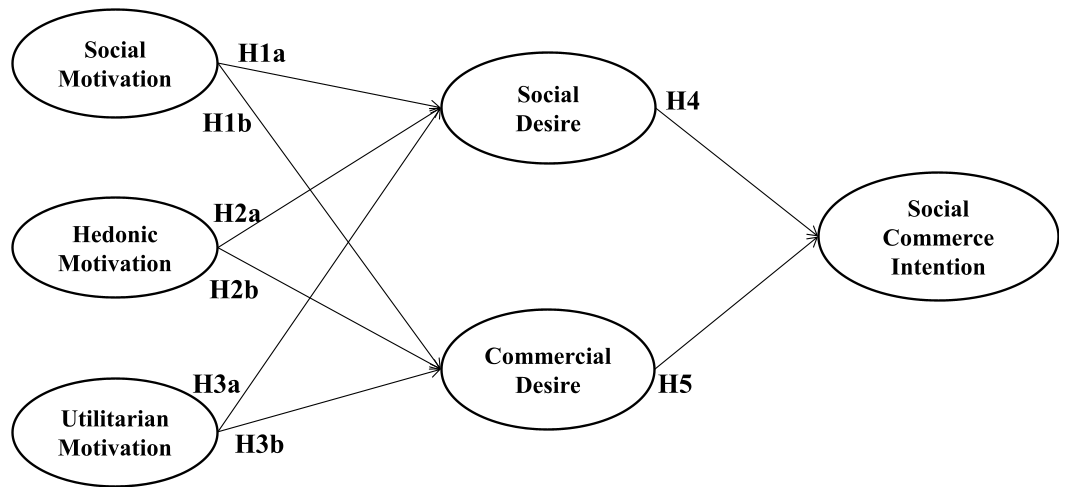
Using Partial Least Squares (PLS), the authors analyzed data from Facebook users to see which motivation fuels which desire, and how those desires translate to Social Commerce Intention (SCI).
Key Insights: Why "Social" Isn't Enough
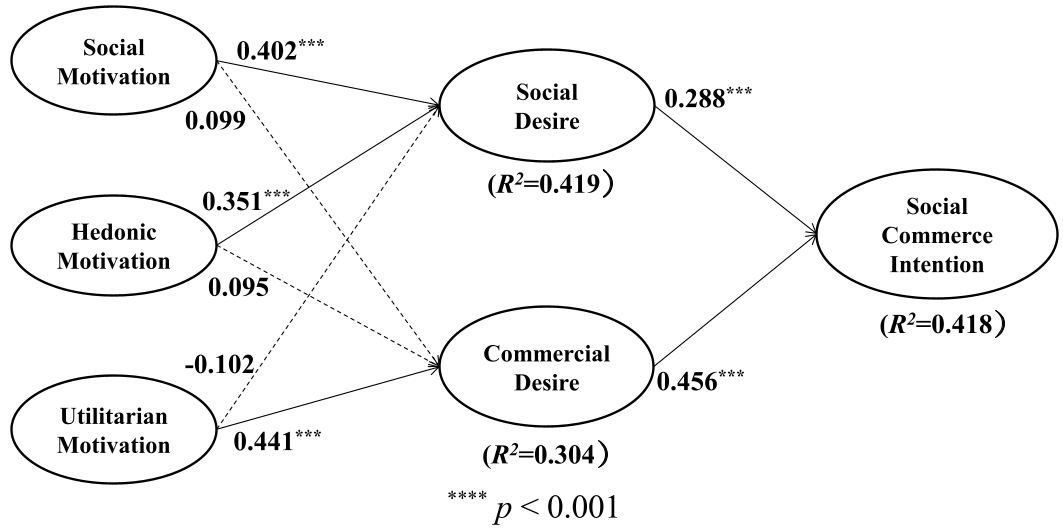
The experimental results (illustrated below) provide a sobering reality check for social media marketers.
1. The Disconnect
Social and Hedonic motivations are great for engagement—they significantly predict Social Desire. However, they have zero statistically significant impact on Commercial Desire. In other words, just because a user enjoys your meme doesn't mean they want to buy your product.
2. The Utilitarian Engine
Utilitarian Motivation is the only significant predictor of Commercial Desire (). Users need a "reason to shop"—such as product specifications, comparisons, or efficiency—to move into a commercial mindset.
3. Impact on Intention
Interestingly, Commercial Desire () has a much stronger grip on final purchase intention than Social Desire (). While social interaction "greases the wheels," the commercial drive is what actually turns the engine.
Critical Analysis & Future Outlook
Takeaway for Firms
To move the needle, firms must stop treating SNS strictly as awareness channels and start enhancing utilitarian value.
- Simplify the Path: Reduce friction in the "Buy Now" process.
- Monetary Incentives: Use rewards to stimulate the pragmatic "utilitarian" side of the brain.
- User Reviews: Leverage social power not just for "chatter," but for credible product information (Word-of-Mouth).
Limitations
The study focuses on Facebook, a platform that is increasingly seen as "legacy" by younger demographics. Future research should apply this dual-desire model to short-video platforms (TikTok/Reels), where the line between Hedonic (entertainment) and Utilitarian (product discovery via influencers) is increasingly blurred.
Conclusion
Social commerce is not just "E-commerce + Social." It is a delicate balance of psychological triggers. To succeed, platforms must satisfy the user's social hunger while simultaneously providing the utilitarian tools necessary to ignite their commercial desire.