
Beyond the Water Cooler: Why Professionals Network Inside the Firewall
Motivations for social networking at work
This paper introduces "Beehive," an internal social networking site (SNS) developed for IBM employees to facilitate personal and professional connections within a corporate firewall. Through a mix of qualitative interviews and quantitative usage analysis, the researchers explore how enterprise social networks foster connections that go beyond existing work teams, specifically targeting weak ties and new acquaintances.
TL;DR
IBM researchers explored the "Beehive" social network—a precursor to modern internal platforms—to understand why employees share personal lives at work. They discovered that unlike Facebook, which maintains existing friendships, enterprise social networks are used for social browsing: meeting new people to advance careers, find experts, and build a "silent army" for project support.
Context: Published in 2008 at ACM CSCW, this study is a seminal work in Enterprise Social Networking (ESN). It moves beyond the idea of social tools as just "information repositories" (like Wikis) and looks at them as engines for social capital.
Pain Points: The "Isolated" Professional
Before internal social networks, corporate life was often siloed. Communication was strictly hierarchical or team-based. The authors noted that:
- Corporate Directories were "Dead": Most employee profiles were empty, providing only a name and phone number without personality or context.
- Weak Ties were Neglected: Professionals had no easy way to maintain contact with former colleagues or meet experts in different divisions.
- The Millennial Gap: Younger workers accustomed to MySpace/Facebook expected a similar level of expression and connectivity at work that legacy tools didn't provide.
The "Three C's" of Social Networking at Work
The core contribution of this paper is the identification of three distinct motivations for using social software in a company:
1. Caring (The Social Glue)
This is the "life side" of the work/life balance. Users share vacation photos, hobbies, and "about you" statements to build trust. As one subject noted, “It helps me to like these people more, which makes me want to work with them.”
2. Climbing (The Strategic Networker)
Networkers use the site for career advancement. By commenting on a Senior VP’s profile about a shared interest (like a sports team), employees become more than just a name on a spreadsheet. They use the platform to "get known" in a company of 300,000+ people.
3. Campaigning (The Project Evangelist)
This was the most unique finding. Users use status messages and lists to bypass management hierarchies and solicit feedback or support for grassroots projects. One user described building a "silent army" of 1,500 people to support a transformation project.
Methodology: The Beehive Architecture
Beehive was designed to mimic the liveliness of Facebook but was tailored for the intranet.
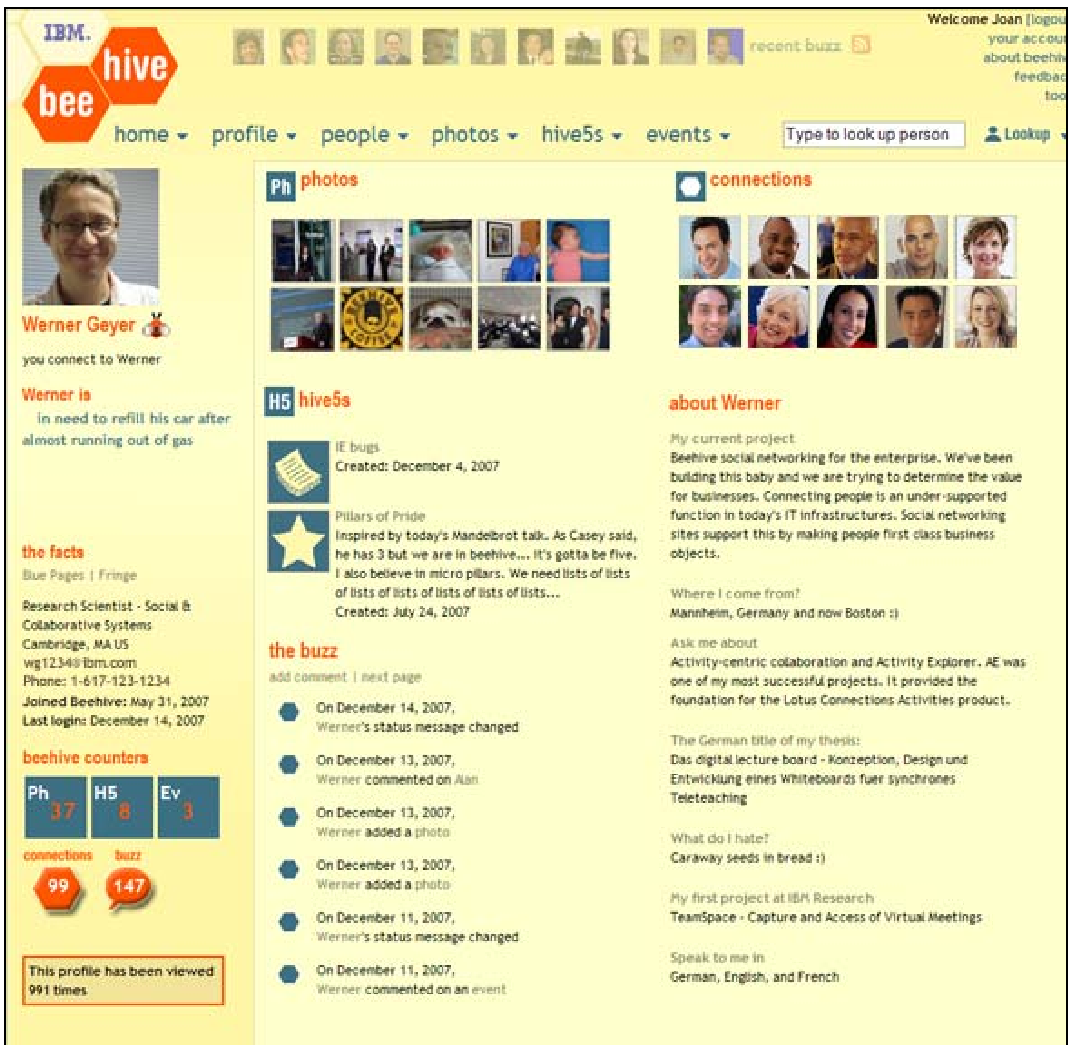 Figure 1: The Beehive profile prominently features status updates and "About You" sections to foster person-to-person sensemaking.
The researchers observed that commenting was the highest frequency action, even more than adding "friends." This suggests that the platform wasn't just a static directory; it was a dynamic conversation space.
Key Results: Trust Inside the Firewall
The study revealed a surprising divergence from public social media:
- Radical Openness: Over 90% of content was shared with the entire company. Users felt safe sharing their specific location or honest opinions about company directions because of the "walled garden" effect.
- New Ties over Close Friends: Participants explicitly stated they didn't use Beehive to talk to their daily teammates (they used IM or email for that). Instead, they used it to find "domain experts" and "loose social ties."
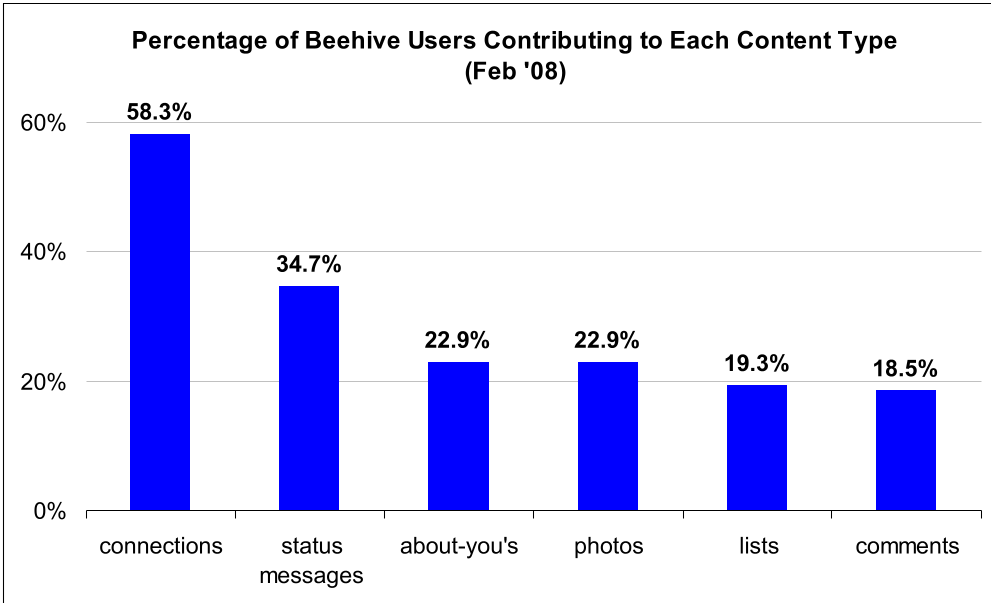 Figure 2: Distribution of content contribution, showing that status messages and connections were the primary entry points for users.
Critical Insight & Conclusion
While this research is nearly two decades old, the Three C's framework (Caring, Climbing, Campaigning) remains a gold standard for evaluating modern collaboration tools like Slack or Microsoft Teams.
The Takeaway: If you want a social tool to succeed in a company, don't just focus on "productivity" or "information." Focus on identity. When employees can express who they are, they don't just work better together—they build the networks that drive innovation and career growth.
Limitations: The study was conducted within IBM, a highly technical and globally distributed culture. The findings of "radical openness" might vary in industries with higher internal competition or stricter compliance requirements.