
Mouse Dynamics Under Emotion: Is Your Behavioral Biometric "Trustworthy" When You're Sad?
Measuring Network User Trust via Mouse Behavior Characteristics Under Different Emotions
This study proposes a robust mouse-behavior-based authentication framework that measures network user trust under varying emotional states. Using a Random Forest classifier, the research demonstrates that identity verification remains consistent across neutral, positive, and negative emotions, achieving a stable accuracy of approximately 80.3% to 83.6%.
TL;DR
Researchers from Chongqing University investigated whether your "digital fingerprint"—specifically how you move your mouse—remains recognizable when you are happy, neutral, or sad. Using a Random Forest classifier and high-dimensional movement features (like jitter and curvature), they discovered that while emotions slightly nudge the data, the system’s ability to verify your identity remains consistently high (above 80%), proving that behavioral biometrics are resilient to psychological shifts.
Problem & Motivation: The "Emotional Gap" in Security
Most network security systems rely on Behavioral Biometrics—identifying you by the way you type or scroll. However, humans are not robots; our motor skills are deeply tied to our limbic system.
The core problem identified by Wang et al. is that prior work focused almost exclusively on static environments. If a user becomes frustrated or joyful, does their mouse-sliding pattern change so much that the security system locks them out? This "emotional noise" could potentially lead to high False Rejection Rates (FRR), rendering biometric trust models unreliable in the real world.
Methodology: Capturing the "Feel" of a Click
The researchers designed a rigorous experiment involving 18 participants and a "FaceReader" software to ensure the subjects were actually feeling the intended emotions (Neutral, Positive, Negative) via video arousal.
1. Feature Engineering
Instead of just looking at speed, the team extracted 10 specific Movement Sequence (MS) features. These include:
- Jitter: The ratio of displacement to the total path distance.
- Curvature: The rate of rotation along the movement arc.
- Angular Velocity: How quickly the "angle" of the mouse path changes.
2. The Model Architecture
The team selected the Random Forest algorithm, known for its ability to handle non-linear relationships and high-dimensional data without overfitting.
 Figure 1: The experimental workflow from emotional arousal to data classification.
Experiments & Results: Resilience in Diversity
The most critical finding of this study is the insignificance of difference.
| Emotion State | Average Accuracy |
|---|---|
| Neutral | 83.6% |
| Positive | 80.3% |
| Negative | 81.9% |
While there was a slight dip in accuracy during "Positive" emotions (perhaps due to physical relaxation reducing the precision of mouse movements), the p-value of 0.582 confirms that these differences are statistically negligible.
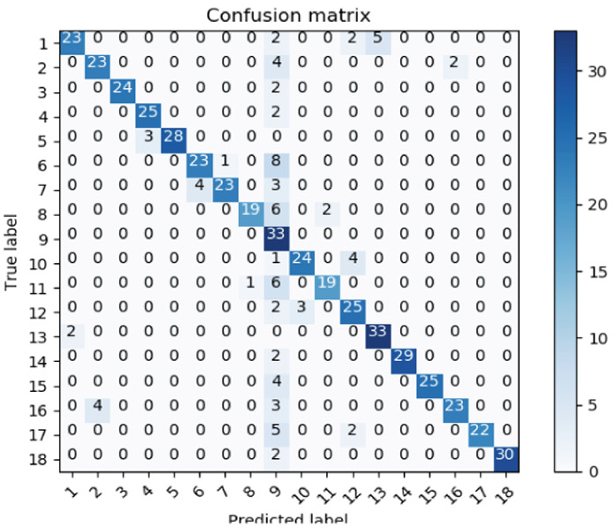 Figure 2: Confusion matrices showing the classification performance across the three emotional states.
Deep Dive: Why Positive Emotions Fluctuated
The authors noted that certain participants (e.g., Participants 1, 5, and 15) saw a drop in accuracy when happy. Their hypothesis? A positive emotional state often leads to muscle relaxation, which subtly alters the "tightness" of mouse control, whereas neutral or negative states might involve more "standardized" or "tense" motor patterns.
Critical Analysis & Conclusion
This work provides a vital "sanity check" for behavioral biometrics. It validates that Mouse Dynamics are a stable form of identity trust that can survive the natural emotional turbulence of human users.
Takeaway
For developers of continuous authentication systems, this means you don't necessarily need to recalibrate your models based on a user's mood. The "intrinsic" movement signature is stronger than the "extrinsic" emotional noise.
Limitations & Future Directions
- Intensity of Emotion: The study used videos, but real-world "high-stakes" emotions (like extreme anger or fear) might yield different results.
- Sample Size: With 18 students, the demographic is narrow. Future research should target a broader age range.
- Algorithmic Evolution: While Random Forest is a solid baseline, the move toward Deep Learning (RNNs/LSTMs) could potentially push these accuracy rates from 80% into the 95%+ range required for enterprise-grade security.
Final Verdict: Your mouse knows it's you, even if you're having a bad day.