
Precise Mouth Geometry: A Gradient-Based Approach to Emotion Analysis
Mouth Features Extraction for Emotion Analysis
This paper presents an original, gradient-based method for extracting mouth features specifically for emotion analysis. By focusing on vertical gradient distribution and morphological filtering, it achieves high precision in key landmark localization (exceeding 90% for horizontal features) on the Yale faces database.
TL;DR
This research introduces a robust, geometric-driven method for extracting mouth landmarks using vertical gradient analysis and morphological operations. Achieving over 95% accuracy in horizontal feature detection, it provides a lightweight yet effective framework for interpreting human emotions without the heavy computational overhead of holistic appearance-based models.
Background & Motivation: Moving Beyond Coarse Detection
In the realm of Human-Computer Interaction (HCI), facial expressions are the most direct window into user sentiment. Historically, researchers have leaned on two pillars: Appearance-based methods (analyzing raw pixel intensities) and Geometric-based methods (measuring the spatial relationship of landmarks).
While modern trends favor deep learning, the authors argue that geometric methods are undervalued. Coarse detectors like Viola-Jones are excellent at finding where a mouth is, but they lack the precision needed to define the shape of a smile or a pout. The motivation here is to bridge that gap—providing a simple, mathematically sound way to extract exact mouth contours that are resilient to illumination changes.
Methodology: The Power of Vertical Gradients
The core insight of this paper is that vertical intensity changes are significantly more informative for lip segmentation than horizontal ones. The process follows a strict 4-step pipeline:
- Vertical Gradient Calculation: Instead of a full 2D gradient, the authors use a 3x3 vertical derivative operator to isolate horizontal edges (the lips).
- Normalization & Squaring: To suppress noise and highlight the lip edges, the gradient values are squared and adjusted via MIN-MAX normalization.
- Kernel Filtering & Thresholding: Specific matrices are used to sharpen the edges. A threshold (best at 250) is applied to create a binary mask of the mouth.
- Morphological Closing: To handle "broken" edges where a contour might split, a "closing" operation (dilation followed by erosion) is used to unify the mouth shape.
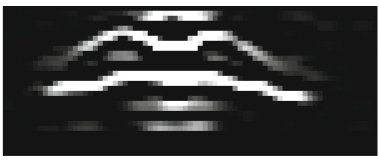 Fig 1. Gradient distribution for different emotions: (a) Happy, (b) Neutral, (c) Sad.
Feature Extraction Logic
Once the shape is isolated, the method extracts six key points:
- : The leftmost and rightmost extremes.
- : The topmost and bottommost points.
- : Derived Width and Height.
Experimental Results: High Precision in Horizontal Planes
The method was validated using the Yale Face Database. The results indicate a specialized proficiency in horizontal tracking:
| Measurement Type | Accuracy (ACC) | Standard Deviation |
|---|---|---|
| Right Corner () | 95.53% | 3.84% |
| Mouth Width () | 92.78% | 7.05% |
| Bottom Lip () | 88.29% | 13.13% |
| Cross-section () | 86.18% | 9.4% |
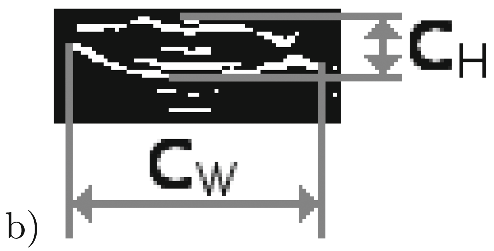 Fig 2. Visualization of the extracted geometric corners and the calculated mouth width/height.
The "Upper Lip" Challenge
One critical finding was the difficulty in detecting the upper lip (), which only reached 43.59% accuracy. This is attributed to the subtle gradient transition between the nose and the Philtrum, which often confuses simple gradient-based thresholds.
Deep Insight & Conclusion
The strength of this work lies in its Inductive Bias: it assumes that the most important information for mouth-based emotion lies in the horizontal stretch and the bottom-lip curve. By ignoring redundant horizontal gradients, the method gains speed and robustness against shadows that typically fall vertically across the face.
Takeaway for Practitioners: While deep learning models (like MediaPipe or Dlib) are industry standards, this gradient-based approach offers a "white-box" alternative. For systems with extremely limited power (IoT devices, embedded sensors), these geometric features provide a high-accuracy signal (Width/Right Corner) that can be fed into a tiny SVM or Random Forest classifier for efficient emotion detection.
Future Work: Integrating these mouth features with similar eye-region trackers will likely mitigate the lower accuracy of the upper-lip detection, creating a holistic facial geometry suite.