
Movement-Based Incentives: Solving the Coverage Hole Problem in Crowdsourcing
2993_Movement-Based Incentive for Crowdsourcing.
The paper proposes a novel movement-based incentive mechanism for mobile crowdsourcing, focusing on "controlled mobility" to eliminate coverage holes caused by uneven participant distribution. By combining a greedy task allocation algorithm with a critical payment policy, it encourages participants in popular areas to move to unpopular zones, achieving a provable (1 - 1/e) approximation ratio for social welfare maximization.
TL;DR
Crowdsourcing often fails because people aren't where the data is. This paper introduces a movement-based incentive mechanism that uses auction theory to pay participants not just for sensing, but for moving to unpopular areas. The result? A massive 145% increase in task completion and a mathematically guaranteed truthful auction.
Context/Background: The "Popularity" Trap
In mobile crowdsensing, we rely on smartphones to map noise pollution or create 3-D building models. However, humans are social creatures—we cluster at building entrances, cafes, and main streets.
The authors observed a critical flaw in existing SOTA methods (like MSensing): they treat participants as static points. This leads to coverage holes—unpopular areas stay dark because no one is there to take a photo. To fix this, the platform needs to act as a "navigator," explicitly rewarding users for wandering off the beaten path.
Point & Motivation: Why Static Auctions Fail
Existing mechanisms focus on maximizing social welfare given where people are. But social welfare is capped by the geographical distribution of the crowd.
- Prior Work Limitation: Does not consider the physical movement cost (energy, time, dissatisfaction).
- The Insight: By treating movement as a "bid-able" cost, the platform can expand the "Effective Sensing Range" of the entire network.
Methodology: Engineering the Move
The paper models the interaction as a Reverse Auction.
1. The Cost of Walking
The moving cost is modeled exponentially: This captures the physical intuition that as the distance increases, the marginal "unhappiness" or battery drain of the participant grows faster.
2. Task Allocation (The Greedy Strategy)
Since maximizing social welfare with mobility is NP-hard, the authors propose a Greedy Algorithm. In each iteration, the platform selects the (participant, destination) pair that provides the highest marginal contribution to social welfare.
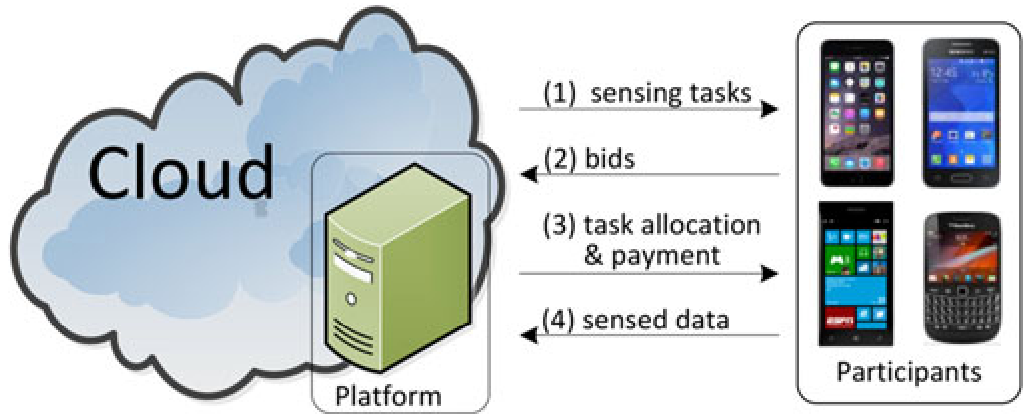 Fig 1: The interaction loop between the platform (buyer) and participants (sellers).
3. Truthfulness via Critical Payment
To prevent participants from lying about their costs, the authors designed a Critical Payment Determination algorithm. A winning participant is paid just enough to have beaten the "next best" alternative. This ensures that bidding one's true cost is always the dominant strategy.
Experimental Proof: Turning Walkers into Winners
The authors simulated a 200m x 200m area where participants were tightly clustered in the center ().
SOTA Comparison
- MSensing (Static): Only tasks in the popular center were completed (29.5% completion ratio).
- Movement-Based (Proposed): Participants spread out, filling the "unpopular" corners (70% completion ratio).
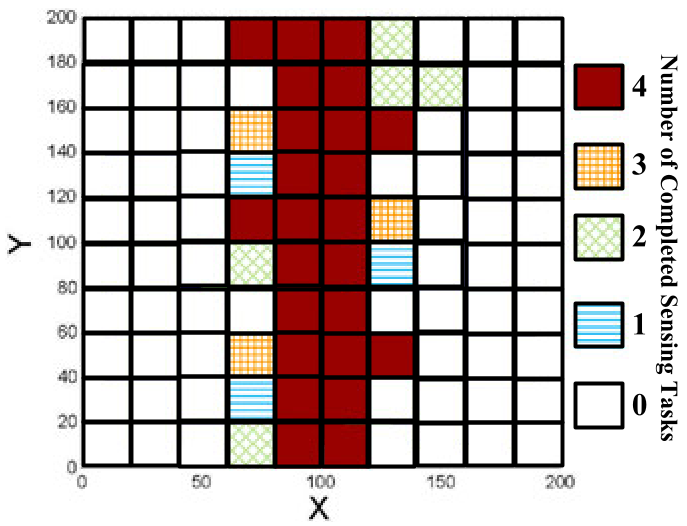 Fig 2: Comparison of task completion. The "0" areas in the middle image show the failure of static sensing, while the right image shows the proposed method achieving near-total coverage.
Sensitivity to "Laziness" ()
The method was tested against varying levels of movement resistance (). Even when movement costs were high, the system still found optimal "short hops" that static systems missed, consistently outperforming the baseline in social welfare.
Critical Analysis & Takeaways
The "Win-Win"
- For the Platform: It gets data from the "dark spots" of the map.
- For the Participant: Users who would have lost the auction in a crowded area now have a "path to victory" by moving slightly.
Limitations
The current model assumes a simplified exponential cost and ignores real-world obstacles (walls, traffic). It also assumes participants will follow platform instructions perfectly once paid.
Future Outlook
This work lays the foundation for "Control-Loop Crowdsourcing," where the platform isn't just a passive observer but an active coordinator of a multi-agent system. Future iterations integrating Real-time Traffic or Privacy-Preserving Trajectories could make this a standard for smart city logistics.