
MOVES: Elevating Vehicular Networks with Social Memory and Probabilistic Logic
MOVES: A MemOry-based VEhicular Social forwarding technique
2021-07-21
Summary
Problem
Method
Results
Takeaways
Abstract
This paper introduces MOVES (MemOry-based VEhicular Social forwarding), a novel packet forwarding technique for Vehicular Social Networks (VSNs). It leverages a time-varying "social degree" that integrates both historical and instantaneous node interactions to identify the most reliable next-hop forwarders, achieving superior data delivery in opportunistic environments.
## TL;DR
In the chaotic environment of Vehicular Social Networks (VSNs), choosing the right "next-hop" is a gamble. **MOVES (MemOry-based VEhicular Social forwarding)** changes the game by introducing "Social Memory." By analyzing how many messages a vehicle has sent and how many neighbors it has connected with over time, MOVES identifies the most reliable "hubs" for data dissemination, drastically cutting overhead and boosting delivery rates.
## The Problem: The "Ephemeral Socialite" Trap
Most existing V2V (Vehicle-to-Vehicle) routing protocols suffer from short-sightedness. They either look purely at geometry (distance to destination) or take a snapshot of a node's status at a single moment.
In a VSN, a vehicle might pass through a crowded intersection and appear highly social, only to turn into a lonely side street seconds later. If a packet is forwarded to this "instant socialite," it might hit a dead end. The challenge is: **How do we distinguish between a truly influential network hub and a temporary neighbor?**
## Methodology: The Architecture of Social Memory
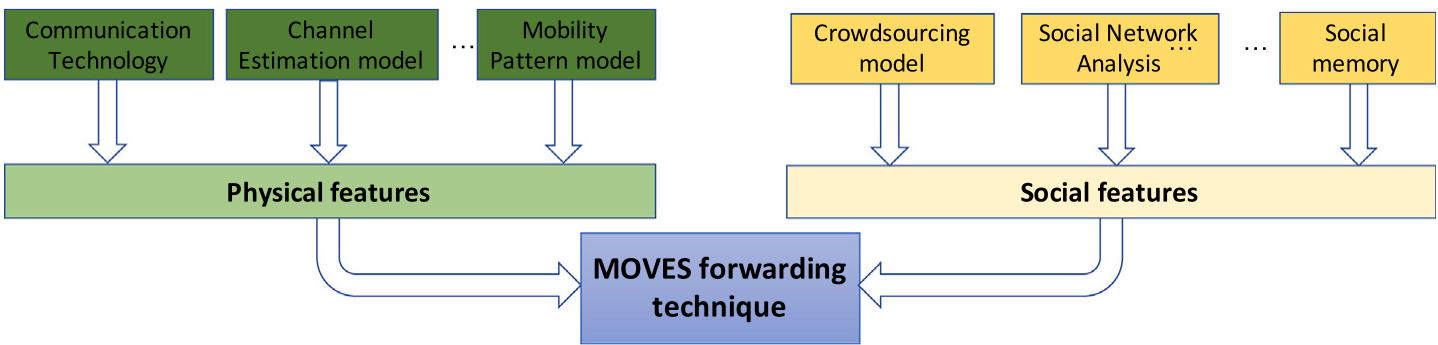
MOVES operates on a dual-engine logic. It treats forwarding as a combination of **Physical Reality** and **Social History**.
### 1. Defining Social Degree ($s_i$)
The core innovation is the Social Degree formula, which combines:
* **Communication Coefficient ($\mathcal{M}$):** Average messages exchanged.
* **Connectivity Coefficient ($\mathcal{C}$):** Average neighbor links.
Critically, it uses a weight $\beta$ to balance historical data (the "Memory") with instantaneous data. If a node's recent activity is higher than its history, it's weighted up, ensuring the model adapts to emerging patterns without losing perspective.
### 2. The Dual-Probability Model
Unlike its predecessor SCARF, which bundles distance and sociality into one event, MOVES treats them as **statistically independent events**:
* **Event 1 ($p_{1,i}$):** The probability that the node is the farthest in the transmission range (maximizing spatial progress).
* **Event 2 ($p_{2,i}$):** The probability that no other neighbor has a higher social degree (based on a Pareto distribution).
## Performance Benchmarks: Real-World Traces
The authors didn't just simulate random walks; they used real GPS traces from **San Francisco (533 taxis)** and **Rome (370 taxis)**.
### Key Findings:
* **Delivery Ratio:** In San Francisco, MOVES reached a delivery ratio of nearly **60%**, consistently staying above Epidemic and SCARF.
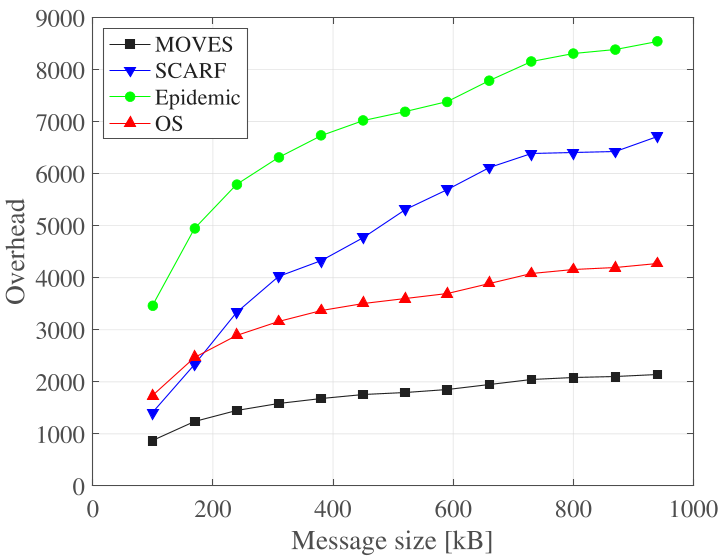
* **Overhead Reduction:** While "Epidemic" routing floods the network with copies, MOVES uses selective logic. This resulted in an overhead reduction of nearly **4x** compared to Epidemic.
* **Latency:** By picking social hubs that are more likely to meet other nodes quickly, MOVES significantly lowered the time messages spent traveling through the network.
## Critical Analysis: Why It Works
The "Secret Sauce" of MOVES is the **Pareto Power-Law** distribution of sociality. In any network, a few "Hubs" do most of the heavy lifting. By using social memory, MOVES identifies these 5-10% of nodes (as seen in the Rome/SF trace analysis) and prioritizes them.
However, the paper reveals a trade-off: **Hop Count.** Because MOVES is selective and sometimes favors sociality over raw distance, it may take more hops to reach a destination compared to distance-only greedy routing. But in the world of high-mobility VSNs, a few extra reliable hops are better than one long hop into a black hole.
## Conclusion & Future Outlook
MOVES proves that in the Internet of Vehicles, the "human component"—our social patterns and routine routes—is a powerful tool for engineering. Future iterations could integrate **machine learning** to predict the quality of physical links, combining social memory with signal-strength forecasting to create a truly "cognitive" vehicular network.
**Takeaway for Researchers**: When designing for mobility, don't just look at where the node is; look at who the node *has been*.