
Beyond Metadata: Using Social Network Analysis to Distill the Essence of Cinema
Movie indexing and summarization using social network techniques
The paper introduces a social network analysis (SNA) framework for movie indexing and summarization by modeling character co-appearances as a weighted graph. Utilizing centrality measures like Eigenvector and Closeness, the system automatically identifies protagonists and generates condensed movie versions that preserve narrative coherence.
TL;DR
Researchers have developed a method to summarize movies not by looking at pixel changes, but by analyzing the "social power" of characters. By treating a movie as a dynamic social network, the system identifies the protagonist and key plot-driving scenes, reducing full-length features by up to 75% while keeping the story understandable.
Background Positioning
In the era of massive multimedia archives like IMDb and Netflix, the challenge has shifted from storage to retrieval. Most automated summaries are "dumb"—they pick high-action shots based on audio volume or color histograms. This paper elevates the task to a semantic level, treating movies as what they truly are: a series of character interactions.
The Problem: Why Audio-Visual Cues Aren't Enough
Prior works (like RoleNet or dialogue-based "Character-nets") have two fatal flaws:
- Signal Noise: Visual-only methods struggle with accuracy in face detection and recognition speed.
- Dialogue Dependency: Methods relying on scripts or subtitles fail in action-heavy or horror movies where silence is a narrative tool.
The authors argue that the simple "on-screen appearance" and "co-appearance" are the most robust indicators of a character's role in the storyline.
Methodology: The Geometry of Stardom
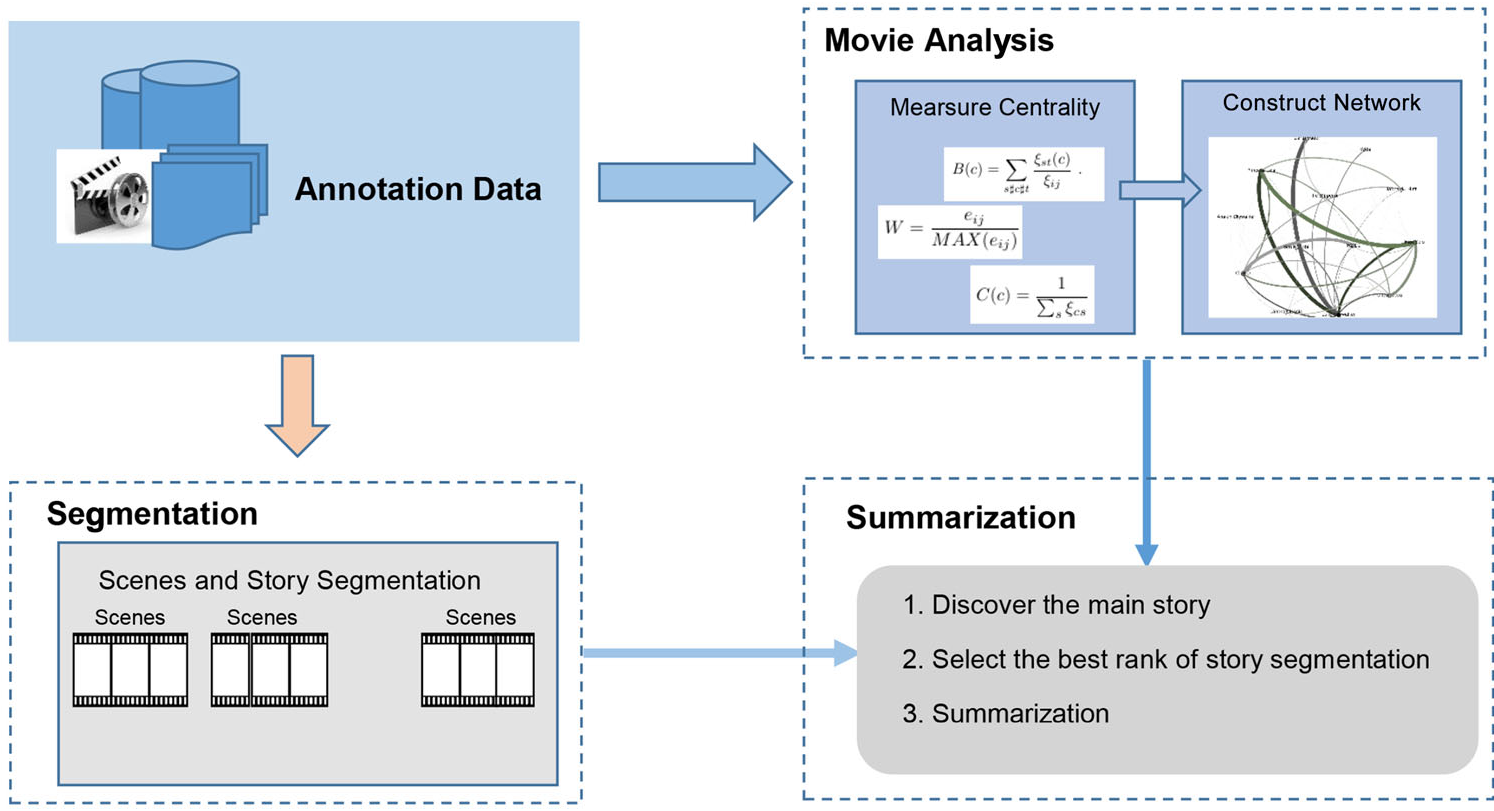
The core of this approach is the Character Network (CN).
1. The Appearance Model
A character is represented by a set of time intervals . When two characters appear together, a weighted edge is formed.
2. Measuring "Social Power"
The system doesn't just count screen time. It uses three critical Graph Theory metrics:
- Closeness Centrality: How "near" a character is to all others.
- Eigenvector Centrality: Influential characters are those connected to other influential characters.
- Weighted Degree: The raw volume and frequency of interactions.
These are combined into a final score to distinguish the "Protagonist" from "Minor Characters."
Experiments: Testing on the Greats
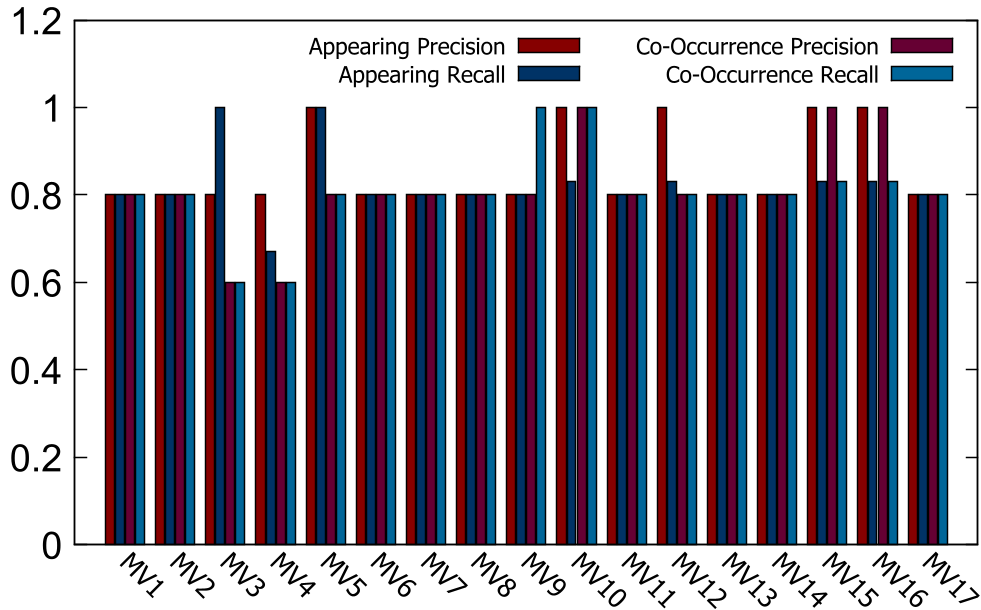
The authors validated their system on 17 heavyweights of pop culture, including Star Wars, The Lord of the Rings, and Harry Potter.
Identifying the Hero
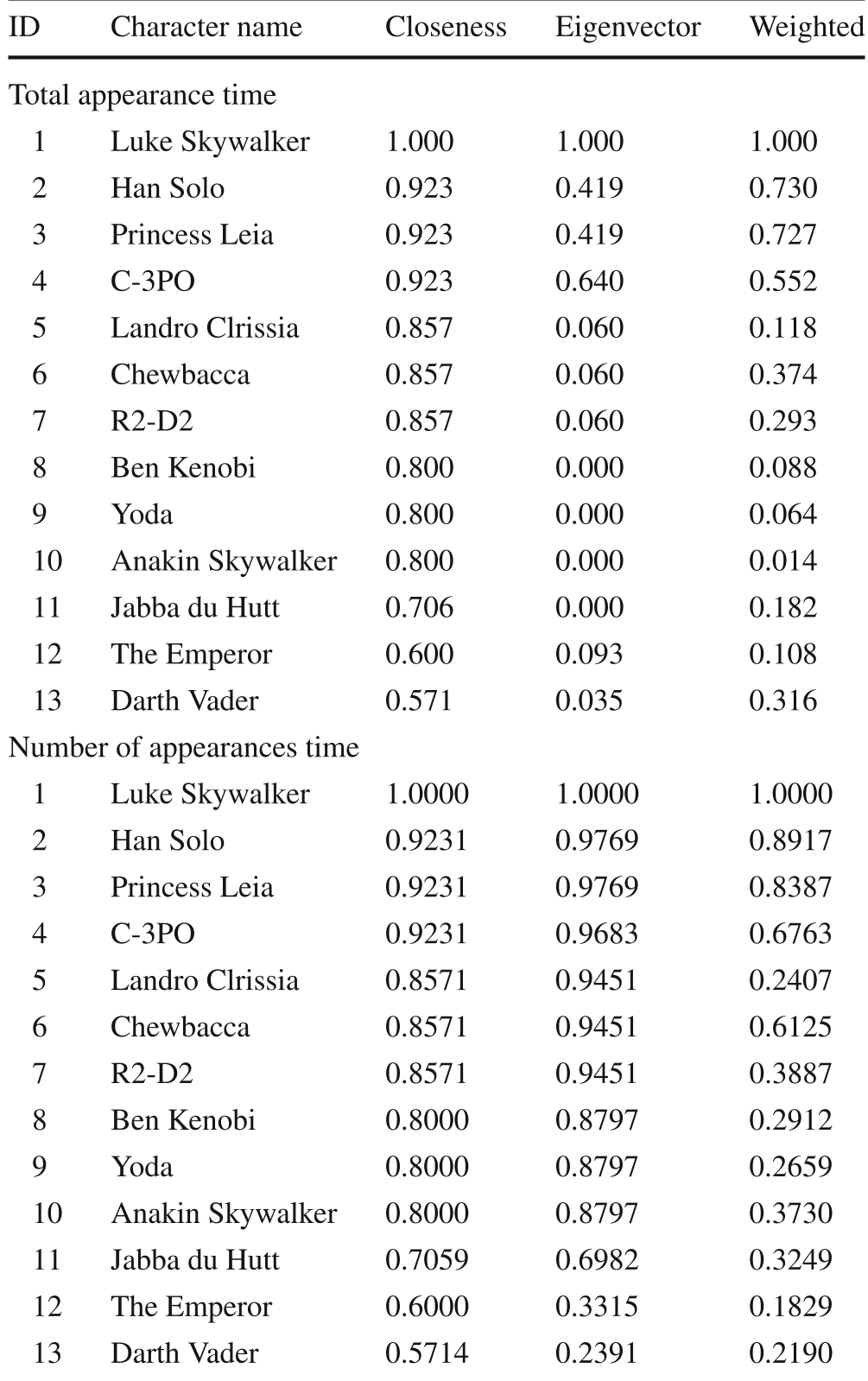
In Star Wars: A New Hope, the system correctly identified Luke Skywalker as the node with the highest centrality across all metrics, significantly higher than even Han Solo or Princess Leia.
Efficient Summarization
The system generated two versions:
- Version 1: Protagonist-only appearances.
- Version 2: Protagonist + Main supporting cast.
Surprisingly, even after removing 75% of the footage, user surveys showed that viewers still scored their understanding of the plot at a high 4.0/5.0.
Critical Insight & Future Outlook
The beauty of this work lies in its simplicity. By stripping away the complexity of "what is happening" in a scene and focusing on "who is together," the researchers found a shortcut to the narrative structure.
Limitations: The current system relies on manual character annotation. For this to truly scale, it must be paired with SOTA (State-of-the-Art) facial recognition and speaker identification to automate the "on-screen" detection phase.
Conclusion: This paper moves the needle from video processing to video understanding. Future extensions could integrate sentiment analysis to not just know who is on screen, but the emotional valence of their relationship, creating even more nuanced "director's cut" summaries automatically.