
Decoding the Kinematics of Slope Mowing: How Elderly Experts Navigate Steep Terrain
Mowing Patterns Comparison: Analyzing the Mowing Behaviors of Elderly Adults on an Inclined Plane via a Motion Capture Device
This study investigates the mowing behaviors of elderly workers on steep terrain using the Xsens MVN Animate Pro motion capture system. By analyzing 32,700 data points across 23 body joints, the researchers identified safe and effective working patterns for three scenarios: Typical Inclined (TI), Top-Down (TD), and Bottom-Up (BU) mowing.
TL;DR
As Japan’s agricultural workforce ages, elderly farmers are increasingly tasked with maintaining steep, terraced fields—a high-risk job where unstable posture leads to fatal falls. This study uses high-precision motion capture to "reverse-engineer" the safety knacks of experienced mowers, revealing that the secret to safety lies in the rigid stabilization of the load-bearing leg and modulated effort levels depending on the standing incline.
Context: The Hidden Danger of the Rice Terrace
In the hilly regions of Japan, automated mowers often fail due to complex, steep topographies. This leaves manual U-handle mowing to senior citizens. Statistics show that nearly 30% of agricultural accidents in these areas stem from "unstable posture." While we know that falls happen, we haven't scientifically documented how experts avoid them—until now.
Methodology: High-Precision Motion Capture in the Wild
The researchers deployed the Xsens MVN Animate Pro, a wearable suit capable of tracking 23 joints at 60Hz. Unlike traditional 17-joint models, this setup included spinal segments and toes, allowing the calculation of the S&H angle (the angle between the inclined plane and the horizontal line).
Core Scenarios Analyzed:
- Typical Inclined (TI): Standing directly on the slope.
- Top-Down (TD): Standing at the top ridge, reaching down.
- Bottom-Up (BU): Standing on flat ground at the base.
 Figure 1: The experimental area and the three defined mowing scenarios (TI, TD, BU).
The "Cutting" vs. "Throwing" Dynamic
The study identifies three basic actions: cutting (c), throwing (t), and moving (m). Interestingly, the Mann-Whitney U tests revealed that while "cutting" and "throwing" look different to the naked eye, their joint angles are statistically similar. The primary difference is intensity: throwing grass requires significantly higher hand-moving distances ( and ), indicating a burst of power that can jeopardize balance on a slope.
Strategic Insights: The "Static Lower Body" Rule
The most profound finding comes from the comparison of action "c" (cutting) across all scenarios.
- Balance over Bravery: In the TI (Typical Inclined) scenario, workers kept their load-bearing leg (left knee and ankle) within a very narrow range of motion. This "locking" of the lower body is a crucial safety mechanism to prevent slips.
- The Deception of Flat Ground: Even in Top-Down (TD) mowing where workers stand on seemingly "flat" ground, the shaking level () was identical to working on a slope. This suggests that the act of reaching down the incline creates a shifting center of gravity that is just as dangerous as standing on the slope itself.
- Strength Regulation: Only in the BU (Bottom-Up) scenario did workers exert their utmost strength (highest and waist shaking).
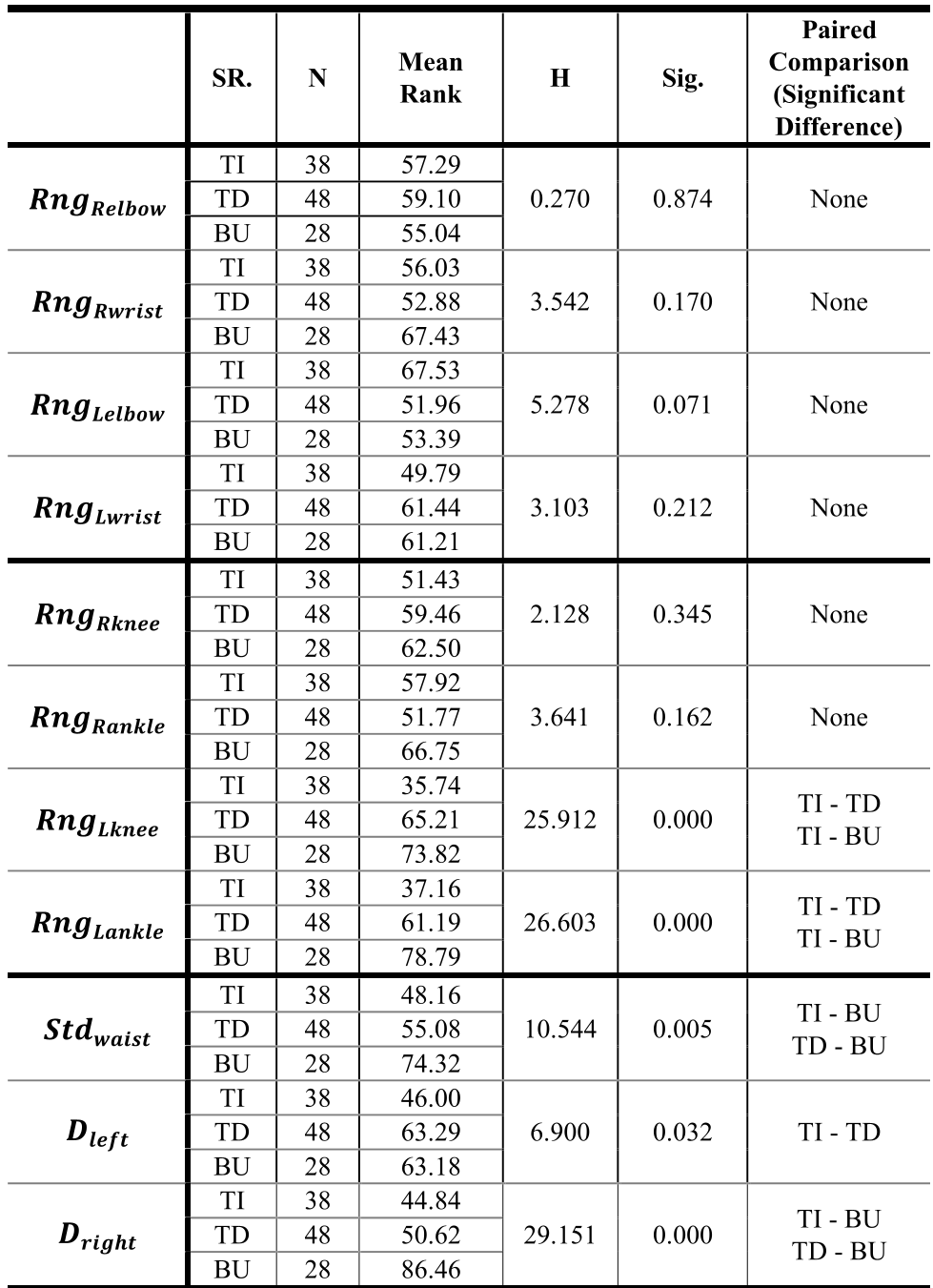 Table 1: Kruskal-Wallis test results showing significant differences in the left knee and ankle range of motion (RngLknee, RngLankle) for the TI scenario.
Conclusion and the Future of "Smart" Mowing
The "knack" of experienced mowers is now quantified: keep the weight-bearing foot firmly planted, minimize lower-body movement on slopes, and never exert maximum force unless both feet are on level ground.
Future Outlook
This data isn't just for academic interest. It serves as a blueprint for:
- Mowing Support Systems: Wearables that can sense when a worker's load-bearing foot is wobbling and trigger an auditory warning.
- Training Programs: Moving beyond "be careful" to specific biometric instructions for new workers.
- Predictive AI: Integrating these kinematic benchmarks into computer vision systems (using depth cameras and eye-tracking) to predict and prevent falls before they occur.
While the study is currently limited by a small sample size of three experts, it establishes a high-precision methodology for human behavior analysis in hazardous agricultural environments.